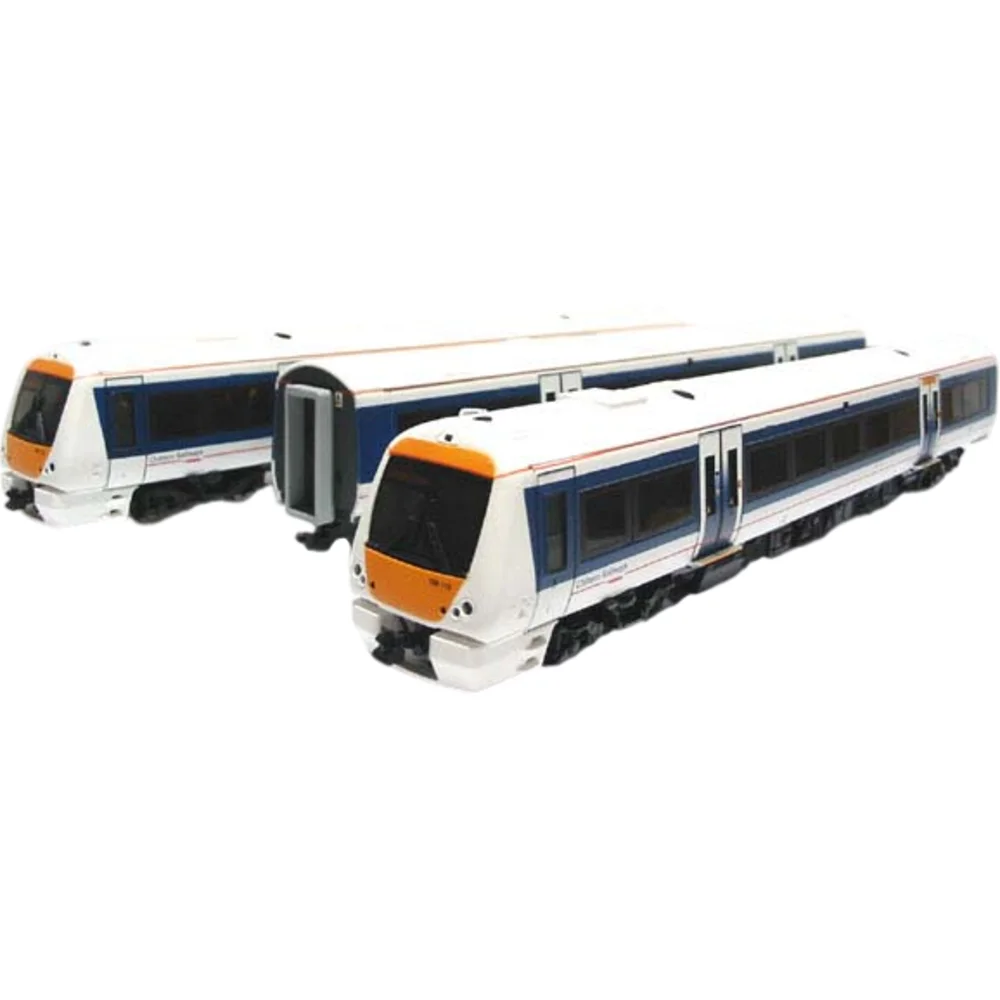
The British Rail Class 168 Clubman represents one of the most significant milestones in British railway history as the first diesel multiple unit ordered after privatisation. Built by ADtranz at Derby Litchurch Lane Works between 1998 and 2004, these express-capable units ended a remarkable 1,064-day procurement drought whilst establishing the design template for the highly successful Turbostar family. All 28 units continue operating exclusively with Chiltern Railways across routes from London Marylebone to Birmingham, Oxford, and Stratford-upon-Avon, with a comprehensive £12 million refurbishment programme extending their service life towards 2040.
For model railway enthusiasts, the Class 168 presents both compelling prototype appeal and frustrating commercial reality. Despite the class's prominence on easily-accessible routes and distinctive Chiltern liveries spanning three decades, only Bachmann Branchline produced OO gauge models—now discontinued since approximately 2009—whilst Graham Farish offered a single N gauge variant that similarly disappeared from catalogues. The secondary market commands premium prices for these increasingly scarce models, forcing enthusiasts seeking authentic Chiltern Railways traction to either hunt diligently or convert the more readily available Class 170 Turbostar models using the identical tooling.
From breaking the post-privatisation deadlock with September 1996's ground-breaking order through pioneering the Turbostar concept that revolutionised British regional express operations, the Class 168 story encompasses technical innovation, operational excellence, and the challenges facing a modernising railway industry. The class's exclusive association with Chiltern Railways—surviving multiple franchise transfers whilst maintaining consistent high-quality service—creates fascinating modelling opportunities for layouts depicting contemporary British railways from the late 1990s through today's evolving network.
Quick Takeaways
- Twenty-eight units built: ADtranz constructed the fleet at Derby Litchurch Lane Works between 1998-2004, with nine additional conversions from Class 170/3 stock in 2015-2016
- Post-privatisation pioneer: Chiltern's September 1996 order ended Britain's 1,064-day rolling stock procurement drought, making Class 168 the first DMU ordered by any privatised Train Operating Company
- Turbostar family prototype: The five Class 168/0 units served as development vehicles for the entire Turbostar platform, directly informing standardised Class 170 production and influencing Electrostar electric multiple units
- MTU power specification: Each vehicle carries one MTU 6R 183 TD13H turbo-diesel engine producing 315 kW (422 hp), transmitted through Voith T211rzze hydrodynamic gearbox to ZF final drives
- 100 mph express capability: Maximum speed classification enables premium express services between London Marylebone and Birmingham, Oxford, Leamington Spa, and Stratford-upon-Avon across Chiltern's expanding network
- Continuous Chiltern service: All 28 units remain in active operation exclusively with Chiltern Railways—an exceptional record spanning franchise transfers through M40 Trains, Laing Rail, Deutsche Bahn, and Arriva UK Trains ownership
- Limited model availability: Bachmann's discontinued OO gauge models (32-470, 32-471) and Graham Farish's N gauge offering (371-435) command premium secondary market prices, with no current production alternatives from any manufacturer
Historical Background and Context
The genesis of the Class 168 emerged during the turbulent final years of British Rail, when Network SouthEast developed specifications for an express variant of the successful Class 165/166 Networker Turbo family. NSE envisaged 100 mph capable units for expanded services on the Chiltern Main Line to Birmingham, featuring enhanced passenger amenities appropriate for longer-distance travel compared to the suburban-focused Networkers that had transformed Thames Valley and Chiltern local services since their 1990-1992 introduction.
British Rail privatisation fundamentally disrupted this procurement timeline. The complex process of fragmenting BR into multiple entities—Railtrack infrastructure management, three rolling stock leasing companies, twenty-five train operating franchises, and various support functions—created regulatory paralysis that froze rolling stock orders for nearly three years. The railway industry's attention focused on establishing commercial frameworks, negotiating franchise terms, and managing the unprecedented organisational upheaval rather than commissioning new trains.
When M40 Trains (the original Chiltern Railways franchise holder) commenced operations on 21 July 1996, Managing Director Adrian Shooter inherited both the Chiltern route and NSE's unfulfilled express DMU requirement. The franchise's ambitious growth plans demanded modern traction capable of delivering the premium service quality that would differentiate Chiltern from competitors whilst attracting passengers from parallel road and existing rail routes.
In September 1996, Chiltern Railways made railway history by placing Britain's first post-privatisation rolling stock order. The £34 million contract with ADtranz (ABB Daimler-Benz Transportation) specified five three-car diesel multiple units for delivery during 1998. This groundbreaking order ended a remarkable 1,064-day procurement drought—nearly three years during which no new passenger trains had been commissioned anywhere in Britain—and signalled that privatisation's paralysis was finally ending.
Insider Tip: The Networker Connection
The initial five Class 168/0 units feature distinctive Networker-style cabs identical to Classes 165/166, creating a unique transitional appearance that distinguishes them from later Turbostar-cab examples. ADtranz deliberately used the proven Networker cab design whilst finalising the completely new frontal structure that would characterise all subsequent Turbostar production. For modellers, note that no commercial model represents this 168/0 configuration—the Bachmann models depict only the later Turbostar-cab variants. The 168/0 units' unique appearance makes them particularly fascinating prototype subjects deserving scratch-building or significant modification projects.
ADtranz constructed all Class 168 units at their Derby Litchurch Lane Works—the historic facility where countless British railway vehicles had emerged since the 19th century. The company employed aluminium alloy bodyshells constructed from seam-welded extrusions, a technique proven on the Networker family and subsequently adopted across the entire Turbostar range. Glass-reinforced plastic and steel cab ends provided crash protection whilst maintaining acceptable weight distribution.
The first completed unit, 168001, entered passenger service on 26 May 1998, immediately demonstrating the substantial improvements over earlier Chiltern traction. The 100 mph capability, air conditioning throughout, comfortable 2+2 seating, and modern reliability transformed journey experiences on the London-Birmingham corridor. Contemporary press coverage praised the spacious interiors, smooth acceleration, and quieter operation compared to aging locomotive-hauled Mark 2 coaches or first-generation DMUs.
Chiltern's satisfaction with the initial batch prompted progressive fleet expansion. Between 1999 and 2004, ADtranz delivered twenty-three additional units across three sub-classes (168/1, 168/2, and further 168/0 examples), bringing total fleet strength to twenty-eight units before the subsequent Class 170/3 conversions. Each batch incorporated refinements based on operational experience, with the 168/1 and 168/2 variants featuring the production Turbostar cab design that eliminated the Networker styling whilst improving visibility and maintenance access.
The designation "Clubman" reflected Chiltern's premium service positioning. Unlike many regional operators emphasising basic transportation, Chiltern marketed itself as providing business-class standards throughout the train, with First Class accommodation offering genuine enhancement over Standard rather than merely segregated seating. The Class 168's spacious layout, consistent air conditioning, and refined ride quality delivered the promised premium experience.
Design and Technical Specifications
The engineering excellence of the British Rail Class 168 lies in its role as the prototype platform that established the entire Turbostar family's fundamental design philosophy. ADtranz deliberately retained proven hydraulic transmission technology from the Class 165/166 Networker family rather than adopting alternative systems, recognising that the Chiltern Main Line's challenging gradients—particularly the climb from Princes Risborough through the Chilterns towards Aynho Junction—demanded transmission characteristics favouring torque multiplication over theoretical efficiency gains.
At the heart of each vehicle sits a single underfloor-mounted MTU 6R 183 TD13H inline six-cylinder turbo-diesel engine. This powerplant produces 315 kW (422 hp) at rated speed, representing substantial improvement over the Perkins engines fitted to earlier Networkers. A three-car formation therefore delivers 945 kW total output, whilst four-car sets generate 1,260 kW—sufficient power for rapid acceleration and sustained high-speed running with passenger loads approaching 300 people.
Power transmission follows the proven hydraulic route. Each engine drives a Voith T211rzze two-speed hydrodynamic transmission—essentially a sophisticated fluid coupling with torque converter operation providing seamless power delivery without gear changes. The Voith unit transmits power to ZF final drives (replacing the Gmeinder units used on Class 165/166), with a final drive ratio of 76:23 optimised for the 100 mph maximum speed requirement whilst maintaining acceptable acceleration characteristics.
The bogie arrangement employs one powered bogie and one unpowered trailing bogie per vehicle, with the powered bogie consistently positioned at the inner end of each vehicle. This creates a symmetrical power distribution across multi-car formations—a three-car unit has powered bogies at positions 1-inner, 2-both-ends, and 3-inner, ensuring balanced adhesion and traction effort. The P3-23 powered bogies and T3-23 trailing bogies utilise rubber-metallic primary suspension combined with air spring secondary suspension, delivering the refined ride quality essential for express passenger service.
The aluminium alloy bodyshell construction employs seam-welded extrusions creating a strong yet lightweight monocoque structure. This manufacturing technique—proven on the Networker family and subsequently adopted across numerous British multiple unit types—provides excellent strength-to-weight ratios whilst simplifying production and facilitating repairs. The use of large extruded sections minimises the number of individual joints requiring welding, reducing manufacturing complexity and improving structural integrity.
Technical Innovation: Metropolitan Line Compatibility
A unique feature distinguishes Class 168 from other Turbostar variants: tripcock equipment fitted to all 168/0, 168/1, and 168/2 sub-class vehicles. This mechanical safety system responds to trip arms positioned at signals on London Underground's Metropolitan Line, automatically applying emergency brakes when a train passes a signal at danger. The equipment enables Class 168 operation between Harrow-on-the-Hill and Amersham on Metropolitan Line infrastructure—a capability shared with no other Turbostar class. This creates authentic operating scenarios for modellers depicting the unique junction between main-line and London Underground operations at Harrow, where Chiltern services share tracks with Metropolitan Line trains through the distinctive "Met-land" suburbs.
Interior accommodation provides 2+2 seating throughout both First and Standard Class compartments, with unidirectional seating in most vehicles and small 2+1 bays near vestibule areas. The seating layout deliberately avoids the high-density 2+3 configurations common on commuter units, recognising that Chiltern's longer-distance express role demanded space and comfort rather than maximum capacity. Air conditioning fitted as standard represented significant luxury when many contemporary DMUs relied on opening windows and forced ventilation.
Safety systems incorporate multiple protection layers meeting contemporary regulatory requirements. Automatic Warning System (AWS) provides audible and visual warnings of signal aspects, requiring driver acknowledgement. Train Protection and Warning System (TPWS) adds automatic brake application when approaching signals at danger or exceeding speed restrictions. The fleet was also equipped for Automatic Train Protection (ATP) operation during Chiltern's brief ATP trial period, though this sophisticated continuous cab-signalling system was subsequently abandoned across the British network due to cost considerations.
The Class 168/3 sub-class represents an unusual conversion programme. In 2015-2016, Chiltern acquired nine former First TransPennine Express Class 170/3 two-car units originally built by Bombardier (ADtranz's successor) in 2001. Brush Traction at Loughborough Works converted these units for Chiltern service, reclassifying them as Class 168/3 (numbered 168321-168329) through modifications including interior refurbishment, reprogrammed control systems ensuring compatibility with existing Class 168 fleet management protocols, and installation of tripcock equipment for Metropolitan Line operation. This pragmatic approach rapidly expanded fleet capacity whilst avoiding lengthy new-build procurement timelines.
Service History and Operations
The British Rail Class 168 has maintained exclusive association with Chiltern Railways throughout its entire service life—an exceptional consistency in Britain's often-turbulent franchised railway environment. This remarkable continuity reflects both the class's technical suitability for Chiltern's operational requirements and the franchise's own unusual stability compared to many troubled contemporary operators.
Initial deployment focused on flagship express services between London Marylebone and Birmingham Snow Hill/Moor Street following the first unit's entry to service in May 1998. The Class 168's 100 mph capability enabled competitive journey times on this corridor, challenging both Virgin West Coast services via the longer Euston-Birmingham route and increasing road congestion on the parallel M40 motorway. Contemporary marketing emphasised the premium "Clubman" service concept—business-class standards throughout the train rather than merely providing separate First Class accommodation.
Progressive fleet expansion during 1999-2004 enabled Chiltern to develop an increasingly sophisticated service pattern. The railway pioneered intensive off-peak services featuring consistent hourly intervals rather than traditional peak-focused timetables, recognising that regular-interval departures simplified journey planning and attracted discretionary travellers. Class 168 operation expanded to include London-Oxford services via Bicester Village (particularly after the Bicester-Oxford route reopened in 2015), London-Leamington Spa, London-Stratford-upon-Avon, and peak-hour extensions to Kidderminster and Stourbridge Junction.
The railway's operational philosophy emphasised reliability and consistency. Unlike some operators struggling with aging inherited fleets, Chiltern's relatively homogeneous modern traction—Classes 165, 168, and later 172 Turbostars plus locomotive-hauled services—enabled systematic maintenance procedures and crew training. Drivers qualified on one Turbostar type could easily transition to others, whilst common components simplified spare parts inventory and workshop procedures.
Operational Insight: The Aylesbury-Amersham Metropolitan Connection
Class 168 operations include fascinating movements over London Underground's Metropolitan Line between Harrow-on-the-Hill and Amersham—the only National Rail DMU services operating on Tube infrastructure. Chiltern trains share tracks with Metropolitan Line service to Amersham, requiring unique tripcock safety equipment fitted to all 168/0, 168/1, and 168/2 vehicles. For modellers, this creates opportunities to depict the unusual sight of main-line diesel units operating through quintessentially Underground stations including Moor Park, Rickmansworth, and Chorleywood, complete with Metropolitan Line signage, tube map displays, and distinctive station architecture. The Harrow junction where Chiltern and Metropolitan services diverge/converge provides particularly interesting operational scenarios.
Franchise ownership transferred multiple times whilst maintaining operational continuity. M40 Trains became Chiltern Railways, acquired by Laing Rail, subsequently purchased by Deutsche Bahn in January 2008, and finally transferred to Arriva UK Trains in 2011. Despite these corporate changes, the Chiltern brand, service philosophy, and operational practices remained remarkably consistent—a testament to management continuity and Deutsche Bahn/Arriva's recognition that Chiltern's successful formula required protection rather than disruption.
The fleet underwent its first significant interior refurbishment approximately 2007, addressing wear from intensive use and updating soft furnishings. A second refurbishment programme commenced around 2013, introducing revised livery incorporating the Arriva corporate identity alongside traditional Chiltern branding. The current third-generation refurbishment—a comprehensive £12 million programme managed by Arriva TrainCare at Crewe Works—began in 2024 with completion scheduled for 2026.
This latest refurbishment delivers substantial improvements: new seat cushions and carpets throughout, complete LED lighting replacement providing better illumination and reduced energy consumption, installation of 5G-ready Wi-Fi infrastructure, USB and mains power sockets at every seat, and a revised exterior livery featuring dark navy blue base colour with light blue accent striping. Unit 168215 emerged as the first refurbished example, unveiled at London Marylebone in May 2024 carrying the name "Marylebone Station 125 Years" commemorating the station's 1899 opening.
A notable technical experiment saw unit 168329 converted to "HybridFLEX" diesel-battery hybrid configuration in 2021. Vivarail integrated battery packs enabling electric-only operation on suitable routes, with diesel engines providing range extension. The converted unit entered passenger service in February 2022 as Britain's first 100 mph battery-diesel hybrid train, generating significant media attention and industry interest in electrification alternatives.
However, the HybridFLEX trial encountered operational challenges. The additional weight and complexity of battery systems combined with the relatively short distances on Chiltern routes limited practical benefits. Reports suggested maintenance complications and performance shortfalls compared to standard diesel-only units. By 2024, Chiltern had deemed the conversion unsuccessful, with 168329 scheduled for reversion to standard diesel specification—a pragmatic acknowledgment that hybrid technology may suit different operational profiles better than Chiltern's intensive express services.
Fleet maintenance occurs primarily at Aylesbury Depot, which provides heavy maintenance capabilities including a wheel lathe facility for reprofiling worn wheelsets. Wembley Light Maintenance Depot handles routine servicing, refuelling, and minor repairs. The major refurbishment work takes place at Arriva TrainCare's Crewe facility, where Class 168 units join other Arriva-operated trains receiving comprehensive overhauls.
The December 2021 transition to National Rail Contracts fundamentally changed Chiltern's operational framework. Rather than operating under traditional franchise agreements with revenue risk and profit potential, Chiltern now works as a management contractor receiving fixed fees for operating services to Department for Transport specifications. Despite this significant structural change, operational patterns remained consistent—the Class 168 fleet continues performing identical duties under the new contractual arrangements.
Current deployment encompasses the full Chiltern network radiating from London Marylebone. Typical Class 168 workings include London-Birmingham express services (the flagship route), London-Oxford via Bicester Village, London-Aylesbury Vale Parkway via Amersham over Metropolitan Line infrastructure, London-Stratford-upon-Avon serving Shakespeare's historic town, peak-hour London-Leamington Spa/Banbury services, and occasional London-Kidderminster/Stourbridge Junction extensions. The fleet works alongside Class 165 Networker Turbos on shorter-distance services, Class 172 Turbostars on various routes, and Class 68-hauled Mark 3 coaching stock on Birmingham Moor Street services introduced in 2026.
Withdrawal and Preservation Legacy
The withdrawal history of the British Rail Class 168 remains entirely unwritten, as all twenty-eight units continue in active service with Chiltern Railways. This exceptional record—approaching three decades of continuous operation without a single permanent withdrawal—reflects both the fundamental soundness of the Turbostar design and Chiltern's systematic maintenance investment ensuring fleet longevity.
The comprehensive £12 million refurbishment programme currently progressing through 2024-2026 signals Chiltern's confidence in extended Class 168 service life. Rather than pursuing fleet replacement, the operator has committed substantial capital to modernising interiors, updating electrical systems, and enhancing passenger amenities. This investment strategy only makes economic sense if the railway anticipates many additional years of productive operation from the refurbished units.
Government consultation documents published in December 2024 discussing future rolling stock requirements indicate Class 165 and 168 units are expected to remain in service until approximately 2040. This projection suggests the Class 168 fleet could achieve over four decades of continuous operation—an impressive longevity for diesel multiple units, particularly given the intensive express service patterns and high annual mileages typical of Chiltern operations.
No specific replacement programme has been announced. Chiltern's order for Mark 5A coaching stock hauled by Class 68 locomotives—entering service in early 2026 for Birmingham Moor Street services—represents partial fleet renewal focusing on the highest-profile route. However, this development doesn't necessarily signal imminent Class 168 replacement across the broader network. The DMU fleet's operational flexibility, lower infrastructure costs (no separate locomotive management required), and suitability for frequent-stop services may ensure continued deployment on most Chiltern routes well into the 2030s.
Preservation's Future Opportunity
When eventual withdrawal occurs—likely 2035-2040 based on current projections—Class 168 preservation appears virtually certain given the class's historical significance and distinctive characteristics. Unit 168001, Britain's first post-privatisation DMU and named "Adrian Shooter" after Chiltern's founding Managing Director, would be an obvious candidate for heritage collection acquisition. The unique Class 168/0 sub-class with its Networker-style cab married to Turbostar body represents a transitional design of particular historical interest. Unlike the tragic complete extinction of Victorian locomotive classes, the Class 168 exists in the preservation era when societies and museums actively seek significant recent traction. Multiple examples will likely survive, ensuring future generations can experience these important trains.
The engineering legacy extends far beyond the twenty-eight Class 168 units themselves. As the prototype platform for the entire Turbostar family, lessons learned from the "bespoke" Class 168/0 build directly informed standardised Class 170 production. ADtranz/Bombardier subsequently constructed over 250 Class 170 Turbostars for operators across Britain between 1998 and 2005, making the Turbostar one of the most numerous and successful British diesel multiple unit families.
The fundamental design principles validated by Class 168—aluminium monocoque bodyshells with seam-welded extrusions, modular construction enabling varied formations, hydraulic transmission for torque characteristics, and systematic component standardisation—subsequently influenced the immensely successful Electrostar electric multiple unit family. Classes 375, 376, 377, 378, 379, and 387 Electrostars employed very similar structural approaches adapted for electric traction, with over 1,000 vehicles built between 2001 and 2015. The Class 168 therefore stands as ancestor to a substantial proportion of Britain's contemporary passenger train fleet.
The class's perfect reliability record—no catastrophic failures, no major safety incidents, no fundamental design flaws requiring expensive remediation—validated the modular standardised approach to DMU construction. This influenced subsequent procurement specifications across the British railway industry, with operators and rolling stock leasing companies increasingly favouring proven platform technologies over bespoke designs with uncertain development risks.
Commercially, the Class 168 demonstrated that private-sector train procurement could deliver timely, cost-effective rolling stock meeting demanding operational requirements. The successful entry to service, sustained reliability, and passenger satisfaction contradicted critics who claimed privatisation would produce inadequate investment and declining service quality. Chiltern's broader success story—consistent reliability, growing passenger numbers, infrastructure investment, and route expansion—owed much to the Class 168's fundamental fitness for purpose.
Modelling Significance and Scale Replications
The British Rail Class 168 presents exceptional modelling significance due to its unique position as Britain's first post-privatisation DMU, its continued exclusive operation with the well-documented Chiltern Railways franchise, and its representation of contemporary British railway operations from 1998 through today's evolving network. For railway modellers seeking authentic modern traction, Class 168 operation spans nearly three decades with distinctive livery variations reflecting Chiltern's corporate evolution whilst maintaining consistent service patterns easily researched and recreated.
However, the modelling landscape creates profound frustration. Despite the prototype's prominence on easily-accessible routes radiating from London Marylebone, commercial model coverage has been extremely limited. Only two manufacturers ever produced ready-to-run Class 168 models, and both products disappeared from catalogues over a decade ago. This inexplicable neglect leaves enthusiasts seeking Chiltern Railways traction facing difficult choices: hunt the increasingly expensive secondary market, convert more readily available Class 170 models using identical tooling, or abandon hopes of authentic Class 168 representation entirely.
Bachmann Branchline produced the only OO gauge Class 168 models, both now discontinued. Catalogue number 32-470 represented Class 168/1 unit 168110 in Chiltern Railways livery, whilst 32-471 offered an unnumbered Class 168/1 three-car formation. Both models utilised Bachmann's Class 170 Turbostar tooling—entirely appropriate given the external identity between 168/1, 168/2, and Class 170 variants.
The models featured a CAN motor driving all axles through geared transmission, directional lighting with working headlights and tail lights, interior detail visible through glazed windows, and separately applied detail parts including grab handles and windscreen wipers. However, these models were merely DCC compatible rather than DCC ready—no decoder socket was fitted, requiring hardwiring for digital conversion. No sound-fitted versions were ever produced, a significant limitation given that contemporary DMU sound decoders can dramatically enhance operational realism.
Originally priced around £93-95 in 2006/07 Bachmann catalogues, these models appeared circa 2003 and remained available until approximately 2009 before being discontinued without replacement. Secondary market prices currently range £80-120 depending on condition, with boxed examples in excellent condition commanding the upper end of this range. Availability remains sporadic—these models surface occasionally on eBay, specialist second-hand retailers, and model railway forums, but sustained searching often proves necessary.
No other OO gauge manufacturer—Hornby, Dapol, Accurascale, Rapido Trains UK, Heljan, Revolution Trains, or any specialist producer—has announced or produced Class 168 models. This creates a significant gap in available British modern image traction, particularly frustrating given that Bachmann already possesses suitable tooling through their extensive Class 170 range.
Advanced Modelling: Class 170 Conversion Opportunities
Since the Class 168/1 and 168/2 sub-classes are externally identical to Class 170 Turbostars, modellers can create convincing Class 168 representations by repainting any Bachmann Class 170 variant. Bachmann has produced numerous Class 170 models (catalogue numbers 32-451A, 32-452A, 32-453, and many others) representing various operators, with some remaining in current production. Purchase any available Class 170 model, strip the existing livery using appropriate paint removers suitable for plastic models, apply Chiltern Railways livery using either decals or careful hand-painting, and renumber appropriately. This approach provides access to DCC-ready models with Next18 decoder sockets—a substantial improvement over the older DCC-compatible-only Class 168 models. Note that the Class 168/0 with its distinctive Networker-style cab cannot be represented through simple Class 170 repaints, requiring either scratch-building or extensive modification combining Networker and Turbostar components.
Graham Farish, Bachmann's N gauge brand, produced a single Class 168 variant: catalogue number 371-435 representing a Class 168/1 three-car formation in Chiltern Railways livery. This model employed Graham Farish Class 170 tooling scaled to N gauge's 1:148 proportion, with appropriate mechanical specifications including coreless motor, directional lighting, and weighted chassis for reliable operation. Like the OO gauge models, the N gauge variant was DCC compatible but not socket-fitted.
This Graham Farish model similarly disappeared from production around 2009-2010, leaving N gauge modellers facing identical challenges to their OO counterparts. Secondary market prices typically range £70-130 depending on condition and packaging completeness. No other N gauge manufacturer—Dapol N Gauge or Revolution Trains—has announced Class 168 models.
O gauge (1:43.5 scale) modellers face complete absence of any Class 168 representation. No manufacturer produces or has announced ready-to-run models, and the specialist nature of O gauge production makes commercial Class 168 tooling unlikely in the foreseeable future. Heljan's extensive British diesel multiple unit range includes Classes 117, 121, 122, and 128 but excludes all Turbostar variants. O gauge enthusiasts seeking Class 168 models must either scratch-build from raw materials or substantially modify other DMU models—both approaches requiring advanced modelling skills and considerable time investment.
The kit market provides no solutions either. No etched brass, resin, or 3D-printed Class 168 body kits are currently available from major UK suppliers including Shawplan, PMP, Ultima, or specialist 3D printing designers. This represents a significant missed opportunity, as body kits could enable advanced modellers to create Class 168 representations in scales where no ready-to-run option exists.
Unique Modelling Tips and Layout Integration
Successfully incorporating British Rail Class 168 models into layout operation requires understanding the specialised nature of Chiltern Railways' service patterns and the authentic operational scenarios that characterised express and semi-fast passenger work from 1998 through today's contemporary railway environment. Unlike preserved steam or heritage diesel traction suitable for nostalgic period layouts, Class 168 representation demands modern settings with infrastructure, signalling, and operational practices reflecting Britain's privatised railway era.
Era selection proves fundamental for authentic Class 168 deployment. The earliest appropriate timeframe begins May 1998 when unit 168001 entered passenger service. Layouts depicting Era 9 (1995-2004) should show initial Class 168 introduction alongside earlier traction including locomotive-hauled Mark 2 coaches, first-generation DMUs being displaced, and the broader context of railway privatisation. Era 10 (2005-present) encompasses mature Chiltern operations with increasing Class 168 deployment, progressive livery changes reflecting franchise ownership transfers, and the network expansion following infrastructure investment.
Authentic operating scenarios should reflect Chiltern's distinctive service philosophy. Unlike many regional operators, Chiltern pioneered intensive off-peak services with consistent hourly or half-hourly intervals rather than traditional peak-focused timetables. Typical Class 168 duties involve express services calling at major stations only—London Marylebone, High Wycombe, Bicester North, Banbury, Leamington Spa, Warwick Parkway, and Birmingham Moor Street/Snow Hill. Semi-fast services add intermediate calls at locations including Denham, Beaconsfield, Princes Risborough, and Haddenham & Thame Parkway.
Train formations typically comprise three-car or four-car units operating singly, though pairs sometimes combine during peak periods or for special events. The Bachmann/Graham Farish models represent only three-car formations. Modellers seeking prototypical four-car units would need to acquire two three-car models and carefully separate one, creating a four-car formation from vehicles of two models—a technically challenging modification requiring careful electrical work to maintain lighting and power pickup across the modified formation.
Weathering Authenticity for Express Service
Class 168 weathering should reflect intensive express passenger operation whilst maintaining the relatively clean appearance expected of premium-service trains. Chiltern Railways maintains higher cleaning standards than many operators, recognising that external presentation contributes to the "Clubman" brand image. Focus weathering effects on operational areas: light rail dust and brake dust along solebar edges, subtle exhaust staining on roof panels above engine compartments, minimal oil staining around bogie areas, and light general grime accumulated during service. Avoid heavy industrial weathering inappropriate for passenger-rated units receiving regular depot attention. Bogies and underframe components accumulate more visible dirt, whilst body sides should remain relatively clean between scheduled washing. The contemporary refurbished livery with navy blue base particularly shows weathering subtly.
Layout infrastructure authenticity demands attention to contemporary British railway characteristics. Modern colour-light signalling with multiple-aspect displays replaced semaphores throughout Chiltern routes during the 1990s-2000s. Overhead electrification equipment is notably absent—Chiltern operates entirely with diesel traction, creating distinctive "non-electrified main line" atmosphere increasingly rare on major British routes. Station buildings should suggest 1990s-2000s refurbishment with Chiltern's characteristic cream and blue colour scheme, digital departure boards, and modern passenger amenities.
The fascinating Metropolitan Line connection between Harrow-on-the-Hill and Amersham provides unique modelling opportunities. Chiltern trains share London Underground infrastructure, creating the unusual sight of National Rail DMUs operating through quintessentially Underground stations. Modellers can depict Moor Park, Rickmansworth, or Chorleywood stations with distinctive Metropolitan Line purple roundels, tube map displays, and Underground signage alongside standard Network Rail wayfinding. This junction between main-line and Underground operations at Harrow represents one of British railways' most interesting operational interfaces.
Timetable construction enables systematic operations reflecting intensive service patterns. A realistic operating sequence might begin with an early morning London-Birmingham express departing Marylebone, calling at principal stations before terminating at Moor Street. The unit then works a Birmingham-Oxford service via Leamington Spa and Banbury, subsequently returns as Oxford-London Marylebone, and finishes with an evening London-Aylesbury Vale Parkway via Amersham over Metropolitan Line infrastructure. This varied workload creates engaging movements across different route sections whilst remaining prototypically accurate.
Depot scenes provide excellent static display opportunities. Model a section of Aylesbury Depot featuring inspection pits, fuelling points, exterior washing equipment, and maintenance workshops. Class 168 units should share space with Class 165 Networker Turbos and Class 172 Turbostars, creating authentic Chiltern fleet atmosphere. Include details such as diesel fuel tanks, train washing plant, wheel-cleaning equipment, and storage containers for spare parts. Depot staff figures add life—cleaners, maintenance engineers, and supervisors engaged in routine activities.
The absence of Class 168/0 models with Networker-style cabs presents both challenges and opportunities for advanced modellers. Scratch-building or significantly modifying a combination of Bachmann Class 165 Networker and Class 170 Turbostar models could create these unique transitional units. This ambitious project would require separating a Class 165 cab from its body and grafting it onto a Class 170 body section—technically demanding but achieving a model of the historically significant first five units that no commercial manufacturer has ever represented.
Sound-equipped operations unfortunately remain impossible with the discontinued Bachmann models, as no factory sound-fitted versions were produced and the models lack decoder sockets. However, skilled modellers can hardwire sound decoders—ESU LokSound or Zimo decoders with appropriate DMU sound projects—to dramatically enhance operational realism. The distinctive sound of MTU diesel engines combined with Voith transmission characteristics creates recognisable audio signatures quite different from locomotive-hauled trains or electric multiple units.
Livery variations throughout the Class 168 service life enable era-specific modelling. Original 1998-2011 livery featured white body sides with blue window surrounds and Chiltern branding. The 2011-2024 "Mainline" livery introduced silver body sides with blue and grey bands, larger Chiltern branding, and Arriva corporate elements. The current 2024-onwards refurbishment livery employs dark navy blue base colour with light blue accent striping and revised branding. Modellers can match Class 168 livery to their chosen layout era, ensuring consistency with contemporary Chiltern Railways presentation standards.
Finally
The British Rail Class 168 Clubman represents far more than twenty-eight diesel multiple units operating regional express services; these trains embody the post-privatisation railway industry's first tentative steps towards fleet renewal, the validation of the Turbostar design concept that revolutionised British regional traction, and three decades of consistent high-quality passenger service that established Chiltern Railways' reputation for excellence.
For railway historians, the Class 168 provides fascinating insights into privatisation's practical realities. Chiltern's groundbreaking September 1996 order—ending 1,064 days of procurement paralysis—demonstrated that private-sector operators could commission new rolling stock meeting demanding operational requirements within acceptable timescales and budgets. The subsequent fleet expansion, systematic maintenance investment, and comprehensive refurbishment programmes proved that franchise operators would sustain long-term fleet commitments rather than pursuing short-term cost minimisation at quality's expense.
The engineering legacy extends across hundreds of trains now operating throughout Britain. As the prototype platform for the entire Turbostar family, lessons learned from the Class 168/0's bespoke construction directly informed standardised Class 170 production. Over 250 Class 170 Turbostars subsequently entered service with operators nationwide, making the Turbostar one of the most numerous and successful British diesel multiple unit families. The fundamental design principles—aluminium monocoque construction, hydraulic transmission, modular formations—subsequently influenced the immensely successful Electrostar electric multiple unit family, establishing the Class 168 as ancestor to a substantial proportion of contemporary British passenger trains.
Chiltern Railways' exclusive 28-year association with the Class 168 fleet demonstrates operational partnership at its finest. Despite multiple franchise ownership transfers—M40 Trains to Laing Rail to Deutsche Bahn to Arriva UK Trains—the operational philosophy remained consistent: intensive services, premium passenger amenities, systematic maintenance investment, and progressive route expansion. The current £12 million refurbishment programme extending service life towards 2040 reflects confidence in the fundamental soundness of the Turbostar platform and recognition that properly maintained modern trains can deliver decades of productive operation.
Model railway enthusiasts find in the Class 168 an attractive prototype marred by frustrating commercial reality. The discontinued Bachmann OO gauge and Graham Farish N gauge models—both utilising Class 170 tooling entirely appropriate given external identity—command premium secondary market prices when they surface. The complete absence of O gauge representation and lack of body kits in any scale forces enthusiasts to either hunt diligently, convert more readily available Class 170 models, or abandon hopes of authentic Class 168 representation. This neglect seems inexplicable given the prototype's prominence, easy accessibility for photography and research, and distinctive Chiltern liveries spanning three decades.
For modellers incorporating Chiltern Railways into contemporary layouts, the Class 168 provides versatile modern traction suitable for express services, semi-fast workings, and the fascinating Metropolitan Line junction operations between Harrow and Amersham. Whether representing initial 1998 introduction during railway privatisation's turbulent early years, mature operations through the 2000s-2010s, or today's refurbished fleet in striking navy blue livery, these models bring character and authenticity to any modern British railway layout.
As Britain's railway industry evolves towards electrification and zero-emission traction, the Class 168 fleet approaches its operational twilight. Government projections suggest service until approximately 2040, giving these trains potentially four decades of continuous operation—an impressive longevity validating both Turbostar engineering and Chiltern's maintenance investment. When eventual withdrawal occurs, preservation appears virtually certain given the class's historical significance. Unit 168001—Britain's first post-privatisation DMU—will surely survive, ensuring future generations can appreciate these important trains that bridged the gap between nationalisation and the modern era.
The British Rail Class 168 Clubman story ultimately celebrates vision, persistence, and the successful marriage of engineering excellence with operational pragmatism. Adrian Shooter's determination to break the post-privatisation procurement deadlock, ADtranz's development of the Turbostar platform, and three decades of Chiltern Railways' systematic fleet management created a success story that transformed regional railway operations. The sight and sound of a Class 168 accelerating away from Marylebone—MTU diesels humming and Voith transmission seamlessly delivering power—represents the culmination of British railway evolution from Victorian origins through nationalisation's challenges to today's privatised network. These distinctive trains will remain familiar sights on Chiltern routes for years to come, continuing the remarkable journey that began when 168001 entered service on that May day in 1998.
Frequently Asked Questions
How many British Rail Class 168 units were built and when?
Twenty-eight Class 168 units were constructed, comprising nineteen built new by ADtranz/Bombardier at Derby Litchurch Lane Works between 1998 and 2004, plus nine additional units converted from Class 170/3 stock by Brush Traction at Loughborough in 2015-2016. The fleet comprises five Class 168/0 units (168001-168005), eight Class 168/1 units (168106-168113), six Class 168/2 units (168214-168219), and nine Class 168/3 units (168321-168329), totalling 85 vehicles across various formations.
What makes the Class 168 historically significant?
Class 168 holds unique distinction as Britain's first post-privatisation diesel multiple unit. Chiltern Railways' September 1996 order ended a remarkable 1,064-day procurement drought during which no new passenger trains had been commissioned anywhere in Britain. This groundbreaking order signalled that privatisation's regulatory paralysis was ending and that private-sector operators would invest in fleet renewal. The class also pioneered the Turbostar platform, establishing design principles subsequently adopted across over 250 Class 170 units and influencing the successful Electrostar electric multiple unit family.
What routes do Class 168 units operate?
All Class 168 units operate exclusively with Chiltern Railways on routes radiating from London Marylebone. Principal services include London-Birmingham Snow Hill/Moor Street (flagship express route), London-Oxford via Bicester Village, London-Aylesbury Vale Parkway via Amersham over Metropolitan Line infrastructure, London-Stratford-upon-Avon, London-Leamington Spa and Banbury, and peak-hour extensions to Kidderminster and Stourbridge Junction. The fleet has never operated with any other franchise throughout its entire 28-year service life.
What is the difference between Class 168 sub-classes?
Class 168/0 units (168001-168005) feature distinctive Networker-style cabs borrowed from Class 165/166 whilst ADtranz finalised the production Turbostar cab design. Class 168/1 units (168106-168113) introduced the production Turbostar cab with improved visibility and maintenance access. Class 168/2 units (168214-168219) feature wide gangways at both cab ends enabling easier passenger movement when units couple together. Class 168/3 units (168321-168329) are converted ex-Class 170/3 two-car formations modified by Brush Traction for Chiltern compatibility including tripcock equipment for Metropolitan Line operation.
Can Class 168 units operate on London Underground infrastructure?
Yes, Class 168/0, 168/1, and 168/2 sub-classes are fitted with tripcock equipment enabling operation on London Underground's Metropolitan Line between Harrow-on-the-Hill and Amersham. This mechanical safety system responds to trip arms at signals, automatically applying emergency brakes when approaching signals at danger. Chiltern services share Metropolitan Line infrastructure through Moor Park, Rickmansworth, and Chorleywood, creating the unusual sight of National Rail DMUs operating through quintessentially Underground stations. Class 168/3 units received tripcock equipment during their 2015-2016 conversion.
What OO gauge Class 168 models are currently available?
Unfortunately, no Class 168 models are currently in production. Bachmann Branchline produced two OO gauge variants—catalogue numbers 32-470 (Class 168/1 unit 168110) and 32-471 (unnumbered Class 168/1)—but both were discontinued around 2009. Secondary market prices typically range £80-120 depending on condition. No other manufacturer including Hornby, Dapol, Accurascale, or Heljan has announced Class 168 models. The pragmatic alternative involves repainting Bachmann Class 170 models, which use identical tooling and remain available in various liveries.
Are Class 168 models available in N gauge or O gauge?
Graham Farish produced one N gauge Class 168 model (catalogue number 371-435) representing a three-car Class 168/1 in Chiltern Railways livery, but this was discontinued around 2009-2010. Secondary market prices range £70-130. No O gauge ready-to-run Class 168 models exist from any manufacturer. Heljan's British DMU range excludes all Turbostar variants. No etched brass, resin, or 3D-printed body kits are available in any scale, creating significant challenges for modellers seeking authentic Chiltern Railways traction.
What is the current status of the Class 168 fleet?
All twenty-eight Class 168 units remain in active service with Chiltern Railways. A comprehensive £12 million refurbishment programme commenced in 2024 with completion scheduled for 2026, delivering new seat cushions and carpets, LED lighting, 5G-ready Wi-Fi, USB and mains power at every seat, and revised exterior livery featuring dark navy blue with light blue accent striping. Government documents indicate the fleet is expected to remain operational until approximately 2040, potentially achieving over four decades of continuous service.
Did the HybridFLEX diesel-battery conversion succeed?
No, the experimental conversion of unit 168329 to diesel-battery hybrid configuration was ultimately deemed unsuccessful. Vivarail converted the unit in 2021, with passenger service commencing in February 2022 as Britain's first 100 mph battery-diesel hybrid train. However, operational challenges including additional weight, maintenance complications, and performance shortfalls compared to standard diesel-only units led Chiltern to schedule reversion to conventional diesel specification by 2024. The trial demonstrated that hybrid technology may suit different operational profiles better than Chiltern's intensive express services.
How can I model Class 168 units if no current models exist?
Since Class 168/1 and 168/2 sub-classes are externally identical to Class 170 Turbostars, modellers can convert Bachmann Class 170 models through careful repainting. Purchase any available Class 170 variant, strip existing livery using appropriate plastic-safe paint removers, apply Chiltern Railways colours using decals or hand-painting, and renumber appropriately. This provides access to DCC-ready models with Next18 decoder sockets—superior to the older discontinued Class 168 models. Note that Class 168/0 units with Networker-style cabs cannot be represented through simple Class 170 repaints.
What maintenance facilities serve the Class 168 fleet?
Primary heavy maintenance occurs at Aylesbury Depot, which provides comprehensive workshop facilities including a wheel lathe for reprofiling worn wheelsets. Wembley Light Maintenance Depot handles routine servicing, refuelling, and minor repairs for units operating London-area services. The current major refurbishment programme takes place at Arriva TrainCare's Crewe Works facility, where Class 168 units receive comprehensive interior overhauls alongside other Arriva-operated rolling stock. This systematic maintenance investment ensures continued fleet reliability approaching three decades of intensive operation.
Will any Class 168 units be preserved?
Preservation appears virtually certain when eventual withdrawal occurs around 2035-2040. Unit 168001, Britain's first post-privatisation DMU and named "Adrian Shooter" after Chiltern's founding Managing Director, would be an obvious heritage collection candidate. The unique Class 168/0 sub-class with Networker-style cabs married to Turbostar bodies represents transitional design of particular historical interest. Unlike Victorian locomotive classes that faced complete extinction before preservation consciousness emerged, Class 168 exists in the modern preservation era when societies actively seek significant recent traction. Multiple examples will likely survive.