British Rail Class 77 – Express Electric Locomotives with Two National Careers
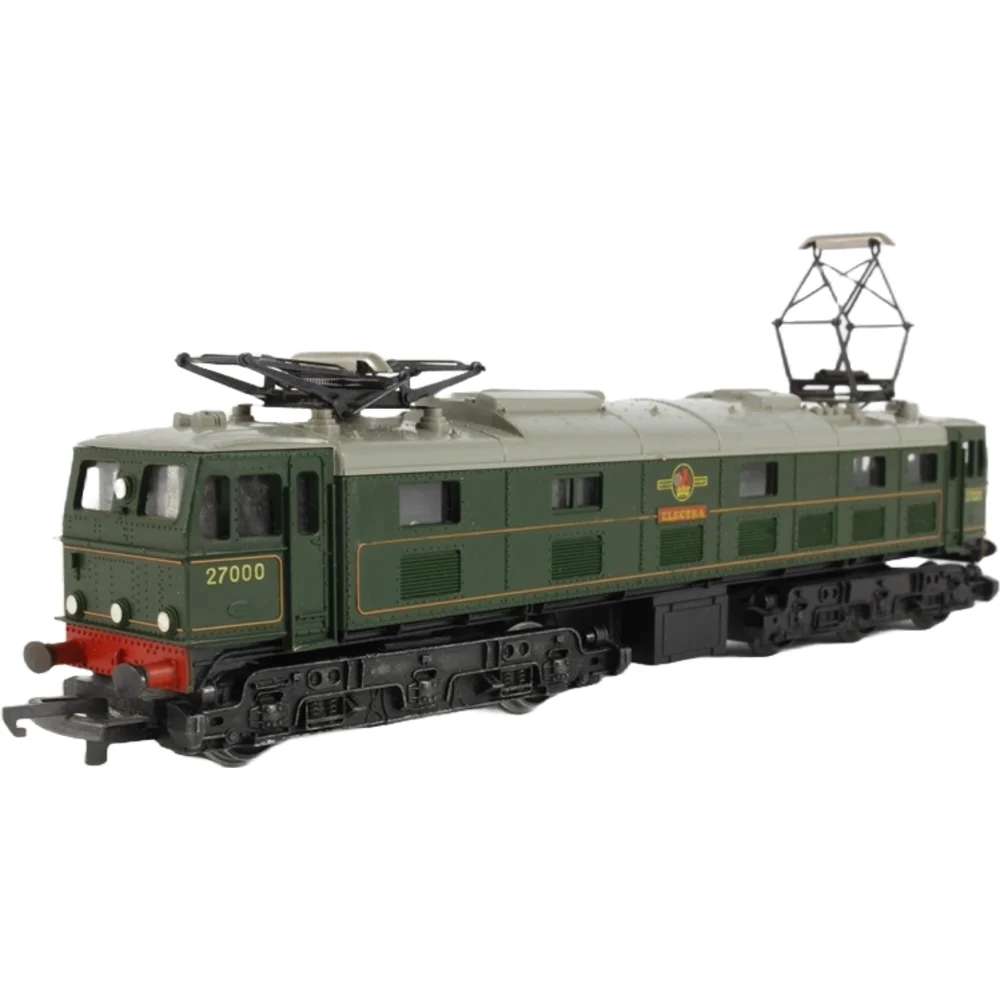
Tri-ang R351 Class 77 in OO
Contents
The British Rail Class 77 represents one of railway history's most intriguing "what-ifs"—seven purpose-built express passenger electric locomotives that served just fourteen years in Britain before enjoying a remarkably successful sixteen-year second career in the Netherlands. Built by Metropolitan-Vickers between 1953 and 1954 for the pioneering Manchester-Sheffield-Wath electrification scheme, these Co-Co electrics were Britain's first overhead electric locomotives designed specifically for express passenger work, capable of 90 mph with 2,760 hp power output that dramatically outperformed contemporary steam traction on the gruelling trans-Pennine route.
For model railway enthusiasts, the BR Class 77 offers compelling prototype appeal spanning two countries and three decades. Originally numbered 27000-27006 and later carrying mythological names including Electra, Ariadne, and Diana, these distinctive locomotives operated Woodhead Route expresses through the three-mile tunnel connecting Manchester and Sheffield from 1954 until 1968. Their premature British withdrawal resulted not from mechanical failure but from strategic electrification decisions—the isolated 1,500V DC system could never connect to BR's adopted 25kV AC standard. Nederlandse Spoorwegen purchased six locomotives in 1969 for just £35,000, renumbering them as NS Class 1500 and operating them successfully until 1986—remarkably outliving their British-based Class 76 siblings by five years.
The international second career makes Class 77 uniquely versatile for modellers. Heljan's exceptional OO gauge range, produced exclusively for Olivia's Trains since 2013, captures both BR liveries (green, blue, and black) and authentic NS yellow-and-grey schemes with unprecedented detail quality. Three locomotives survive in preservation: E27000 Electra at the Midland Railway Centre, E27001 Ariadne at Manchester's Science Museum, and E27003 Diana at Utrecht's Spoorwegmuseum—testament to a design that proved its worth across two railway systems and accumulated over 2.5 million miles each in Dutch service alone.
Quick Takeaways
- Seven locomotives built: Constructed 1953-1954 by Metropolitan-Vickers at Gorton Works, Manchester, numbered 27000-27006, later gaining E prefix and TOPS Class 77 designation
- Express passenger innovation: Britain's first overhead electric locomotives designed specifically for high-speed passenger work, delivering 2,760 hp one-hour rating with Co-Co bogies for superior riding quality
- Woodhead Route operations: Reduced Manchester-Sheffield journey times from 65 minutes to 56 minutes, operating trans-Pennine expresses through the challenging three-mile tunnel from September 1954
- Fourteen-year British service: Withdrawn March 1968 after accumulating approximately 800,000 miles each due to isolated 1,500V DC system incompatible with BR's 25kV AC electrification standard
- Nederlandse Spoorwegen purchase: Six locomotives sold for £35,000 total in 1969, renumbered NS 1501-1506, extensively modified at Tilburg including air brake conversion and Dutch equipment
- Sixteen-year Dutch career: Operated 1970-1986 on The Hague-Venlo international services and freight duties, accumulating average 2.5 million miles per locomotive—over three times British mileage
- Exceptional preservation rate: Three of seven survive: E27000 Electra at Midland Railway-Butterley, E27001 Ariadne at Manchester Science Museum, E27003 Diana at Utrecht Spoorwegmuseum
- Heljan OO gauge models: Exclusive production for Olivia's Trains featuring factory-fitted details, DCC ready with 21-pin socket, available in BR green/blue/black and NS yellow-grey liveries
Historical Background and Context
The genesis of the BR Class 77 lay in the London and North Eastern Railway's November 1936 announcement of the Manchester-Sheffield-Wath electrification scheme—one of Britain's most ambitious infrastructure projects aimed at modernising the gruelling trans-Pennine freight and passenger route. The existing steam-operated line presented formidable operational challenges: long, steep gradients on both sides of the Pennines severely taxed locomotive performance, whilst the poorly ventilated three-mile Woodhead Tunnel created hazardous atmospheric conditions for footplate crews exposed to concentrated smoke and steam.
The LNER's Chief Electrical Engineer selected 1,500V direct current overhead electrification, already proven successful on the Manchester South Junction and Altrincham suburban line electrified in 1931. This system offered the crucial advantage of regenerative braking—traction motors acting as generators during descent could feed electrical power back into the overhead lines, simultaneously assisting ascending trains whilst controlling heavy freight consists on severe gradients without excessive brake block wear. The original 1936 specification called for 69 mixed-traffic locomotives (designated EM1, later Class 76), nine express passenger machines (EM2, later Class 77), and ten banking engines specifically for the Worsborough incline.
War intervened in 1940, halting construction with only overhead line gantries erected west of Woodhead Tunnel. British Railways inherited the uncompleted project at nationalisation in 1948 and proceeded with implementation, though by this stage the technical advantages of 25kV alternating current electrification had become apparent through continental European experience. The decision to proceed with 1,500V DC condemned the Woodhead line to permanent operational isolation—it could never physically connect to future BR electrification schemes that universally adopted the 25kV AC standard. This fundamental incompatibility would ultimately seal the EM2 locomotives' British fate barely fourteen years after entering service.
Metropolitan-Vickers of Trafford Park, Manchester, secured the contract to supply all electrical equipment from their Dukinfield Works, whilst mechanical construction took place at the nearby Gorton Works. The company delivered seven production locomotives between 1953 and 1954, bearing running numbers 27000-27006 in the contemporary BR numbering series. These locomotives gained the "E" prefix in September 1957 to become E27000-E27006, distinguishing electric traction from diesel and steam classes, and finally received TOPS classification as Class 77 in March 1968—ironically, the very month they were withdrawn from regular British Railways service.
Insider Tip: Mythological Names Recognition
All seven Class 77 locomotives received names from Greek and Roman mythology between 1959 and 1960: Electra, Ariadne, Aurora, Diana, Juno, Minerva, and Pandora. These names remained with the locomotives throughout both their British and subsequent Dutch careers—Nederlandse Spoorwegen retained the original English names after purchase, creating the unusual sight of British mythological names displayed on Dutch-liveried locomotives operating continental European services. For modellers recreating authentic consists, these names provide essential character and enable specific locomotive identification across both national contexts.
The EM2 designation indicated "Electric Mixed-traffic, type 2" under British Railways' pre-TOPS classification system, though this proved something of a misnomer—the locomotives were specifically designed and optimised for express passenger work rather than the genuine mixed-traffic duties suggested by their classification. The confusion arose from BR's early electric locomotive classification scheme that lacked a dedicated express passenger category, forcing designers to shoehorn purpose-built express machines into the mixed-traffic designation despite their intended operational role.
Contemporary railway technical press praised the new design's advanced features and impressive power output. The Railway Gazette highlighted the sophisticated electrical control systems enabling smooth acceleration and the regenerative braking capabilities that would prove invaluable on the severe Woodhead gradients. The locomotives represented Metropolitan-Vickers' engineering excellence at its peak—the company had pioneered British main-line electrification and brought decades of continental European experience to bear on the EM2 design, creating machines that would prove their fundamental soundness through nearly three decades of intensive operations across two countries.
Design and Technical Specifications
The engineering excellence of the British Rail Class 77 represented significant advancement over the mixed-traffic EM1 (Class 76) design that formed the backbone of Woodhead electrification. Where the Class 76 employed articulated Bo+Bo wheel arrangement with bogies coupled by a drawbar—an arrangement that caused poor riding characteristics at speeds above 40 mph—the EM2 utilised independent Co-Co bogies based on those successfully fitted to the pioneering LMS diesel-electric locomotives 10000 and 10001. This fundamental mechanical difference delivered dramatically superior passenger comfort.
The Co-Co configuration positioned three powered axles on each of two independent six-wheeled bogies, distributing the substantial 102-ton weight across six axles and reducing individual axle loading to acceptable levels for passenger service speed restrictions. Crucially, Metropolitan-Vickers relocated drawgear and buffers from the bogies themselves to the locomotive body, transmitting haulage forces through the superstructure rather than the bogie frames. This arrangement eliminated the articulated coupling that plagued Class 76 high-speed operation, providing the smooth, stable ride essential for express passenger work where maintaining passenger comfort proved as important as raw haulage capacity.
At the heart of the design sat six Metropolitan-Vickers MV108 traction motors, each producing 460 hp and mounted in resilient suspension to minimise unsprung weight. The motors employed sophisticated series-parallel control switching that maximised performance across the operating speed range. Starting utilised all six motors connected in series, providing maximum torque for initial acceleration. Intermediate speeds switched to two parallel circuits of three motors, balancing power and speed. High-speed running employed three parallel circuits of two motors, with two motors on each bogie remaining permanently connected in series throughout all speed ranges to ensure balanced power distribution.
The power output figures demonstrated the EM2's dominance over contemporary traction. The 2,760 hp one-hour rating represented nearly double the continuous output of the Class 76 (1,868 hp versus 1,300 hp), whilst vastly exceeding any British steam locomotive's sustained power capabilities on the demanding Woodhead gradients. Even the mighty LNER A3 Pacifics, capable of brief 2,000+ hp bursts, could not sustain such output for the extended periods required during trans-Pennine climbs. The continuous rating of 2,490 hp ensured the locomotives could maintain express schedules hour after hour without the performance degradation that affected steam traction as fireboxes deteriorated and boiler pressure dropped between water stops.
Each locomotive carried a sophisticated Bastian & Allen electrically-powered steam generator producing 1,000 lb/h of steam at 50 psi for carriage heating—a critical requirement for passenger comfort during winter operations. The generator drew power from the overhead line, eliminating the need for separate boiler fuel and maintenance whilst providing unlimited heating capacity. A 350-gallon water tank offered approximately two hours of continuous steam generation, sufficient for typical Woodhead Route passenger diagrams with opportunities for replenishment at terminal stations.
Technical Innovation: Regenerative Braking Advantage
The Class 77's regenerative braking system represented sophisticated 1950s engineering that delivered both operational and economic advantages. During descents, the traction motors functioned as generators, converting the locomotive's kinetic energy into electrical power fed back into the overhead catenary. This simultaneously controlled train speed without excessive brake block wear and provided power for ascending trains on the opposite track—effectively "recycling" energy that would otherwise dissipate as heat through friction braking. On the severe 1-in-100 gradients approaching Woodhead Tunnel from both directions, regenerative braking proved invaluable for maintaining scheduled speeds whilst minimising maintenance costs. Modellers recreating authentic Woodhead operations should note this feature when explaining operational practices to layout visitors.
The twin diamond pantographs represented standard British practice for 1,500V DC overhead collection, with both units typically raised during Woodhead operations to maximise current collection reliability. The overhead line equipment reached heights of 20 feet above track level in certain locations—particularly near water columns where clearances demanded elevated wire position—making dual pantograph operation essential for consistent power pickup. The pantographs featured spring-loaded carbon collector strips that maintained contact pressure across varying wire heights whilst minimising wear on both collector and overhead conductor.
Braking systems employed vacuum operation throughout British service, standard for BR passenger stock during the 1950s-1960s era. The vacuum ejector drew power from the main electrical system, eliminating the steam-powered ejectors that served conventional locomotives. Straight air brakes provided locomotive-only braking for light engine movements, whilst the vacuum system controlled train braking through the conventional through-pipe connected to coaching stock. Nederlandse Spoorwegen would later convert the entire braking system to compressed air operation during 1969-1970 modifications, as Dutch railway practice standardised on air braking incompatible with British vacuum equipment.
The substantial 17:64 gear ratio represented a carefully calculated compromise between starting tractive effort and maximum speed capability. The gearing enabled the 90 mph design speed whilst maintaining adequate low-speed torque for accelerating heavy passenger formations from station stops—a balance that proved effective across the varied operational requirements of express passenger service. Contemporary testing recorded impressive acceleration figures, with loaded trains reaching 60 mph from rest in approximately two minutes on level track, performance that dramatically exceeded steam traction capabilities on equivalent formations.
Service History and Operations
Electric services on the Woodhead Route commenced with considerable ceremony on 20 September 1954, following E27000's successful hauling of the inaugural passenger train from Sheffield Victoria to Manchester London Road six days earlier on 14 September. The journey time improvement proved immediately apparent and commercially significant—electric traction completed the challenging trans-Pennine crossing in 56 minutes compared to 65 minutes required by steam locomotives, representing a 14% reduction despite the severe gradients and restrictive clearances that characterised the route. This improvement translated directly into enhanced service frequency and more efficient rolling stock utilisation.
The EM2 fleet quickly demonstrated impressive performance on their demanding route. Official test runs recorded E27001 hauling 285 tons gross trailing load at a steady 60-62 mph up the continuous 1-in-132 gradient from Sheffield through Penistone—a sustained power output completely beyond contemporary steam capabilities on such severe grades. The 5.9 miles between Wadsley Bridge and Wortley were covered in just 5 minutes 42 seconds during trials, averaging nearly 62 mph on continuously rising grades. Drivers reported the locomotives' smooth acceleration, precise speed control through regenerative braking, and absence of the wheelslip problems that plagued steam traction on greasy rails during autumn and winter operations.
Typical EM2 duties centred on express passenger services between Manchester London Road (renamed Manchester Piccadilly in September 1960) and Sheffield Victoria via Woodhead Tunnel, with additional workings extending to Wath and other South Yorkshire destinations. The locomotives handled the prestigious North Country Continental boat train connecting with Harwich sailings until service withdrawal in 1965. Saturday holiday traffic to East Coast resorts including Skegness and Cleethorpes provided seasonal employment, with the EM2s' superior speed and power enabling tight scheduling on these longer-distance workings. Following October 1965, most regular Woodhead passenger services operated with five-car formations rather than the longer rakes that had justified EM2 deployment during the route's busier years.
However, operational advantages progressively eroded through the early 1960s. In 1960, permanent speed restrictions reduced maximum permitted line speed from 65 mph to 60 mph across much of the Woodhead Route, negating substantial portions of the EM2's performance superiority over the more numerous but lower-powered Class 76 locomotives. The isolated 1,500V DC electrification prevented any route expansion or operational flexibility—EM2s were permanently confined to Woodhead metals, unable to work through to destinations beyond the electrified territory without diesel or steam pilot assistance. Estimated costs of £44 million to convert the entire system to BR's adopted 25kV AC standard proved completely prohibitive given the limited route mileage involved and uncertain long-term traffic prospects.
Operational Insight: The Beeching Decision
The 1965 Beeching network reshaping examined Sheffield-Manchester services and recommended concentrating traffic on a single route. Surprisingly, the original Beeching Report initially favoured Woodhead over the longer Hope Valley alternative, citing the substantial electrification investment and superior infrastructure. However, strong local opposition from Hope Valley communities, the prohibitive cost of linking Woodhead services to Sheffield Midland station following Sheffield Victoria's scheduled closure, and growing coal traffic demands serving Fiddlers Ferry Power Station reversed this decision. The requirement to accommodate increasing freight paths whilst reducing passenger services made Woodhead uneconomic for mixed operations. This strategic reversal—overturning Beeching's own initial recommendation—condemned the EM2 fleet despite the locomotives' mechanical excellence and operational success.
All seven EM2 locomotives were withdrawn from regular passenger service on 2 March 1968, officially condemned in October 1968 after accumulating approximately 800,000 miles each during their fourteen-year British careers. The withdrawal represented pure economic necessity driven by infrastructure decisions rather than any mechanical deficiency—the locomotives remained in excellent condition with decades of potential service life ahead. British Railways stored all seven at Bury depot whilst exploring potential foreign sales, recognising that scrapping nearly-new electric locomotives would represent inexcusable waste of valuable assets that retained considerable commercial value to operators using compatible electrification systems.
Nederlandse Spoorwegen showed immediate interest when BR approached potential purchasers. The Dutch national railway faced locomotive shortages whilst preparing their ambitious "Spoorslag '70" high-frequency timetable that demanded additional motive power. NS officials remembered the successful wartime loan of prototype EM1 "Tommy" (later Class 76 No. 76000) which had operated in the Netherlands during 1947-1952, demonstrating British electric traction's suitability for Dutch operations. On 20 August 1969, Dutch railway officials inspected E27002 at Bury depot and conducted high-speed test runs between Sheffield and Reddish Depot, during which the locomotive repeatedly reached 75 mph and briefly touched 80 mph near Crowden—speeds never achieved during regular British service due to permanent way restrictions. The impressive performance convinced NS to purchase all seven locomotives for the remarkably modest sum of £35,000 total—approximately £5,000 per locomotive for nearly-new express passenger traction.
The locomotives shipped via Harwich to Zeebrugge aboard the Cambridge Ferry in September 1969, proceeding immediately to Tilburg Workshops for extensive modification to Dutch railway standards. E27005 Minerva arrived in severely deteriorated condition and was deemed beyond economical repair in November 1969, being cannibalised for spare parts to support the remaining six locomotives. The operational quintet entered Dutch service progressively between May 1970 and June 1971 following comprehensive workshop attention.
Nederlandse Spoorwegen renumbering followed workshop departure order rather than original BR sequence, creating a scrambled relationship between British and Dutch identities. E27003 Diana became NS 1501 entering service in May 1970; E27000 Electra became NS 1502; E27004 Juno became NS 1503; E27006 Pandora became NS 1504; E27001 Ariadne became NS 1505 in April 1971; and E27002 Aurora became NS 1506 in June 1971. The locomotives retained their original English mythological names throughout Dutch service—a distinctive touch that created the unusual sight of British names displayed on continental European livery serving international services between The Hague and the German border.
Modifications at Tilburg Workshops proved extensive and comprehensive. British vacuum braking systems received complete replacement with Dutch compressed air equipment compatible with continental coaching stock. Driving controls relocated from British left-hand side to Dutch right-hand side standard positioning. New pantographs and headlight clusters replaced British equipment to match NS specifications. Advanced ATB (Automatische Trein Beïnvloeding) train protection systems installed throughout provided automatic speed control and signal observance. Improved wheel-slip protection and enhanced sanders addressed adhesion concerns. Crucially, no electrical voltage conversion proved necessary—both Woodhead and Dutch main line systems operated at identical 1,500V DC, enabling direct electrical compatibility that dramatically simplified the conversion process and reduced costs.
Nederlandse Spoorwegen deployed the Class 1500 locomotives primarily on international passenger services from The Hague through Venlo towards Cologne, plus substantial freight duties including Rotterdam Kijfhoek to Roosendaal overnight workings. Based initially at Maastricht depot with later additional allocation to Tilburg, the locomotives exceeded NS's conservative ten-year expected service life by over 50%, continuing reliable operations through 1986. Performance records from 1974 documented regular scheduled speeds of 83-86 mph—faster than any recorded British operation and finally approaching the original 90 mph design speed that Metropolitan-Vickers engineers had specified two decades earlier but British permanent way restrictions had prevented achieving.
The mileage accumulation during Dutch service proved extraordinary. E27000 (NS 1502) Electra alone accumulated approximately 5,000,000 miles—over six times its British mileage. The class averaged 2.5 million miles per locomotive during NS ownership, representing over three times their British career totals and validating the fundamental engineering soundness of Metropolitan-Vickers' 1953 design. These locomotives remained the only second-hand traction ever purchased by Nederlandse Spoorwegen—a remarkable testament to their reliability and performance that Dutch railway management never repeated with any other foreign purchase despite numerous opportunities over subsequent decades.
Following NS's 1978 order for 58 new Class 1600 locomotives from Alsthom, the ageing Class 1500 fleet became increasingly redundant. NS 1506 (Aurora) suffered extensive fire damage in August 1984 whilst being towed with brakes inadvertently applied, leading to early withdrawal and scrapping. The remaining five locomotives continued service until final withdrawal on 30 June 1986—remarkably outliving their British Class 76 siblings by five years, as those larger mixed-traffic machines faced scrapping following complete Woodhead closure in July 1981. A grand EM2 Farewell Railtour on 14 June 1986 attracted over 400 British enthusiasts crossing the North Sea to commemorate the class's retirement, with all four surviving operational locomotives (1501, 1502, 1503, 1505) participating in the event including a memorable triple-header finale through the Dutch countryside.
Fleet
| Ordered By | Built By | Built | Withdrawn | Length Of Service | Running Numbers | Names |
|---|---|---|---|---|---|---|
| British Railways | Metropolitan-Vickers | December 1953 | October 1968 | 14.8 years | BR 27000, NS 1502 | Electra |
| British Railways | Metropolitan-Vickers | March 1954 | October 1968 | 14.6 years | BR 27001, NS 1505 | Ariadne |
| British Railways | Metropolitan-Vickers | May 1954 | October 1968 | 14.4 years | BR 27002, NS 1506 | Aurora |
| British Railways | Metropolitan-Vickers | August 1954 | October 1968 | 14.2 years | BR 27003, NS 1501 | Diana |
| British Railways | Metropolitan-Vickers | September 1954 | October 1968 | 14.1 years | BR 27004, NS 1503 | Juno |
| British Railways | Metropolitan-Vickers | December 1954 | October 1968 | 13.8 years | BR 27005 | Minerva |
| British Railways | Metropolitan-Vickers | December 1954 | October 1968 | 13.8 years | BR 27006, NS 1504 | Pandora |
Withdrawal and Preservation Legacy
The withdrawal history of the British Rail Class 77 divides into two distinct national contexts, with British and Dutch careers producing markedly different outcomes despite involving the same seven locomotives. British Railways' premature 1968 withdrawal after merely fourteen years represented strategic infrastructure decisions rather than mechanical obsolescence—the locomotives entered storage in excellent condition with substantial remaining service potential. Nederlandse Spoorwegen's 1986 withdrawal after sixteen years of intensive Dutch operations reflected natural fleet replacement with modern traction rather than any performance deficiency.
Three of the original seven locomotives survive today—a remarkable 42.8% preservation rate for such a small class that demonstrates the lasting affection these distinctive machines generated across two countries and four decades of operations. The survivors represent both British and Dutch heritage, with preservation efforts spanning the North Sea and ensuring future generations can appreciate Metropolitan-Vickers' elegant 1950s express electric design.
E27000 Electra (NS 1502) resides at the Midland Railway Centre, Butterley, Derbyshire, owned and maintained by the EM2 Locomotive Society (Registered Charity No. 294207). Repatriated from the Netherlands on 17 July 1986 immediately following Dutch service withdrawal, Electra underwent comprehensive cosmetic restoration at Bradford between 1987 and 1989, emerging in authentic British Railways Brunswick green livery with full lining and appropriate period running number 27000. The locomotive returned briefly to continental Europe in 1989 for Nederlandse Spoorwegen's 150th anniversary celebrations, operating four railtours and one regular Utrecht-Rotterdam service train under its own power on the Dutch 1,500V DC network, covering 3,191 miles and demonstrating continued mechanical excellence despite its 35-year age. Currently displayed in BR "electric blue" livery applied during 1996 repainting, Electra remains theoretically operational with all mechanical and electrical systems intact, though it has never worked under electric power in Britain due to the complete absence of 1,500V DC overhead infrastructure on preserved heritage railways.
E27001 Ariadne (NS 1505) occupies static display at the Science and Industry Museum, Manchester, formerly the Museum of Science and Industry. Nederlandse Spoorwegen donated the locomotive to the museum on the specific condition it remain in Dutch livery and condition, preserving the visual evidence of the international second career that characterised the class's unique history. Ariadne serves as a static exhibit in the museum's Power Hall, providing visitors with accessible close-up examination of the distinctive Co-Co design and Metropolitan-Vickers electrical equipment. The locomotive emerged for a rare outdoor photograph session on 2 July 2017—its first outdoor appearance in many years—enabling enthusiasts to capture images of the machine in natural daylight conditions. The museum location in Manchester proves particularly appropriate given the locomotive's original construction at nearby Gorton Works and its operational service connecting Manchester with Sheffield through Woodhead Tunnel.
Preservation's Cross-Channel Success
The Class 77's exceptional three-locomotive survival rate reflects coordinated preservation efforts spanning two countries and demonstrating international cooperation rarely seen in railway heritage. The EM2 Locomotive Society's determination to repatriate Electra from the Netherlands secured the locomotive's return to British soil, whilst Manchester's Science Museum accepted Ariadne specifically to commemorate both British construction heritage and Dutch operational service. Meanwhile, Dutch enthusiasts preserved Diana in the Netherlands, ensuring that country's sixteen-year operational relationship remained commemorated through physical survivor. This tri-national preservation effort guarantees that future generations across Europe can appreciate these remarkable machines that proved their worth through three decades of intensive express passenger service on two national railway systems.
E27003 Diana (NS 1501) was preserved by Werkgroep Loc 1501, a dedicated Dutch preservation group, from 1986 onwards. The locomotive remained operational for enthusiast railtours throughout the late 1980s and 1990s, finally operating its last revenue service on 23 November 2007 before withdrawal due to expired certification and the substantial cost of recertification for continued main line operation. Following extended storage at Blerick depot, Diana arrived at the Spoorwegmuseum (Netherlands Railway Museum) in Utrecht during July 2020 to commemorate the Class 1500's 50th anniversary of Dutch service. The museum formally accepted donation of the locomotive on 1 June 2021, securing permanent preservation. Currently serving as a static indoor exhibit, the museum has indicated potential interest in investigating future operational restoration if funding and technical resources permit, though no definitive plans exist. The locomotive's preservation in the Netherlands ensures Dutch railway heritage appropriately commemorates the only second-hand locomotives NS ever purchased.
The nameplate from scrapped E27004 Juno (NS 1503) survives on display at Kidderminster Railway Museum, providing modest commemoration of the lost locomotive. E27005 Minerva was scrapped in the Netherlands in 1969 before entering service, whilst E27002 Aurora (NS 1506) was scrapped following catastrophic fire damage in 1984, and E27006 Pandora (NS 1504) was scrapped following Dutch service withdrawal in 1986.
The engineering legacy extends beyond individual preserved locomotives. The Class 77 validated design principles that influenced British electric locomotive development throughout the 1960s-1980s: independent Co-Co bogies for express passenger work, regenerative braking for operational economy, sophisticated series-parallel motor control for performance across speed ranges, and comprehensive electrical train heating systems. These lessons informed subsequent BR electric classes including the later AL6 (Class 86) that became Britain's most successful mixed-traffic electric design. The EM2's fundamental engineering soundness—demonstrated through nearly three decades of intensive operations accumulating millions of miles across two national railway systems—proved that British electrical engineering could match continental European standards when given appropriate specifications and proper operational support.
Modelling Significance and Scale Replications
The British Rail Class 77 presents exceptional modelling significance due to its unique position spanning two countries, multiple liveries, and three operational decades from 1954 through 1986. For railway modellers seeking distinctive electric traction with fascinating historical context, these locomotives provide compelling prototype appeal enhanced by the international second career that distinguishes them from purely British subjects. The relatively small seven-locomotive fleet enables prototypical representation without excessive duplication, whilst the variety of BR liveries and authentic Dutch NS yellow-and-grey schemes offers visual diversity rare among such limited classes.
The modelling landscape centres entirely on Heljan's OO gauge production, manufactured exclusively for Olivia's Trains of Sheffield under a special licensing arrangement secured in 2013. This exclusive relationship ensures consistent quality standards and accurate prototype research, with Heljan's engineering team consulting preserved examples and NS historical records to capture authentic details across both British and Dutch configurations. The models represent Heljan's commitment to producing overlooked but historically significant British electric traction, filling gaps that mass-market manufacturers traditionally ignored in favour of more commercially obvious diesel and steam subjects.
First released in 2013 following several years of development, Heljan's Class 77 models immediately earned acclaim for exceptional detail quality and thoughtful attention to prototypical variations. The models feature factory-fitted separate details including delicate handrails, horns, lamp irons, vacuum/air brake pipes, and coupling gear, plus working directional headlights and tail lights appropriate to BR and NS operating practices. Finely etched bodyside grilles provide visual depth whilst accurately representing the ventilation openings that characterised Metropolitan-Vickers' distinctive styling. Cosmetic cross-arm pantographs—the correct diamond-shaped pattern for 1,500V DC overhead collection—sit appropriately positioned on the roof, though naturally remain non-functional given the absence of actual overhead electrification on model railways.
The technical execution demonstrates Heljan's characteristic attention to operational performance. A modern coreless motor drives all twelve wheels through geared transmission to both bogies, ensuring powerful performance and smooth slow-speed operation suitable for express passenger service simulation. Comprehensive all-wheel electrical pickup collects current from track via metal wheel sets and phosphor-bronze pickups on all axles, minimising the stalling problems that plagued earlier electric locomotive models with limited pickup arrangements. The substantial diecast metal chassis provides excellent weight distribution approximating the prototype's 102-ton bulk whilst maintaining low centre of gravity for stable operation.
Models
| Builder | Catalogue # | Year | Running # | Class, Operator (Livery) "Name" | Scale | Finish | Era | DCC |
|---|---|---|---|---|---|---|---|---|
| Heljan | 7700* | 27000 | British Rail Class 77, British Railways (Lined Black with Early Emblem) "Electra" | OO | P | 4 | DCC21 | |
| Heljan | 7701* | E27005 | British Rail Class 77, British Railways (Green) "Minerva" | OO | P | 5 | DCC21 | |
| Heljan | 7702* | 27004 | British Rail Class 77, British Railways (Electric Blue) "Juno" | OO | P | 5 | DCC21 | |
| Heljan | 7703* | 27002 | British Rail Class 77, British Railways (Black with Early Emblem) "Aurora" | OO | P | 4 | DCC21 | |
| Heljan | 7704* | 27001 | British Rail Class 77, British Railways (Green with Late Crest) "Ariadne" | OO | P | 5 | DCC21 | |
| Heljan | 7705* | E27003 | British Rail Class 77, British Railways (Green) "Diana" | OO | P | 5 | DCC21 | |
| Heljan | 7706* | E27006 | British Rail Class 77, British Railways (Electric Blue) "Pandora" | OO | P | 5 | DCC21 | |
| Tri-ang | R351 | 27000 | British Rail Class 77, British Railways (Green with Late Crest) "Electra" | OO | P | 5 | No | |
| Tri-ang | R351 | 27000 | British Rail Class 77, British Railways (Electric Blue) "Electra" | OO | P | 5 | No | |
| Tri-ang | R351 | 27000 | British Rail Class 77, British Rail (Blue) "Electra" | OO | P | 6 | No | |
| Tri-ang | R388 | TRANSFER | British Rail Class 77, British Railways (Green with Late Crest) "TRANSFER" | OO | P | 5 | No | |
| Tri-ang | R388 | TRANSFER | British Rail Class 77, British Railways (Electric Blue) "TRANSFER" | OO | P | 5 | No | |
| Tri-ang | R388 | TRANSFER | British Rail Class 77, British Rail (Blue) "TRANSFER" | OO | P | 6 | No |
Each model comes DCC ready with a standard 21-pin socket pre-fitted and a factory-installed speaker for straightforward sound decoder installation. The minimum radius specification of Radius 2 curves (438mm/17.25") suits most OO gauge layouts, though the substantial 254mm overall length benefits from gentler radii where space permits. Close coupling via NEM362 standard coupling pockets enables realistic train formations, though modellers should note the prototype's 59-foot length makes the models unsuitable for tight radius industrial sidings or tramway layouts where shorter locomotives prove more appropriate.
DCC Sound Fitted variants feature ESU LokSound V5 decoders with authentic Class 77 audio recordings including motor sounds, brake squeal, compressor operation, and horn. The sound quality proves impressive, with clear motor acceleration and deceleration sounds that enhance operational realism during station stops and speed changes. ESU's sophisticated decoder programming enables extensive customisation of operating characteristics, allowing modellers to adjust acceleration rates, maximum speed, and sound volumes to match individual preferences and layout requirements.
Advanced Modelling: Era-Appropriate Details
Heljan's tooling variations enable period-specific authenticity across the class's 32-year service timeline. British Railways green livery (product codes 7701, 7704, 7705) represents 1954-1966 operations on Woodhead Route services, appropriate for layouts depicting the electrification's peak years. BR electric blue (7702, 7706) suits 1966-1968 final British service period and provides striking visual contrast to contemporary maroon coaching stock. BR black with early emblems (7700) or matt finish (7703) offers alternative early-period representation. The NS Dutch yellow-grey livery (7702OT1505) becomes appropriate only for layouts set from 1970 onwards, representing the Netherlands career that extended through 1986. Matching locomotive livery to layout era and coaching stock creates convincing authenticity that enhances visitor appreciation.
Retail pricing reflects the comprehensive feature set and limited-edition production status. DCC Ready versions originally retailed at £200-£260 depending on livery variant and retailer discounting. DCC Sound Fitted models commanded £280-£320, representing approximately 40% premium for factory-fitted ESU decoders and speakers. However, availability has become severely constrained following initial production runs selling out—most variants remain unavailable through primary retail channels, with only sporadic pre-owned examples appearing through specialist dealers and auction sites. Collectors willing to wait can occasionally secure examples at £180-£300 depending on condition and livery desirability.
Current availability requires contacting Olivia's Trains directly (telephone 0114 3216 160) to enquire about remaining stock and potential future production runs. Hattons Model Railways' pre-owned section occasionally lists second-hand examples, whilst eBay and specialist railway model auction sites provide alternative hunting grounds for determined collectors. The limited-edition nature of these releases makes re-production unlikely unless Heljan and Olivia's Trains identify sufficient demand to justify new tooling runs—an uncertain prospect given the specialist nature of electric locomotive subjects and the small prototype fleet that limits mass-market appeal.
Alternative model options remain severely limited. The vintage Tri-ang R351 (27000 Electra in electric blue livery) from 1961 appears occasionally in pre-owned markets at £20-£60, though these primitive models require complete electrical rewiring for DCC conversion and lack the detail quality contemporary modellers expect. As curiosities representing 1960s toy train standards these Tri-ang models hold nostalgic appeal, but cannot compete with Heljan's accurate scale representation for serious layout operation.
MSL Hobbies Ltd produces nickel silver etched brass body kits in OO gauge, N gauge, and O gauge for skilled kitbuilders willing to undertake comprehensive scratchbuilding projects. These kits provide only body shells and detail parts—modellers must source appropriate donor chassis, motors, gearboxes, and electrical pickups from other sources. The N gauge kit specifically suggests Graham Farish Class 31 running gear as suitable donor mechanism, requiring extensive modification to accommodate the different body length and weight distribution. O gauge and OO gauge kits similarly demand advanced modelling skills including soldering etched brass components, fabricating custom chassis components, and integrating electrical systems. These kits suit experienced modellers seeking unique projects rather than typical ready-to-run purchasers.
No ready-to-run models exist in N gauge or O gauge from any manufacturer. The small prototype fleet and specialist electric traction subject matter have prevented commercial production at these scales, leaving Heljan's OO gauge range as the only accessible ready-to-run option for most modellers. N gauge and O gauge enthusiasts requiring Class 77 representation must either build from MSL kits or commission custom models from professional builders—expensive and time-consuming approaches that explain why few N or O gauge layouts feature these distinctive locomotives despite their historical significance.
Unique Modelling Tips and Layout Integration
Successfully incorporating British Rail Class 77 models into layout operation requires understanding the specialised nature of their trans-Pennine express passenger role and the authentic operating scenarios that characterised Woodhead Route services from 1954 through 1968. Unlike mixed-traffic designs that might appear on diverse duties, the Class 77 operated exclusively on specific passenger diagrams connecting Manchester and Sheffield via the distinctive three-mile Woodhead Tunnel—a geographical and operational context that demands careful attention to period infrastructure and appropriate train formations.
Era selection proves fundamental for authentic Class 77 deployment. British Railways operation spans 1954-1968, with distinct sub-periods offering different modelling opportunities. The 1954-1959 early period saw locomotives in original BR black livery with early British Railways totem, operating intensive passenger services during the electrification's peak years. The 1959-1966 middle period introduced BR Brunswick green with full yellow warning panels, representing the class's prime years when all seven locomotives operated regular diagrams. The 1966-1968 final period featured BR electric blue livery applied fleet-wide, though operational intensity declined as passenger traffic migrated to alternative routes preceding complete closure. Nederlandse Spoorwegen operation from 1970-1986 provides continental European context with distinctive yellow-and-grey livery and international passenger services reaching toward the German border.
Layout infrastructure for authentic British-era representation requires 1,500V DC overhead catenary—the distinctive electrification system that characterised Woodhead operations. Sommerfeldt produces suitable OO gauge overhead line equipment including catenary wire, support gantries, section insulators, and feeder cables that enable visually convincing representation. For modellers seeking operational overhead collection, some advanced practitioners have successfully created working 12V DC catenary systems using Sommerfeldt components powered separately from track circuits, though this approach demands considerable electrical expertise and careful safety precautions. Simplified non-working representations using brass wire suspended from scale gantries provide equally authentic visual appearance without electrical complexity, proving entirely acceptable for most layouts where overhead serves purely decorative purposes.
The Woodhead Route's characteristic infrastructure includes the massive stone tunnel portals that dominated both Manchester and Sheffield approaches, distinctive steel overhead line gantries supporting the catenary system, and stations including Manchester London Road/Piccadilly, Guide Bridge, Glossop, Hadfield, Penistone, and Sheffield Victoria. The severe gradients on both sides of the Pennines created dramatic operational interest—trains accelerated purposefully from Manchester toward the long climbs, crested the summit near Woodhead, then descended carefully using regenerative braking toward Sheffield. Period signalling featured upper-quadrant semaphores progressively replaced by colour-lights during the 1960s, providing appropriate lineside detail for different timeframes.
Weathering Authenticity for Electric Operation
Class 77 weathering should reflect the relatively clean operation of electric traction whilst acknowledging the industrial environment through which Woodhead services operated. Focus weathering effects on roof areas where overhead line arcing created distinctive carbon deposits around pantograph bases, plus accumulated industrial pollution from Manchester and Sheffield atmospheres. Bodyside panels accumulated road grime and brake dust along lower edges, whilst bogies and underframe components showed typical running gear weathering including oil staining and track dirt. However, avoid the heavy coal dust and ash weathering appropriate for steam locomotives—electric traction remained substantially cleaner than contemporary steam operation. British Railways maintained reasonable external cleanliness standards for passenger-rated locomotives, so moderate weathering proves most prototypically accurate. Nederlandse Spoorwegen applied higher cosmetic standards, making NS-liveried models suit lighter weathering that emphasises the Dutch railway's traditionally pristine fleet appearance.
Coaching stock selection requires careful attention to period authenticity and regional allocation. British Railways Woodhead services typically employed BR Mark 1 corridor coaches in maroon livery during 1954-1965, representing standard BR express passenger stock of the era. The introduction of BR blue-and-grey coaching stock livery from 1965 onwards provided alternative formations appropriate for 1965-1968 final service period. Earlier periods might include Thompson and Gresley-designed LNER coaches inherited at nationalisation, particularly on secondary services and seasonal holiday trains. Nederlandse Spoorwegen formations demand Plan E and Plan W series Dutch coaching stock appropriate for 1970-1986 operations, plus occasional international through coaches connecting with German services beyond Venlo.
Train lengths should reflect the Class 77's substantial 2,760 hp power output and express passenger classification. Typical formations comprised six to eight coaches on regular Manchester-Sheffield expresses, with longer rakes of nine to eleven coaches appearing on Saturday holiday services to East Coast resorts. Shorter three to five-coach formations became common post-1965 as traffic declined and service frequencies reduced. The locomotives could comfortably handle twelve-coach formations on level sections, though the severe Woodhead gradients typically limited practical consists to eight coaches maximum to maintain scheduled speeds. Modellers should avoid excessive train lengths that exceed prototypical loading—even powerful electric locomotives faced physical limitations on 1-in-100 gradients that characterised trans-Pennine operations.
Operational sessions benefit from incorporating the intensive service patterns that characterised Woodhead operations during peak years. A realistic operating sequence might involve an early morning Manchester-Sheffield express departure, mid-morning return working with a through coach detachment at Guide Bridge for the Glossop branch, early afternoon North Country Continental boat train connection, late afternoon Sheffield-Manchester commuter service, and evening return working. This varied timetable creates engaging movements whilst remaining prototypically accurate to actual 1950s-1960s service patterns. The regenerative braking capability should be explained when demonstrating operations to visitors—the prototype's ability to recover energy during descents and feed power to ascending trains on opposite tracks represented sophisticated 1950s technology that modern modellers can appreciate even if unable to physically replicate.
Nederlandse Spoorwegen operational scenarios suit modellers seeking continental European variety. Typical NS duties included The Hague to Venlo international passenger services, Rotterdam Kijfhoek to Roosendaal overnight freight workings, and various regional passenger diagrams across the Dutch 1,500V DC network. Dutch infrastructure differed markedly from Pennine settings—flat landscapes, distinctive station architecture with characteristic canopies and platform furniture, and catenary support structures following continental European patterns. These environmental differences enable modellers to create visually distinct settings despite using the same basic locomotive models, simply through appropriate infrastructure choices and coaching stock selection.
Sound-equipped models enhance operational realism through authentic audio experiences. Programme sound decoders to emphasise the electric motor whine that characterised traction motor acceleration, the distinctive transformer hum audible at station stops, and the horn sounds appropriate to BR or NS operations. British Railways employed a two-tone air horn pattern, whilst Nederlandse Spoorwegen used different continental European horn signals that careful sound programming can replicate. The absence of steam locomotive exhaust beats and whistle screams makes electric traction sound profiles markedly different—emphasising smooth motor acceleration rather than percussive cylinder beats creates authentic electric locomotive atmosphere.
Depot scenes provide excellent static display opportunities whilst demonstrating maintenance infrastructure appropriate to electric traction. Model a section of Reddish depot (the primary Woodhead electric locomotive facility) featuring inspection pits, wheel lathes, electrical equipment test benches, and overhead maintenance gantries enabling safe pantograph examination. Class 77s sharing space with Class 76 mixed-traffic stablemates creates authentic Woodhead atmosphere, whilst adding period diesel shunters and engineers' departmental stock enhances operational variety. Include details such as electrical supply cables, 1,500V DC test equipment, and specialist tools appropriate to electric traction maintenance—distinctive elements that differentiate electric depot facilities from steam or diesel equivalents.
The limited seven-locomotive prototype fleet makes multiple-unit operation relatively rare but not entirely unknown. Modellers can justifiably depict two Class 77s double-heading particularly heavy Saturday holiday trains or special workings, though single locomotive haulage represented normal practice for regular express services. The more common sight involved Class 77 express passenger locomotives passing Class 76 freight locomotives on parallel tracks—creating interesting operational contrasts between express and freight traction designs serving the same electrified route.
Finally
The British Rail Class 77 represents far more than seven electric locomotives; these machines embody the triumphs and tragedies of British railway electrification policy, demonstrating both the engineering excellence achievable when proper resources supported innovative design and the strategic shortsightedness that condemned successful infrastructure through incompatible standardisation decisions. Metropolitan-Vickers' elegant 1953 design delivered impressive performance spanning three decades and two countries, accumulating millions of miles whilst proving that British electrical engineering could match continental European standards when given appropriate opportunities.
For railway historians, the Class 77 provides fascinating insights into the complex interplay between technical capability, strategic planning, and economic reality that shaped post-nationalisation British Railways development. The Woodhead electrification represented Britain's most ambitious main-line electric traction scheme when completed in 1954, employing sophisticated 1,500V DC overhead systems, regenerative braking technology, and purpose-built express passenger locomotives that dramatically outperformed contemporary steam traction. Yet strategic decisions favouring 25kV AC standardisation—entirely sensible from broader network perspective—condemned this successful isolated installation to premature closure barely fourteen years after completing the expensive electrification work. The locomotives themselves bore no responsibility for this infrastructure failure—their subsequent sixteen-year Dutch career accumulating over 2.5 million miles each validated the fundamental engineering soundness that British permanent way restrictions and strategic incompatibilities prevented fully exploiting.
The international second career makes Class 77 unique among British-built locomotives. Where most exported British traction faced early scrapping or languished in deteriorating storage, the Class 77 fleet (minus casualty Minerva) thrived under Nederlandse Spoorwegen ownership, regularly achieving the 90 mph design speeds that British permanent way restrictions prevented, operating prestigious international services connecting with German railways, and ultimately outliving their British-based Class 76 siblings by five years despite the larger mixed-traffic locomotives' supposedly more versatile capabilities. This Dutch success story demonstrates that engineering excellence transcends national boundaries—Metropolitan-Vickers' 1953 design proved equally capable serving trans-Pennine expresses and continental European international services when operational context supported rather than constrained the locomotives' inherent capabilities.
The exceptional three-locomotive preservation rate ensures future generations can appreciate these distinctive machines through physical survivors rather than merely archival photographs and technical specifications. E27000 Electra at Butterley, E27001 Ariadne at Manchester's Science Museum, and E27003 Diana at Utrecht's Spoorwegmuseum represent coordinated international preservation efforts spanning two countries and ensuring both British construction heritage and Dutch operational service receive appropriate commemoration. The 1989 return of Electra to the Netherlands for NS's 150th anniversary—operating regular service trains and railtours under its own power on the Dutch 1,500V DC network—demonstrated that preserved electric locomotives can achieve genuine operational status given appropriate infrastructure, providing a tantalising glimpse of what might be possible should Britain ever develop 1,500V DC heritage railway operations.
Heljan's exceptional OO gauge models provide the only ready-to-run representations of this historically significant class, delivering unprecedented detail quality and authentic livery variations spanning both British Railways and Nederlandse Spoorwegen eras. The exclusive production arrangement with Olivia's Trains ensures consistent prototype research and quality standards, whilst limited-edition releases create collector appeal beyond the locomotives' inherent modelling interest. For enthusiasts seeking distinctive electric traction that tells fascinating international stories, these models enable authentic layout representation spanning 1954-1986 operations across two national railway systems—versatility rare among British prototype subjects.
Model railway enthusiasts incorporating Class 77s into contemporary layouts gain access to express passenger operations requiring sophisticated infrastructure representation including overhead catenary systems, appropriate BR Mark 1 coaching stock, and characteristic Woodhead Route geographical features. The trans-Pennine setting offers dramatic operational interest through severe gradients, lengthy tunnel transits, and the distinctive sight of powerful electric locomotives conquering challenging alignments that defeated lesser steam predecessors. Alternatively, Nederlandse Spoorwegen operations provide continental European variety enabling modellers to explore Dutch railway practice whilst maintaining 1,500V DC electrical compatibility with British Woodhead infrastructure—a unique modelling opportunity reflecting the prototype's remarkable international career.
The engineering legacy persists through subsequent British electric locomotive designs that incorporated lessons learned from EM2 operations. The successful Co-Co bogie arrangement, sophisticated series-parallel motor control, regenerative braking capabilities, and comprehensive electric train heating systems all influenced later BR electric classes that formed the backbone of West Coast Main Line and East Coast Main Line electrified operations through the 1960s-1980s. The fundamental soundness of Metropolitan-Vickers' engineering—validated through nearly three decades of intensive express passenger service accumulating extraordinary mileages across two national railway systems—demonstrated that British electrical engineering expertise could deliver world-class electric traction when freed from the strategic constraints and infrastructure incompatibilities that prematurely ended Woodhead operations.
As preserved railway enthusiasts continue developing ambitious infrastructure projects and the railway heritage movement evolves beyond purely steam-focused preservation, the British Rail Class 77 stands as perfect candidate for eventual operational restoration. The existence of three survivors, proven capability for modern railway operation demonstrated during 1989 Dutch tours, and growing enthusiast interest in electric and diesel traction preservation create favourable conditions. The primary obstacle remains developing appropriate 1,500V DC overhead infrastructure—a substantial challenge requiring considerable capital investment and technical expertise. Yet the precedent exists through continental European heritage railways that successfully operate historic electric traction, demonstrating that determined preservation societies can overcome even such formidable technical and financial barriers when commitment and expertise align with achievable goals. The Class 77 story—triumph, tragedy, international rebirth, and ultimate preservation—deserves operational continuation that would enable future generations to experience these remarkable machines performing the express passenger duties for which Metropolitan-Vickers so expertly designed them seven decades ago.
Frequently Asked Questions
How many British Rail Class 77 locomotives were built and when?
Seven locomotives comprised the complete Class 77 fleet, constructed by Metropolitan-Vickers at Gorton Works, Manchester, between 1953 and 1954. Originally numbered 27000-27006, they gained the "E" prefix in 1957 to become E27000-E27006, and finally received TOPS classification as Class 77 in March 1968—coincidentally the same month they were withdrawn from British Railways service. The class represented Britain's first purpose-built express passenger electric locomotives designed for overhead 1,500V DC operation.
Why were these locomotives called EM2?
The designation "EM2" indicated "Electric Mixed-traffic, type 2" under British Railways' pre-TOPS classification system, distinguishing them from the EM1 (later Class 76) freight locomotives that formed the bulk of Woodhead electrification motive power. Despite the "mixed-traffic" designation, the EM2s were specifically designed and optimised for express passenger work rather than genuine mixed-traffic duties—the classification arose from BR's early electric locomotive categorisation lacking a dedicated express passenger designation.
What made the Class 77 different from the Class 76?
Class 77 locomotives employed independent Co-Co bogies (two six-wheeled bogies with all axles powered) compared to Class 76's articulated Bo+Bo arrangement (two four-wheeled bogies coupled by drawbar). The Co-Co configuration delivered dramatically superior riding quality at express passenger speeds, whilst nearly doubling power output—2,760 hp one-hour rating versus Class 76's 1,868 hp. Class 77s also featured standard electric train heating equipment and design speeds of 90 mph compared to Class 76's 65 mph maximum, making them purpose-built express passenger machines versus the Class 76's mixed-traffic role.
Why were the Class 77s withdrawn after only fourteen years of British service?
Strategic infrastructure decisions rather than mechanical deficiency caused premature withdrawal. The 1,500V DC Woodhead electrification became permanently isolated when British Railways adopted 25kV AC as standard for all future electrification schemes. Converting the Woodhead system to 25kV AC would have cost an estimated £44 million—prohibitive for the limited route mileage. The 1965 Beeching reshaping redirected Sheffield-Manchester passenger traffic to the Hope Valley Line, whilst growing freight demands for Fiddlers Ferry Power Station coal traffic made mixed passenger-freight operations uneconomic. The locomotives remained in excellent mechanical condition at withdrawal.
What happened to the Class 77s after British Railways withdrawal?
Nederlandse Spoorwegen purchased all seven locomotives for £35,000 total in 1969 following successful test runs. Six locomotives (E27005 Minerva was scrapped for spare parts) underwent extensive modification at Tilburg Workshops including air brake conversion, control relocation, Dutch pantographs and signalling equipment, and ATB train protection installation. Renumbered NS 1501-1506, they entered Dutch service between May 1970 and June 1971, operating primarily on The Hague-Venlo international passenger services and freight duties until final withdrawal in June 1986—sixteen years of Dutch service exceeding their fourteen-year British career.
How successful were the Class 77s in Dutch service?
Remarkably successful—the locomotives exceeded NS's expected ten-year service life by over 50%, continuing reliable operations through 1986. They accumulated average mileages of 2.5 million miles each during Dutch ownership—over three times their British career totals. E27000 Electra alone achieved approximately 5 million miles in Dutch service. NS regularly operated them at 83-86 mph, finally approaching the 90 mph design speed British permanent way restrictions prevented achieving. They remained the only second-hand locomotives ever purchased by Nederlandse Spoorwegen—testament to their exceptional reliability.
Which Class 77 locomotives survive today and where are they preserved?
Three locomotives survive: E27000 Electra (NS 1502) at Midland Railway Centre, Butterley, Derbyshire, owned by EM2 Locomotive Society and theoretically operational though never worked under electric power in Britain; E27001 Ariadne (NS 1505) on static display at Science and Industry Museum, Manchester, in Dutch livery per NS donation conditions; and E27003 Diana (NS 1501) at Spoorwegmuseum (Netherlands Railway Museum), Utrecht, donated June 2021 following operational preservation by Dutch enthusiasts through 2007. This represents a remarkable 42.8% survival rate for such a small class.
Has any preserved Class 77 operated under electric power since withdrawal?
Yes—E27000 Electra returned to the Netherlands in 1989 for Nederlandse Spoorwegen's 150th anniversary celebrations, operating extensively under its own power on the Dutch 1,500V DC network. The locomotive hauled four railtours and one regular Utrecht-Rotterdam service train, covering 3,191 miles and demonstrating continued mechanical excellence despite its 35-year age. However, no Class 77 has ever operated under electric power in Britain due to the complete absence of 1,500V DC overhead infrastructure on preserved heritage railways.
What model railways produce Class 77 models and in which scales?
Heljan produces the only ready-to-run Class 77 models in OO gauge, manufactured exclusively for Olivia's Trains of Sheffield. Models feature factory-fitted details, DCC ready with 21-pin socket and speaker, working lights, and are available in various BR liveries (green, blue, black) plus NS Dutch yellow-grey. MSL Hobbies offers etched brass kits in OO, N, and O gauges requiring advanced kitbuilding skills. No ready-to-run models exist in N gauge or O gauge. Vintage Tri-ang R351 from 1961 appears occasionally in pre-owned markets but requires complete rewiring for modern operation.
Are Heljan Class 77 models still available to purchase?
Availability is severely limited following initial production runs selling out. Most variants remain unavailable through primary retail channels, with only sporadic pre-owned examples appearing through specialist dealers. Contact Olivia's Trains directly (telephone 0114 3216 160) to enquire about remaining stock or potential future production runs. Hattons Model Railways' pre-owned section occasionally lists examples, whilst eBay provides alternative hunting grounds. The limited-edition nature makes re-production unlikely unless sufficient demand justifies new tooling runs.
What coaching stock should I use with Class 77 models?
British Railways era (1954-1968) requires BR Mark 1 corridor coaches in maroon livery (1954-1965) or blue-and-grey livery (1965-1968), with formations typically comprising six to eight coaches on regular expresses and up to eleven coaches on Saturday holiday services. Earlier periods might include Thompson and Gresley LNER coaches. Nederlandse Spoorwegen era (1970-1986) demands Plan E and Plan W series Dutch coaching stock appropriate for international passenger services, plus occasional German through coaches for The Hague-Cologne workings. Avoid excessive train lengths—twelve coaches represents absolute maximum even for powerful electric locomotives on severe Woodhead gradients.
Can I model Woodhead Route operations without overhead catenary?
While overhead catenary dramatically enhances visual authenticity, its omission remains acceptable for layouts where space, budget, or technical complexity prevent installation. Many modellers operate Class 77s on layouts without overhead representation, treating the electric traction as running from track power in the same manner as diesel locomotives. However, even simplified non-working catenary using brass wire suspended from basic gantries substantially improves period atmosphere. Sommerfeldt produces suitable OO gauge components for modellers seeking authentic appearance, whilst advanced practitioners occasionally create working 12V overhead collection systems for ultimate realism.