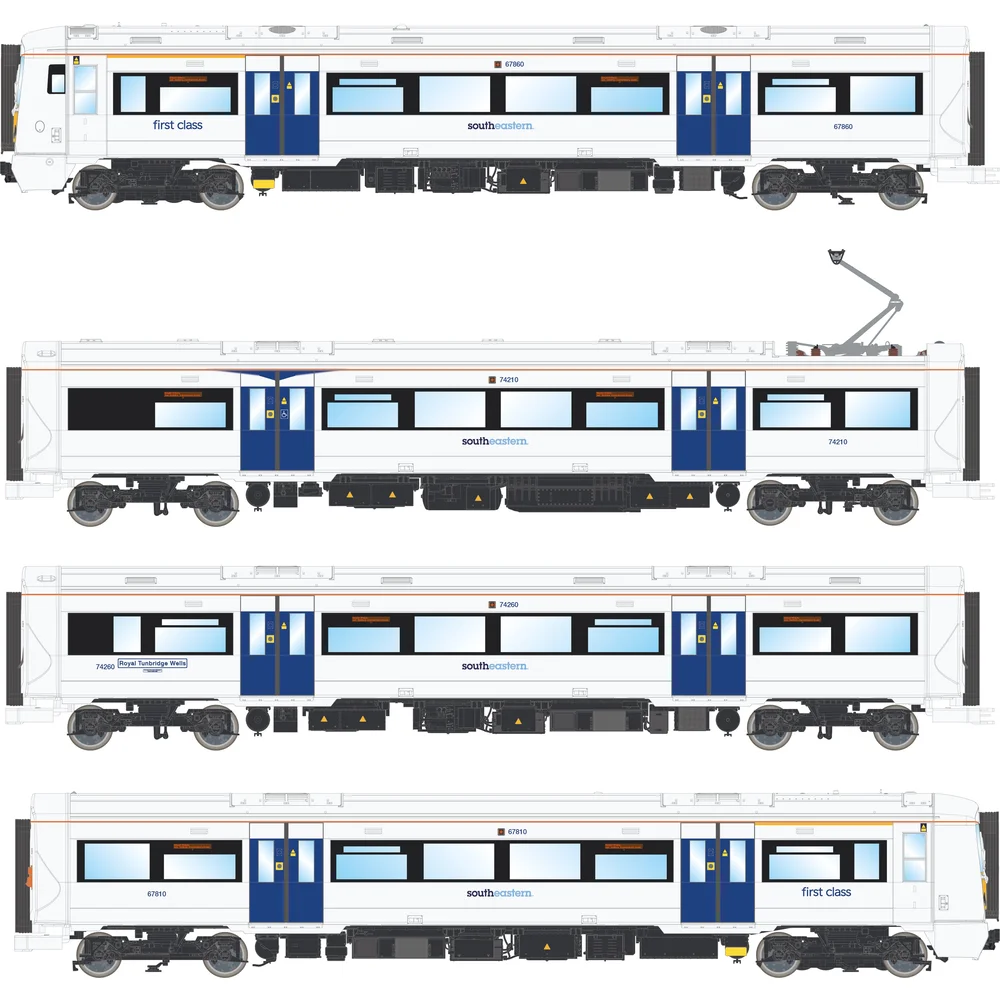
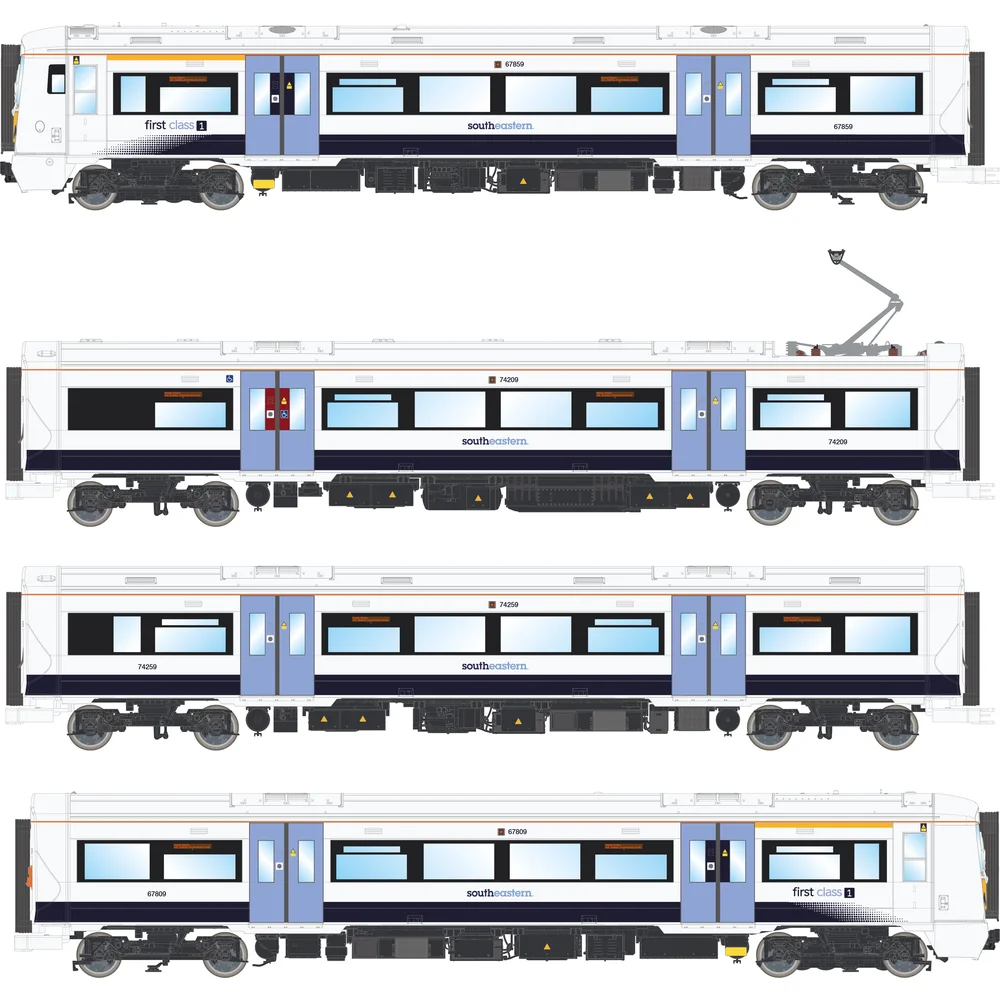
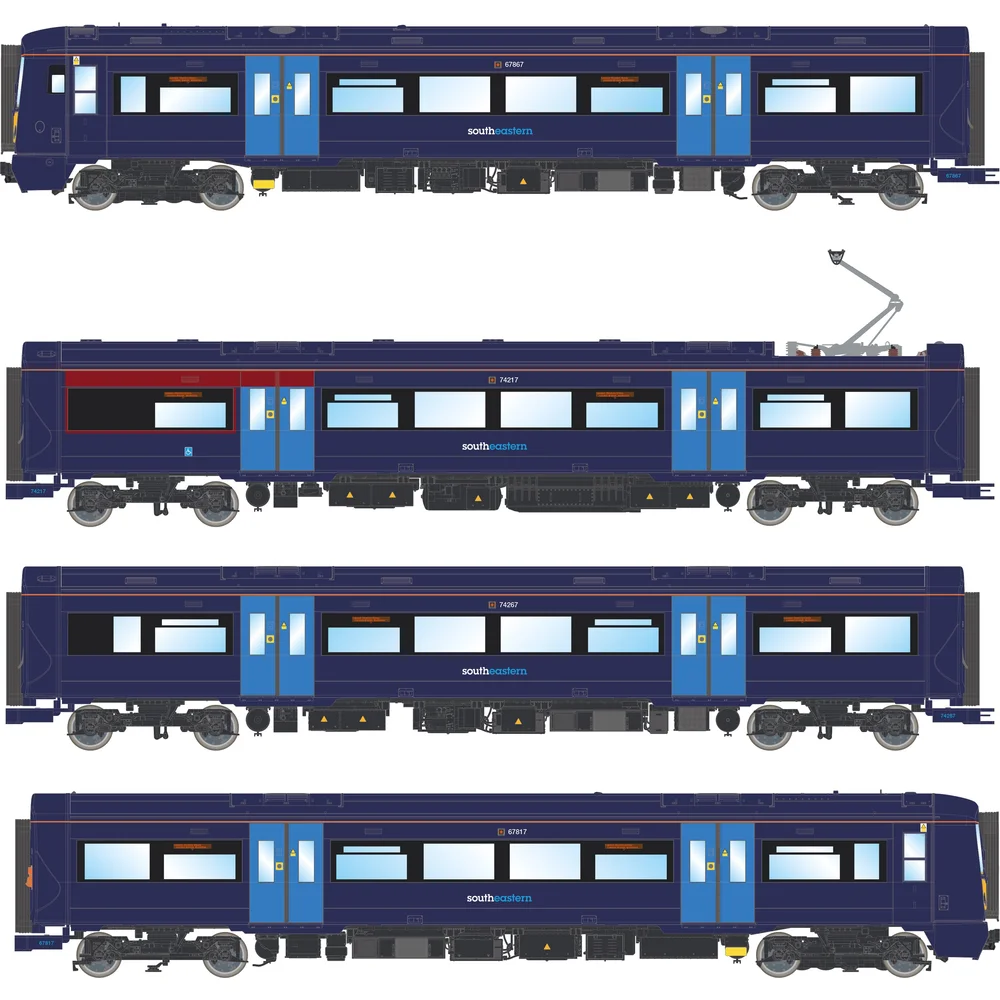
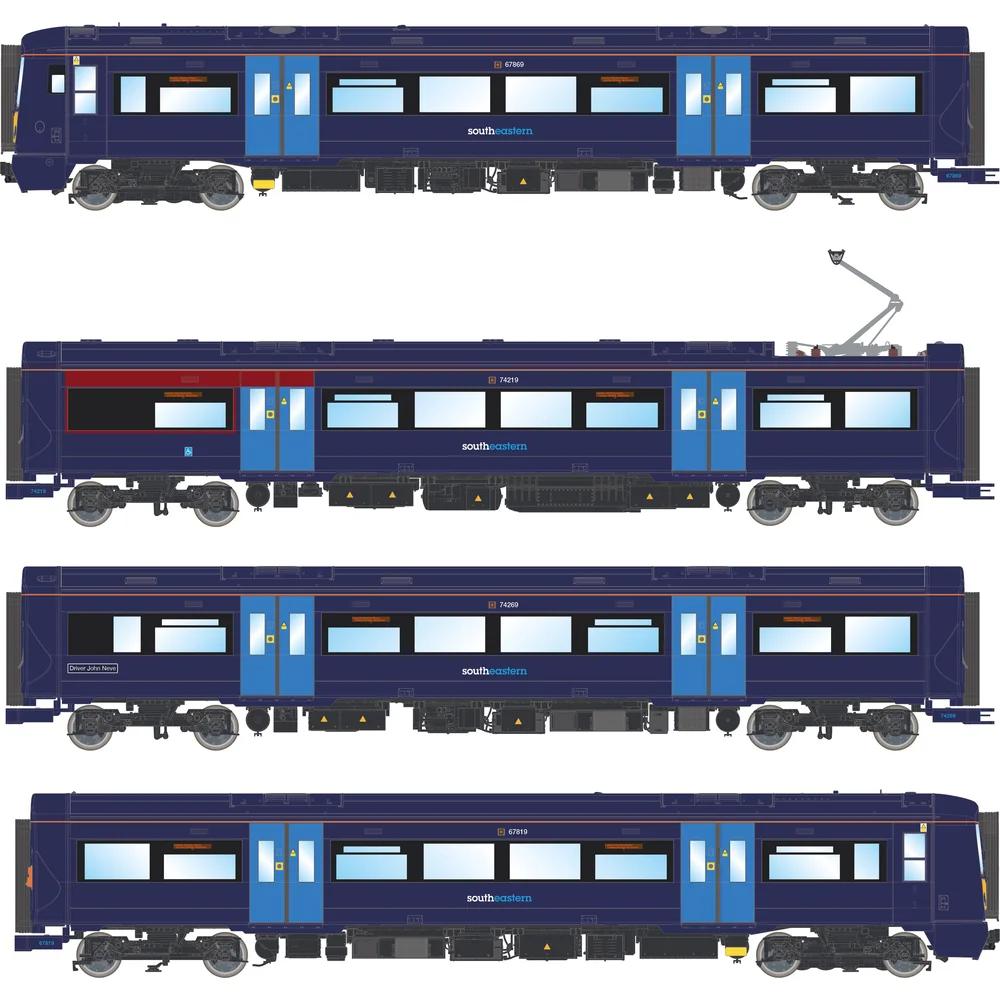
The British Rail Class 170 Turbostar diesel multiple unit remains one of Britain's most significant post-privatisation train types, with over 120 units still operating daily across Scotland and England as of 2025. Built between 1998 and 2005 by Adtranz (later Bombardier, now Alstom) at Derby Litchurch Lane Works, these versatile DMUs revolutionised regional rail travel by replacing aging first-generation units with modern air-conditioned trains featuring 100 mph capability and comprehensive accessibility features. The fleet spans seven sub-classes serving diverse routes from Edinburgh-Glasgow Express services to East Anglian stopping trains, with ongoing £23 million refurbishment programmes demonstrating operator confidence in extended operational lives through the 2030s.
For model railway enthusiasts, the Class 170 offers compelling opportunities to recreate authentic modern-era British railway operations. Bachmann Branchline produces OO gauge models with their new 2024 tooling featuring 21-pin DCC sockets and improved detail levels, whilst Graham Farish provides N gauge representations, though these lack DCC compatibility. The widespread deployment across multiple operators creates diverse livery options spanning Midland Mainline's original turquoise, CrossCountry burgundy, ScotRail Saltire, and East Midlands Railway's contemporary purple Regional scheme.
The Class 170's historical significance extends beyond technical specifications—it represents the first new train type designed specifically for privatised railway operations. Initial deployment with Midland Mainline in May 1999 proved the concept, leading to orders totalling approximately 139 units from eight operators. This success established the Turbostar platform that evolved into the Class 168, 171, 175, and 180 families, fundamentally shaping Britain's regional railway landscape for over two decades. Despite approaching 30 years of service, comprehensive refurbishments and modern emissions reduction trials suggest continued operation well into the 2030s, making these DMUs thoroughly contemporary subjects for railway modellers.
Quick Takeaways
- 139 units constructed: Built at Derby Litchurch Lane Works between 1998-2005, representing Britain's first purpose-designed privatisation-era train type
- Seven distinct sub-classes: Variations include Class 170/1 (Midland Mainline), 170/2 (Anglia Railways), 170/3 (South West Trains/Hull Trains), 170/4 (ScotRail), 170/5 and 170/6 (Central Trains), and 170/7 (Southern, later reclassified as Class 171)
- MTU power and 100 mph capability: Each car fitted with MTU 6R 183TD13H six-cylinder diesel producing 315 kW, coupled to Voith T211rzze hydraulic transmission enabling maximum speeds of 100 mph
- Aluminium construction: Welded aluminium alloy extrusions create lightweight, corrosion-resistant bodyshells with 30-40 year design life expectancy
- Four current operators: East Midlands Railway (43-44 units), CrossCountry (29 units), ScotRail (34 units), and Northern Trains (16 units) as of 2025
- Major refurbishment programmes: CrossCountry and EMR each investing £23 million during 2025 to upgrade interiors with USB charging, new seating, and enhanced passenger information systems
- Limited model availability: Bachmann Branchline offers OO gauge models with new 2024 tooling featuring DCC sockets (£200-280 typical pricing), whilst Graham Farish produces non-DCC-compatible N gauge versions (£138-195 street pricing)
Historical Background and Context
The genesis of the Class 170 Turbostar emerged from the fundamental restructuring of British railways during the mid-1990s. Following privatisation legislation in 1993-1994, newly created train operating companies gained procurement autonomy previously held by British Rail's centralised engineering departments. This transformation created unprecedented opportunities for rolling stock manufacturers to develop train types specifically tailored to commercial operators' requirements rather than government-imposed standardisation.
Adtranz, the German-Swiss railway equipment manufacturer formed in 1996 through ABB Daimler-Benz Transportation merger, identified this market opportunity early. The company's Derby Litchurch Lane Works possessed extensive DMU construction experience from British Rail Engineering Limited days, most recently producing the successful Class 165 and 166 Networker Turbo units for Thames Trains and Chiltern Railways. These trains established a modular construction philosophy that Adtranz evolved into the Turbostar family, sharing design elements with the parallel Electrostar electric multiple units (Classes 375-379) to achieve manufacturing economies of scale.
The first concrete order materialised in April 1997 when Midland Mainline specified 17 Turbostar units for London St Pancras stopping services to Leicester, Derby, and Nottingham. This franchise, operated by National Express Group, required modern air-conditioned trains with 100 mph capability to replace life-expired first-generation DMUs including Classes 101, 108, and 116 that had operated since the 1950s-1960s. The Turbostar's design promised dramatically improved passenger comfort, accessibility compliance, and operational flexibility through multiple-working capability.
Adtranz unveiled the inaugural unit, 170105, at Derby Works on 3 November 1998, with extensive media coverage highlighting the revolutionary features: air conditioning throughout, wheelchair-accessible toilets, passenger information systems, sliding plug doors with selective door operation, and comprehensively redesigned interiors with modern seating and lighting. Following commissioning trials, passenger service commenced in May 1999, immediately demonstrating the step-change in regional railway quality that privatisation's commercial pressures had catalysed.
Insider Tip: Turbostar Family Recognition
The Class 170 shares its basic body structure with several related DMU types, creating identification challenges at distance. The distinctive features include rounded cab fronts with large wraparound windscreens, bodyside windows in groups of three separated by wider pillars, and roof-mounted air conditioning units visible as rectangular boxes. The hydraulic transmission creates characteristic whining sounds during acceleration distinctly different from mechanical gearbox types. For modellers, this family relationship means mixing Class 170, 171, and 168 units in consists remains prototypically accurate, as they share identical coupling and multiple-working systems.
The commercial success of Midland Mainline's initial deployment triggered rapid order expansion. ScotRail specified 24 units for Edinburgh-Glasgow Express services in October 1998, prioritising the 100 mph capability to maintain competitive journey times against road competition. Anglia Railways ordered 12 three-car units in November 1998 for Liverpool Street-Norwich workings, including novel buffet facilities in centre cars. Central Trains became the largest single customer with orders totalling 53 units for their extensive Birmingham-centred network covering the Midlands, East Anglia, and North West England.
Additional operators joined the Turbostar revolution through 1999-2001. South West Trains ordered units for South Western suburban services, whilst Hull Trains specified a small batch for their open-access Liverpool-Hull operations. Southern Railway purchased six two-car units, later modified with Dellner couplers and redesignated Class 171 to reflect the incompatibility with standard Turbostar formations. This diverse operator base demonstrated the design's fundamental versatility across contrasting operational requirements.
Production continued at Derby Litchurch Lane through 2005, with Bombardier Transportation (which acquired Adtranz in May 2001) delivering the final units. Total construction reached approximately 139 vehicles, though precise numbers vary between sources due to subsequent reclassifications—nine Class 170/3 units transferred to Chiltern Railways and became Class 168/3, whilst Southern's six units became Class 171/7. The completed fleet represented the largest single DMU order in British railway history since BR's Sprinter programme of the 1980s.
The Turbostar's introduction fundamentally transformed regional railway quality standards. Passengers accustomed to spartan first-generation DMUs with basic heating, no air conditioning, and minimal accessibility found the Class 170's modern amenities revelatory. The units' reliability—MTU engines and Voith transmissions proved exceptionally dependable—enabled intensive service patterns that supported franchise revenue growth. This operational success established the business case for subsequent modern DMU orders including Classes 220, 221, 158/9 Express refurbishments, and ultimately the current generation of Class 195-799 types.
Design and Technical Specifications
The engineering excellence of the British Rail Class 170 lies in sophisticated integration of proven diesel-hydraulic technology within a modern, lightweight aluminium structure. At the heart of each vehicle sits an underfloor-mounted MTU 6R 183TD13H six-cylinder inline turbocharged diesel engine producing 315 kW (422 hp) at 1,900 rpm. This compact powerplant, developed by MTU Friedrichshafen specifically for rail traction applications, delivers exceptional power density whilst maintaining acceptable noise and vibration levels through sophisticated mounting systems.
Power transmission follows proven hydraulic principles through the Voith T211rzze two-stage hydrodynamic converter. This torque converter system provides infinitely variable ratio changes between engine and final drive, eliminating gear changes and their associated mechanical shocks. The transmission incorporates retarder functions enabling dynamic braking without wheel-rail friction, reducing brake shoe wear and improving passenger comfort during deceleration. Each engine drives a single bogie through cardan shafts and final drive gearing, with the second bogie per car remaining unpowered but providing crucial weight distribution and stability.
Total power output varies by formation: two-car units deliver 630 kW (844 hp) from two engines, whilst three-car units provide 945 kW (1,267 hp) from three engines. This power-to-weight ratio enables excellent acceleration characteristics—typical 0-60 mph times of 60-80 seconds laden compare favourably with contemporary diesel locomotives hauling similar passenger loads. The 100 mph maximum speed capability positions Class 170s alongside express passenger types despite their regional classification.
Body construction employs seam-welded aluminium alloy extrusions for structural components including underframe, bodysides, and roof sections. This technique, pioneered by BREL for the Advanced Passenger Train and refined through successive DMU generations, delivers exceptional strength-to-weight ratios whilst eliminating corrosion concerns that plagued steel-bodied predecessors. Single-piece extruded roof sections span the full vehicle width, providing inherent water-tightness and structural rigidity. Cab ends incorporate glass-reinforced plastic mouldings and steel composites, Huck-bolted to the main aluminium structure to create secure connections between dissimilar materials.
The bogie design represents evolutionary development of Adtranz's P3 and T3 families, optimised for 100 mph running whilst maintaining acceptable ride quality on Britain's variable track quality. Primary suspension uses coil springs between axleboxes and bogie frames, whilst secondary suspension employs air springs between bogie frames and carbody. This two-stage system effectively isolates passengers from track irregularities across the operating speed range. Disc brakes on all axles provide ample retardation capability, supplemented by the Voith transmission's dynamic braking function.
Technical Innovation: Modular Interior Configuration
The Class 170's interior design introduced unprecedented modularity to British DMU construction. Operators specified seating layouts, toilet positions, luggage space allocation, and accessibility provisions during ordering, with Adtranz accommodating diverse requirements through standardised mounting systems. This flexibility enabled ScotRail to specify first-class accommodation in Express units (170/4 sub-class numbers 170401-434), whilst Central Trains opted for entirely standard-class layouts (170/5 and 170/6) to maximise capacity on intensive commuter services. The modular philosophy extended to mechanical systems—identical engine, transmission, and bogie installations across all sub-classes simplified maintenance despite outward configuration differences.
Accessibility features comply with rail vehicle accessibility regulations implemented during the late 1990s. Each unit includes wheelchair spaces with adjacent accessible toilets featuring enlarged dimensions, grab rails, and emergency alarm systems. Low-floor boarding vestibules with passenger-operated sliding plug doors minimise step heights, though full level boarding remains impossible on Britain's varied platform infrastructure. Visual passenger information systems, audible station announcements, and priority seating near doorways complete the accessibility package that represented substantial advancement over first-generation DMUs with high floors, slam doors, and minimal provision for mobility-impaired passengers.
The air conditioning installation, conspicuous through roof-mounted condenser units, fundamentally transformed passenger comfort expectations. Previous DMU types relied on opening windows and basic heating systems, creating seasonal temperature extremes that passengers tolerated but increasingly resented. The Class 170's climate control maintains comfortable temperatures year-round, addressing one of the most common passenger complaints about older rolling stock. This feature alone justified premium fare structures on upgraded routes.
Safety systems incorporated contemporary best practice including Automatic Warning System (AWS) providing audible and visual alerts at signals, Train Protection Warning System (TPWS) for automatic brake application when approaching signals at danger, and comprehensive fire detection throughout vehicles. Selected units operating on the Edinburgh-Glasgow route received European Rail Traffic Management System (ERTMS) equipment during electrification works, demonstrating the platform's adaptability to evolving signalling technologies.
The sub-class variations reflect original operator specifications rather than fundamental technical differences. Class 170/1 units for Midland Mainline included first-class accommodation with 2+1 seating configurations, whilst 170/2 units for Anglia Railways featured buffet facilities in centre cars. ScotRail's 170/4 sub-class split between Express variants (with first class) and suburban units (standard class only). Central Trains' 170/5 two-car and 170/6 three-car units prioritised capacity with high-density seating layouts. These variations demonstrate the modular design's flexibility in satisfying diverse operational requirements from a common mechanical platform.
Service History and Operations
The Class 170 Turbostar fleet entered service progressively between May 1999 and 2005, with deployment patterns reflecting the privatised railway's fragmented structure. Midland Mainline pioneered operations, introducing 170105 on London St Pancras stopping services to Leicester, Derby, and Nottingham in May 1999. The units replaced aging first-generation DMUs that had served those routes since the 1960s, delivering transformational improvements in passenger comfort, reliability, and journey times. The 100 mph capability enabled competitive schedules against road transport, supporting franchise revenue growth that vindicated National Express's investment in modern rolling stock.
ScotRail's deployment commenced in late 1999 on the Edinburgh-Glasgow Express service via Falkirk High, Britain's busiest inter-city railway corridor outside London. The Class 170/4 three-car units with first-class accommodation provided frequency and capacity increases that attracted passengers from road and air alternatives. At peak, ScotRail operated 59 Class 170s across Express, suburban, and rural services spanning the Central Belt, Fife, and Highland routes to Inverness and Aberdeen. This extensive deployment established the Turbostar as synonymous with modern Scottish railway operations throughout the 2000s-2010s.
Anglia Railways introduced Class 170/2 units on Liverpool Street-Norwich services during 2000, with the distinctive buffet cars providing refreshment facilities on the two-hour journey. Central Trains' massive 53-unit allocation served their sprawling network radiating from Birmingham to destinations including Leicester, Nottingham, Cardiff, Derby, Hereford, Cambridge, and Liverpool. This intensive utilisation demonstrated the type's versatility across contrasting operational patterns from intensive urban commuter services to rural branch line operations.
South West Trains and Hull Trains operated smaller fleets on specialised duties. SWT's units worked South Western suburban services, whilst Hull Trains' examples provided their open-access Liverpool-Hull operations before eventual transfer to other operators. Southern Railway's six two-car units underwent modification with Dellner couplers, creating incompatibility with standard BSI-coupled Turbostars and prompting reclassification as Class 171 to prevent operational confusion.
Operational Insight: Franchise Changes and Cascades
The Class 170 fleet's operational history reflects the privatised railway's franchise churn, with units cascading between operators as contracts changed. Midland Mainline's 17 units transferred to East Midlands Trains in 2007, subsequently moving to CrossCountry and East Midlands Railway. Central Trains' 53 units dispersed to London Midland, CrossCountry, and EMR following franchise termination in 2007. ScotRail's fleet reduced from 59 to 34 units as Edinburgh-Glasgow electrification displaced Turbostars from Express services, with displaced units transferring to Northern Trains. These cascades maximised asset utilisation whilst complicating fleet histories for railway historians and modellers tracking individual unit movements.
The franchise restructuring of 2017-2019 fundamentally reshaped Class 170 deployment. East Midlands Railway emerged as the largest operator with 43-44 units comprising 27 two-car and 17 three-car formations. These units serve the Robin Hood Line (Nottingham-Mansfield-Worksop), Derwent Valley Line (Derby-Matlock), Nottingham-Skegness coastal services, and the Liverpool-Norwich cross-country route. Units wear distinctive EMR Regional purple livery, creating strong visual identity on regional stopping services.
CrossCountry consolidated 29 units from various sources, primarily serving Cardiff-Birmingham-Nottingham and Birmingham-Leicester-Stansted Airport routes. A significant reconfiguration occurred during 2021 when six ex-West Midlands Trains centre cars were inserted into two-car sets, creating additional three-car formations to increase capacity on busy services. This engineering work demonstrated the platform's modularity—centre cars transferred between formations without fundamental modifications.
ScotRail's retained fleet of 34 three-car units operates various Fife Circle services, Edinburgh-Glenrothes, and some Highland routes where electrification hasn't yet reached. The Edinburgh-Glasgow Express service transitioned to Class 385 electric units following route electrification, displacing Turbostars to secondary duties. This pattern reflects broader Scottish railway electrification that will progressively reduce diesel operations through the 2030s.
Northern Trains acquired 16 three-car units cascaded from ScotRail during 2018-2019, deploying them on Sheffield-Hull-Scarborough services and the Harrogate Loop from Leeds. These units supplemented Northern's diverse DMU fleet pending delivery of new Class 195 and 331 units, demonstrating continued utility despite approaching 20 years of service.
The major development affecting future Class 170 operations involves comprehensive refurbishment programmes commenced during 2025. CrossCountry's £23 million investment through Arriva TrainCare Crewe addresses all 29 units with new E-Leather seating, USB-A and USB-C charging at every seat, refreshed toilets, enhanced CCTV, and WiFi improvements. Significantly, the programme removes first-class accommodation to increase standard-class capacity, reflecting commercial realities on regional services where premium revenue doesn't justify space sacrifice.
East Midlands Railway's £23 million programme mirrors CrossCountry's scope across 44 units, introducing FISA seating designed for the Class 810 Aurora fleet, 230V power sockets complementing USB-C charging, and dedicated bicycle storage areas responding to environmental transport policies. The refurbishment maintains EMR Regional purple livery whilst updating interiors to contemporary standards matching recent new-build units.
ScotRail's C6 overhaul contract awarded to Brodie Engineering covers 17 units with heavy maintenance including brake controller replacement, battery renewals, air conditioning system overhauls, and full exterior repainting. This work, commencing late October 2025, extends operational lives through the 2030s whilst maintaining the fleet's reliability standards.
These substantial investments signal operator confidence in continued Class 170 operations well beyond 2030, though this conflicts with government decarbonisation targets requiring diesel elimination by 2040. Porterbrook CEO Mary Grant publicly described the 2040 target as "wholly unrealistic," noting that replacement rolling stock orders haven't commenced and delivery timescales make the deadline unachievable. East Midlands Railway has trialled Eminox exhaust after-treatment systems on Class 170s, demonstrating potential for emissions reduction that might extend diesel operations beyond nominally planned phase-out dates.
Withdrawal and Preservation Legacy
The withdrawal history of the British Rail Class 170 remains largely unwritten as of December 2025, with the entire operational fleet still providing daily passenger services across four train operating companies. At 20-27 years of age, the units sit comfortably within the typical 30-40 year design life for modern DMUs, with comprehensive refurbishment programmes extending viable operational periods well into the 2030s. This longevity reflects both the soundness of the original Adtranz engineering and the commercial reality that replacement rolling stock procurement remains complex and expensive in Britain's privatised railway structure.
No Class 170 units have faced scrapping or entered preservation collections. The fleet's continued utility prevents withdrawal, whilst the type's relative modernity and lack of nostalgic appeal hasn't yet attracted preservation interest from heritage railways or museum collections. This contrasts sharply with older DMU types like Classes 101-108 where multiple examples survive in working order on preserved lines and in static collections. The Class 170's preservation prospects depend entirely on withdrawal timing and whether early examples retain sufficient historical significance to warrant retention.
Fleet movements during 2017-2025 involved cascades rather than withdrawals. West Midlands Trains replaced their Class 170 allocation with new Class 196 Civity DMUs during 2022-2023, but displaced Turbostars transferred to East Midlands Railway rather than facing withdrawal. Similarly, Transport for Wales' 12 Class 170/2 units moved to EMR by January 2024 following Class 197 deliveries. These cascades maximised return on rolling stock company investments whilst deferring ultimate withdrawal decisions to the late 2020s or 2030s.
The most immediate withdrawal pressure affects Northern Trains' 16-unit fleet. The operator issued a major rolling stock replacement tender in January 2025, shortlisting Alstom, CAF, Hitachi, Siemens, and Stadler for 329 new trains. If deliveries commence around 2030 as anticipated, Northern's Class 170s would likely be among the first withdrawn, potentially creating preservation opportunities for early examples with significant operational histories.
Preservation's Future Opportunity
Unlike Victorian-era locomotive classes that vanished entirely before preservation movements matured, the Class 170 exists in an era when heritage railways actively seek modern traction for operational diversity and period authenticity. Early withdrawals during the late 2020s could attract preservation interest from railways seeking to represent late-1990s/early-2000s railway operations. Units with particular historical significance—such as 170105, the first to enter passenger service with Midland Mainline—might warrant retention as nationally significant artefacts. However, the practical challenges of maintaining specialised components like MTU engines and Voith transmissions may deter smaller heritage operations lacking modern diesel expertise.
ScotRail publicly stated that Class 170s will be their "last fleet withdrawn" around 2035, with new electric, battery-electric, and alternative fuel trains planned for introduction between 2027-2035. This timeline suggests at least a decade of continued Scottish operations, though individual unit withdrawal patterns will depend on condition assessments and cascade opportunities to other operators requiring capacity increases.
CrossCountry's replacement plans remain undefined despite industry recognition that discussions must "start soon." The operator's 29-unit fleet serves crucial regional routes where no immediate electrification plans exist, suggesting continued diesel operation through the 2030s. The substantial 2025 refurbishment investment demonstrates commitment to extended service lives, though the removal of first-class accommodation signals adaptation to changing market conditions rather than imminent withdrawal.
East Midlands Railway's position appears most secure, with their 43-44 unit fleet representing over one-third of the national Class 170 total. The 2025 refurbishment programme positions these units for operation through 2040, though government decarbonisation targets create significant uncertainty. EMR's trials of Eminox exhaust after-treatment systems demonstrate efforts to extend diesel viability through emissions reduction, potentially enabling continued operation beyond 2040 if battery-electric or hydrogen alternatives fail to mature sufficiently.
The government's 2040 diesel elimination target casts a long shadow over all conventional DMU classes including Class 170. The commitment requires transition to zero-emission traction through electrification, battery-electric, or hydrogen fuel cell technologies. Current progress towards this target appears inadequate—electrification programmes proceed slowly, battery-electric technology remains unproven for longer-distance services, and hydrogen infrastructure development lags requirements. Industry experts including Porterbrook's CEO publicly question the target's achievability, suggesting potential deadline extensions that would benefit Class 170 longevity.
If government maintains the 2040 deadline, Class 170 withdrawals would accelerate during the late 2030s as replacement trains enter service. This scenario creates substantial preservation opportunities, with multiple units likely available for heritage railway acquisition. The question becomes whether preservation societies can accommodate the maintenance requirements and operational costs associated with relatively modern, technically sophisticated DMUs compared to simpler heritage diesel types they traditionally favour.
The alternative scenario involves deadline extension or modification, potentially allowing continued diesel operation on non-electrified routes with enhanced emissions control. This would extend Class 170 service lives potentially into the 2040s, though by that point the units would reach 40-45 years of age and face natural obsolescence regardless of regulatory factors. Under this timeline, preservation interest might focus on the historically significant first examples rather than attempting to save multiple units from what would be a very large withdrawal pool.
The engineering legacy extends beyond individual preserved units. The Turbostar platform established design principles that influenced subsequent British DMU development including Classes 172, 220-222, and the current 195-799 generation. The modular construction philosophy, hydraulic transmission advantages, and accessibility design standards pioneered with Class 170 became industry norms. This conceptual legacy ensures the type's historical significance regardless of physical preservation outcomes.
Modelling Significance and Scale Replications
The British Rail Class 170 presents exceptional modelling significance as one of the most visible and widespread modern British DMU types, operating daily services across Scotland and England that contemporary layout operations must accurately represent. For railway modellers seeking to depict post-2000 British railways, Class 170 models provide essential motive power spanning diverse operators and livery schemes from Midland Mainline's pioneering turquoise through to East Midlands Railway's current purple Regional colours. The type's 26-year service history creates authentic operational scenarios across multiple eras, from early privatisation optimism through franchise consolidation to contemporary refurbishment programmes.
The modelling landscape demonstrates significant manufacturer limitations despite the prototype's importance. Only two companies—Bachmann Branchline in OO gauge and Graham Farish in N gauge—have produced ready-to-run Class 170 models, with notable gaps in O gauge and limited livery availability creating sourcing challenges for enthusiasts. Understanding the available options, their technical specifications, and current market availability prevents disappointment when assembling authentic modern-era fleets.
Bachmann Branchline holds exclusive OO gauge manufacturing rights, having released two distinct tooling generations spanning 2001-2024. The original 32-4XX series tooling, introduced in 2001, established the commercial viability of modern DMU subjects but suffered technical limitations that prompted complete retooling. These early models featured basic detail levels, lacked DCC decoder sockets requiring hardwiring for digital conversion, and exhibited mechanical issues including noisy running and poor slow-speed performance. Despite these shortcomings, the range proved commercially successful through extensive livery coverage including Midland Mainline, Central Trains, South West Trains, Anglia Railways, First ScotRail, CrossCountry, London Midland, ONE Railways, and ScotRail Saltire schemes.
The 32-series models are now entirely discontinued, available only through pre-owned markets. Typical pricing for examples in good condition ranges £80-£150 for two-car sets and £100-£180 for three-car formations, depending on livery desirability and condition. Collectors particularly prize the original Midland Mainline turquoise units and early ScotRail examples, whilst later CrossCountry and London Midland variants appear more frequently at lower prices. The lack of DCC sockets limits appeal to digital layout operators, though experienced modellers can retrofit decoders through component-level soldering.
Bachmann's new 2024 tooling represents comprehensive improvement addressing predecessor shortcomings. Catalogue numbers in the 35-XXX series incorporate enhanced detail including separately applied cab details, improved window glazing, refined underframe equipment, and accurate bogies matching prototype variations. Most significantly, the models feature 21-pin DCC decoder sockets enabling straightforward digital conversion without soldering, plus provision for speaker installation in sound conversion projects. Mechanical improvements include quieter running, enhanced slow-speed performance, and smoother power pickup through upgraded current collection systems.
Current releases from the 2024 tooling include limited catalogue numbers: 35-625 depicting Class 170/1 three-car unit 170104 in CrossCountry burgundy livery, 35-626 showing Class 170/4 three-car unit 170453 in ScotRail Saltire livery, and 35-580 representing Class 171 two-car unit 171122 in Southern green livery. Street pricing for three-car sets typically ranges £200-£280 depending on retailer and specific variant, positioning them competitively against contemporary DMU products from Hornby and Dapol whilst offering superior detail quality and DCC readiness.
The major limitation affecting Bachmann's range involves restricted livery availability. The 2024 tooling has not yet replicated the extensive livery coverage of the discontinued 32-series, leaving significant gaps including East Midlands Railway Regional purple, Northern Trains, and various historical schemes. Modellers seeking these variants must either source discontinued 32-series examples accepting their technical limitations, commission custom livery applications, or await potential future releases—Bachmann historically expands successful ranges over multiple years, suggesting additional liveries may appear through 2026-2027.
Advanced Modelling: DCC Sound Installation
Bachmann's 2024 Class 170 tooling facilitates straightforward DCC sound conversion through the 21-pin decoder socket and designated speaker mounting locations. Recommended decoders include ESU LokSound 5 (product reference 58820) offering Class 170-specific sound projects featuring authentic MTU 6R 183 diesel engine recordings, Voith transmission whine, door chimes, and AWS warnings. The decoder requires 28mm round speakers (ESU 50331) mounted in driving car roof spaces, with enclosures improving bass response. Programming should emphasise gradual acceleration/deceleration matching hydraulic transmission characteristics, with momentum CVs set to CV3=40 and CV4=35 for prototypical performance. Total installation cost approximately £100-£120 creates sound-fitted models rivalling factory sound products at lower expense.
Graham Farish provides the only N gauge Class 170 representation, utilising 2005-era tooling that predates modern DCC-ready standards. The models operate reliably on conventional DC layouts with smooth running characteristics and acceptable detail levels for N gauge's 1:148 scale, but present significant challenges for digital conversion. The critical limitation involves complete absence of DCC decoder sockets—conversion requires component-level soldering skills to connect decoders directly to motor and lighting circuits, with no provision for speaker installation creating sound-fitted conversions impractical for most modellers.
Current Graham Farish availability spans multiple catalogue numbers covering representative liveries. Two-car sets (371-427A through 371-432A) retail at £184.95 RRP with typical street pricing £138-£165, whilst three-car sets (371-433) command £219.95 RRP or £165-£195 street pricing. Available liveries include South West Trains, Southern (Class 171), CrossCountry, London Midland, and ScotRail Saltire. Earlier releases in Midland Mainline, Central Trains, First ScotRail, and ONE Railways liveries are discontinued but appear occasionally on secondary markets at £100-£150 depending on condition.
The N gauge range's DCC incompatibility represents significant limitation for contemporary modellers—digital control dominates modern N gauge layouts, yet Graham Farish Class 170 models essentially remain analogue-only products. This creates authentic operation challenges when running alongside DCC-equipped locomotives and rolling stock, limiting the models' utility despite their visual accuracy. The market awaits potential Graham Farish retooling incorporating DCC readiness, though no announcements suggest this development imminent.
O gauge (7mm:1ft scale, 1:43.5 proportion) enthusiasts face complete absence of Class 170 models. Neither Heljan, the dominant O gauge British diesel manufacturer, nor any other producer has announced development plans. The substantial tooling investment required for O gauge production, combined with relatively limited market size compared to OO and N gauges, makes commercial production unlikely without strong pre-order commitments. This leaves scratch-building or commission work as the only options for O gauge modellers requiring Class 170 representation—a significant gap given the type's operational prominence.
No alternative manufacturers including Hornby, Dapol, Revolution Trains, or Accurascale produce or have announced Class 170 models. Bachmann's apparent exclusivity in OO gauge likely stems from tooling investment protecting market position, whilst Graham Farish's N gauge position reflects Bachmann parent company ownership preventing competitor development. This manufacturer concentration contrasts with classes like the Class 66 diesel locomotive where multiple companies produce competing products, limiting modeller choice and maintaining premium pricing.
The limited manufacturer support creates strategic purchasing considerations. Modellers committed to Class 170 representation should acquire Bachmann 2024 tooling models promptly given uncertain production continuation beyond initial releases. Graham Farish N gauge models merit purchase despite DCC limitations if N gauge Class 170 representation takes priority over digital operation. Discontinued 32-series Bachmann models offer budget alternatives for DC layouts or modellers comfortable with hardwired DCC installation. The absence of O gauge options unfortunately requires acceptance or pursuit of expensive custom building projects.
Unique Modelling Tips and Layout Integration
Successfully incorporating British Rail Class 170 models into layout operation requires understanding their specialised role as regional stopping trains rather than main line express units. Unlike InterCity125s or Class 220 Voyagers that work prestigious long-distance services, Class 170s typically operate medium-distance regional routes serving market towns, commuter corridors, and secondary main lines. This operational pattern creates specific scenic and infrastructure requirements that distinguish authentic Class 170 deployment from inappropriate usage that disrupts period accuracy.
Era selection proves fundamental for authentic Class 170 modelling. Era 9 (1995-2004) encompasses the type's introduction and early proliferation, demanding original operator liveries including Midland Mainline turquoise, Central Trains green and cream, original ScotRail blue with Saltire, and Anglia Railways light blue. Infrastructure should reflect late-1990s/early-2000s British railways with mix of semaphore and colour-light signals, pre-modernisation stations, and limited electronic passenger information. Era 10 (2005-2016) covers franchise changes introducing CrossCountry burgundy, First ScotRail blue, London Midland green, and Transport for Wales red schemes. Station modernisation, digital information displays, and CCTV proliferation characterise this period. Era 11 (2017-present) requires current operator liveries including East Midlands Railway Regional purple, updated ScotRail Saltire with white band, Northern Trains magenta, and refreshed CrossCountry burgundy. Contemporary infrastructure includes comprehensive CCTV, electronic real-time information, and accessibility improvements with tactile paving and platform-level colour contrast strips.
Route selection should match prototype deployment patterns for maximum authenticity. Scottish layouts suit ScotRail-liveried units operating Edinburgh-Fife services via the Forth Bridge, Edinburgh-Glenrothes-Dundee routes, or Highland services to Perth and Inverness. Three-car formations predominate, typically operating as single units rather than coupled pairs. Stations should feature ScotRail corporate signage, Scottish-specific infrastructure details including distinctive signal types, and appropriate passenger flow patterns for Scottish regional services.
East Midlands settings enable EMR Regional purple-liveried units serving Robin Hood Line stopping services between Nottingham-Mansfield-Worksop, Derwent Valley Line scenic services Derby-Matlock, or coastal services Nottingham-Skegness. Two-car formations suit branch line operations, whilst three-car sets appear on busier trunk routes. Station architecture should reflect Midlands regional character with Victorian/Edwardian buildings, modern bus interchange facilities, and cycling infrastructure increasingly prominent in contemporary developments.
Cross-country routes feature CrossCountry burgundy livery on Birmingham-Nottingham via Derby, Birmingham-Leicester-Stansted Airport, or Cardiff-Birmingham services. Three-car formations are standard, occasionally strengthened during peak periods though single units remain typical practice. Stations should demonstrate interchange functionality with bus services, car parks, and connections to other rail operators, reflecting CrossCountry's role linking regional centres rather than serving London.
Weathering Authenticity for Modern DMU Service
Class 170 weathering should reflect contemporary DMU maintenance standards rather than heavy industrial effects appropriate for steam or early diesel eras. Focus weathering on operational areas: brake dust accumulation around bogies using rust and dark grey pigments, exhaust staining above underfloor engine positions with subtle brown/black tones, and window frame grime particularly noticeable on white-liveried variants. Underframe areas accumulate heavier deposits including fuel stains near tanks, oil residue around transmission components, and general road grime. However, avoid excessive weathering—modern DMUs receive regular exterior cleaning, and operators maintain reasonable standards for corporate image. Light to moderate weathering proves most authentic, with heavily weathered examples suggesting poor maintenance unrepresentative of actual operations.
Train formations require attention to prototype practice for authenticity. Class 170s operate overwhelmingly as single two-car or three-car units rather than coupled multiple formations. Whilst the BSI automatic couplers enable multiple working with other Class 170s and theoretically with Classes 150, 158, 159, 168, and 171, such combinations rarely occur in revenue service beyond operational contingencies. Modellers should resist temptation to create lengthy multiple formations—single unit operation represents standard practice on virtually all Class 170-operated routes.
Coaching stock incompatibility eliminates locomotive-hauled formations entirely—Class 170s are self-contained DMUs without through jumper cables enabling locomotive-hauled operation. Never depict Class 170s hauling Mark 2, Mark 3, or any other passenger coaching stock, as this represents fundamental operational impossibility. The models should only appear as complete DMU formations, potentially coupled with compatible DMU types in emergency or operational necessity scenarios.
Station scenarios provide excellent operational interest whilst maintaining prototype accuracy. Typical Class 170 duties involve calling at all stations on regional routes, creating opportunities for authentic station stops with passenger movements, selective door operation (opened doors match platform locations), and guard's whistle signals before departure. Platform lengths should accommodate three-car units comfortably (approximately 75-80cm in OO gauge), with shorter platforms appropriate for two-car formations on branch lines. Station furniture including shelters, benches, ticket machines, help points, and information displays contributes period authenticity.
Timetable construction enables systematic operations reflecting intensive regional service patterns. A realistic operating session might involve Class 170 units working hourly services on a regional route, with units passing at intermediate stations equipped with crossing loops, coordinated connections with other services at principal stations, and turnaround times at terminal stations including cab-end changes. This creates engaging operations with constant activity representative of intensive regional railway schedules.
Depot scenes offer static display opportunities demonstrating modern maintenance infrastructure. Model a section of depot facilities featuring maintenance sidings, fuelling points, exterior washing plants, and wheel lathe buildings. Class 170s sharing depot space with other modern types including Classes 150, 153, 156, 158, or contemporary EMUs creates authentic atmosphere showing mixed fleet operations typical of privatised railway maintenance facilities. Include details such as diesel fuel storage tanks, staff facilities, parts storage containers, and requisite health and safety signage characteristic of contemporary railway environments.
DCC operation with sound-equipped models dramatically enhances realism. The distinctive MTU diesel engine note differs markedly from British-built Cummins or Perkins engines fitted to Sprinter classes, creating characteristic sound signature. Programme decoders to emphasise realistic operational sequences: gentle idling at stations, progressive engine notch-ups during acceleration with overlaid Voith transmission whine, steady cruise sounds during running, engine braking during deceleration, and air brake hiss during stops. The door warning chimes, passenger announcements (if sound file includes), and AWS alert sequences complete the authentic audio experience.
Lighting effects merit careful programming for period accuracy. Early Class 170s featured white marker lights at unit ends for identification purposes, whilst later modifications altered lighting configurations to improve energy efficiency and comply with evolving regulations. Cab lights should illuminate when units stand at stations with crew present, extinguishing when departing. Interior saloon lighting remains constantly illuminated during passenger service hours, dimming only during overnight stabling. Modern passenger information displays (if modelled) feature distinctive blue screen glow visible through windows, adding contemporary authenticity.
Finally
The British Rail Class 170 Turbostar represents far more than 139 diesel multiple units; these machines embody the transformation of British regional railways during the pivotal post-privatisation decade. Adtranz's design, refined through operator feedback and competitive pressures absent during BR monopoly years, delivered unprecedented passenger comfort, reliability, and operational flexibility that fundamentally raised expectations for regional train quality. The air conditioning, accessibility features, and 100 mph capability that seemed revolutionary in 1999 became minimum standards that subsequent generations of DMUs had to match or exceed.
For railway historians, the Class 170 programme provides fascinating insights into privatisation's complex impacts. The commercial operators ordering these trains demanded superior products to attract passengers and generate franchise revenue, creating market pressures that drove genuine innovation. Yet the fragmented procurement created inefficiencies—multiple sub-classes with subtly different specifications complicated maintenance and prevented full economies of scale. The subsequent cascade patterns as franchises changed ownership demonstrated both the flexibility of modern rolling stock markets and the complexity of matching assets to evolving operational requirements.
The fleet's remarkable longevity—with comprehensive 2025 refurbishment programmes positioning units for 2035+ operations—validates the fundamental engineering quality. MTU engines and Voith transmissions proved exceptionally reliable despite initial skepticism about European technology in British railway applications. The aluminium construction eliminated corrosion concerns that plagued steel-bodied predecessors, whilst the modular interior design enabled cost-effective updates to contemporary standards. These attributes ensure Class 170s remain competitive against newer train types despite approaching 30 years of service.
The decarbonisation challenge casts the only significant cloud over the type's future. Government's 2040 diesel elimination target creates existential uncertainty for all conventional DMUs including Class 170s, yet the target's achievability remains questionable. Industry experts including Porterbrook's CEO publicly doubt sufficient alternative traction will be available by 2040, suggesting potential deadline extensions that could enable Class 170 operation into the 2040s. The ongoing emissions reduction trials demonstrate operator commitment to extending diesel viability through technological improvements rather than wholesale replacement with unproven alternatives.
For model railway enthusiasts, Bachmann's 2024 tooling improvements finally deliver OO gauge Class 170 models meeting contemporary expectations for detail quality, DCC readiness, and operational performance. The 21-pin decoder socket, enhanced mechanisms, and improved appearance create products suitable for modern digital layouts requiring sound-fitted DMU fleets. The limited livery availability represents temporary constraint—successful ranges typically expand over subsequent years, suggesting additional operator schemes forthcoming through 2026-2027.
Graham Farish's N gauge range serves modellers prioritising compact layouts or comprehensive modern fleet representation despite DCC incompatibility limitations. The models operate reliably on DC systems and provide acceptable visual accuracy for N gauge's smaller scale, though the lack of decoder provision increasingly constrains utility as digital control dominates contemporary N gauge. The market awaits potential retooling incorporating DCC readiness, though no announcements suggest this development imminent.
The complete absence of O gauge Class 170 models represents significant gap in larger-scale British modern image modelling. The type's operational prominence across Scotland and England makes this omission particularly frustrating for O gauge enthusiasts seeking to represent contemporary railways authentically. This situation likely persists indefinitely given commercial realities—O gauge tooling costs preclude speculative development without substantial pre-order commitments unlikely to materialise for modern DMU subjects lacking nostalgic appeal.
Understanding Class 170 operational deployment patterns enables authentic layout integration that respects prototype practice. These are regional stopping trains serving market towns and secondary cities, not express units competing with InterCity services. Single unit operation rather than coupled formations, station calling patterns with selective door operation, and appropriate infrastructure reflecting contemporary railway modernisation all contribute to convincing representation. Era selection matters significantly—modellers must choose between original privatisation-era liveries and operators, franchise consolidation period schemes, or current 2020s configurations with ongoing refurbishment programmes.
As British railways transition toward decarbonisation through the 2030s, the Class 170 Turbostar fleet's twilight years will offer fascinating study in how diesel traction adapts to changing environmental priorities. Whether through emissions reduction technology extending operational lives, conversion to alternative fuels, or gradual displacement by battery-electric or hydrogen successors, these units will shape regional railway evolution for another decade at minimum. The preservation movement will eventually embrace early examples as historically significant artefacts of privatisation's first generation, ensuring future generations can appreciate the engineering and commercial innovation these underappreciated machines represent.
The Class 170 story ultimately celebrates pragmatic engineering solving real-world operational challenges. When British railways needed modern regional trains bridging the gap between aging DMUs and uncertain future electrification, Adtranz delivered versatile, reliable machines that operators enthusiastically deployed across diverse services. Twenty-six years later, these Turbostars remain indispensable components of Britain's railway network—a testament to thoughtful design precisely matched to operational requirements and sustained through disciplined maintenance practice. This enduring utility makes them essential subjects for railway modellers seeking to capture the character and operational reality of contemporary British regional railways.
Frequently Asked Questions
When was the British Rail Class 170 Turbostar first introduced to passenger service?
The Class 170 Turbostar entered passenger service with Midland Mainline in May 1999, following an official unveiling of the first unit (170105) at Derby Works in November 1998. The units initially operated stopping services between London St Pancras and Leicester, Derby, and Nottingham, replacing life-expired first-generation DMUs that had served those routes since the 1950s-1960s. This marked the first deployment of purpose-designed privatisation-era rolling stock on British railways.
What engine powers the Class 170 diesel multiple unit and how much power does it produce?
The Class 170 Turbostar uses MTU 6R 183TD13H inline six-cylinder turbocharged diesel engines producing 315 kW (422 hp) each at 1,900 rpm. Each vehicle contains one underfloor-mounted engine, giving two-car units total power of 630 kW (844 hp) and three-car units 945 kW (1,267 hp). Power transmission occurs through Voith T211rzze hydraulic torque converters providing infinitely variable ratio changes, enabling the units' 100 mph maximum speed capability.
Which train operating companies currently operate Class 170 Turbostars as of 2025?
Four operators currently run Class 170 fleets: East Midlands Railway operates the largest fleet with 43-44 units serving Robin Hood Line, Derwent Valley, and cross-country routes. CrossCountry maintains 29 units on Birmingham-Cardiff-Nottingham and Stansted services. ScotRail retains 34 three-car units for Fife Circle and regional Scottish services. Northern Trains operates 16 three-car units on Sheffield-Hull-Scarborough and Harrogate Loop routes. Previous operators including West Midlands Trains and Transport for Wales have cascaded their fleets to these current operators.
What are the main differences between Class 170 sub-classes?
Sub-class variations reflect original ordering operators' specifications rather than fundamental mechanical differences. Class 170/1 (Midland Mainline) included first-class accommodation. Class 170/2 (Anglia Railways) featured buffet facilities in centre cars. Class 170/3 (South West Trains/Hull Trains) comprised mixed batches, with nine units later converted to Class 168/3. Class 170/4 (ScotRail) split between Express units with first class and standard-class-only suburban variants. Classes 170/5 and 170/6 (Central Trains) prioritised capacity with high-density seating. Class 170/7 (Southern) were later reclassified as Class 171 following Dellner coupler installation.
How many Class 170 units were built and how many remain in service?
Approximately 139 Class 170 units were constructed between 1998 and 2005 at Derby Litchurch Lane Works by Adtranz and subsequently Bombardier Transportation. Around 122 units remain classified as Class 170 and continue in active passenger service, with the remainder reclassified as Class 168/3 (nine units) and Class 171 (six units). No units have been scrapped or preserved, as the entire fleet remains operationally viable with comprehensive refurbishment programmes extending service lives through the 2030s.
What refurbishment programmes are currently underway for Class 170 fleets?
Major 2025 refurbishment programmes include CrossCountry's £23 million upgrade covering 29 units with new E-Leather seating, USB charging at every seat, refreshed toilets, and removal of first-class accommodation to increase capacity. East Midlands Railway's £23 million programme addresses 44 units introducing FISA seating, 230V power sockets, USB-C charging, and dedicated bicycle storage. ScotRail's C6 overhaul contract with Brodie Engineering covers 17 units with heavy maintenance including brake controllers, batteries, air conditioning systems, and full exterior repainting commencing late October 2025.
Which manufacturers produce OO gauge Class 170 model trains?
Bachmann Branchline is the sole OO gauge Class 170 manufacturer, having produced two distinct tooling generations. The discontinued 32-series (2001 tooling) lacks DCC sockets and is available only through pre-owned markets at £80-£180 depending on formation and condition. The new 35-series (2024 tooling) features 21-pin DCC decoder sockets, enhanced detail, and improved mechanisms with current releases including CrossCountry, ScotRail Saltire, and Southern (Class 171) liveries at £200-£280 street pricing for three-car sets. No Class 170 models exist from Hornby, Heljan, Dapol, or other manufacturers.
Are N gauge Class 170 models available and do they have DCC capability?
Graham Farish produces the only N gauge Class 170 models using 2005-era tooling. Critical limitation: these models completely lack DCC decoder sockets, requiring complex component-level soldering for digital conversion with no speaker provision for sound fitting. Two-car sets retail at £184.95 RRP (£138-£165 street pricing) whilst three-car sets command £219.95 RRP (£165-£195 street pricing). Available liveries include South West Trains, Southern, CrossCountry, London Midland, and ScotRail Saltire. The DCC incompatibility represents significant constraint for contemporary modellers operating digital layouts.
Can Class 170 units work in multiple with other DMU types?
Class 170s feature BSI automatic couplers with electrical jumpers enabling multiple working with other Turbostar variants including Classes 168 and 171. Theoretically they can couple with Sprinter classes (150, 158, 159) using compatible BSI couplers, though this occurs rarely in revenue service beyond operational contingencies. They cannot work in multiple with Class 165/166 Networker Turbos due to incompatible electrical systems. Prototype practice overwhelmingly involves single unit operation rather than coupled formations—modellers should depict individual two-car or three-car units as standard practice.
What is the future of Class 170 operations given decarbonisation targets?
The UK government's 2040 diesel elimination target creates uncertainty for all conventional DMUs including Class 170s. However, industry experts including Porterbrook CEO Mary Grant describe the target as "wholly unrealistic" given insufficient alternative traction development. Major 2025 refurbishment programmes positioning Class 170s for 2035+ operations suggest operator confidence in extended service lives. East Midlands Railway has trialled Eminox emissions reduction systems demonstrating potential for continued diesel operation through technological improvements. ScotRail expects Class 170s to be their "last fleet withdrawn" around 2035, whilst Northern Trains has issued replacement tenders for 329 new trains potentially displacing Class 170s from 2030 onwards.
Will any Class 170 Turbostar units be preserved when withdrawn from service?
No Class 170 units have yet been withdrawn for preservation as the fleet remains fully operational, making preservation prospects uncertain. However, early withdrawals during late 2020s-early 2030s could attract heritage railway interest in representing modern railway operations. Units with particular historical significance such as 170105 (first to enter passenger service) might warrant retention as nationally significant artefacts. The practical challenges of maintaining specialised components like MTU engines and Voith transmissions may deter smaller heritage operations, though the preservation movement has increasingly embraced modern traction alongside traditional steam and early diesel examples.
Is there an O gauge ready-to-run Class 170 model available?
No ready-to-run O gauge (7mm:1ft scale, 1:43.5 proportion) Class 170 model exists from any manufacturer including Heljan, Dapol, or others. Neither has any manufacturer announced development plans, representing a significant gap given the type's operational prominence. The substantial tooling investment required for O gauge production combined with relatively limited market size makes commercial production unlikely without strong pre-order commitments. This leaves scratch-building or expensive custom commission work as the only options for O gauge modellers seeking Class 170 representation on their layouts.