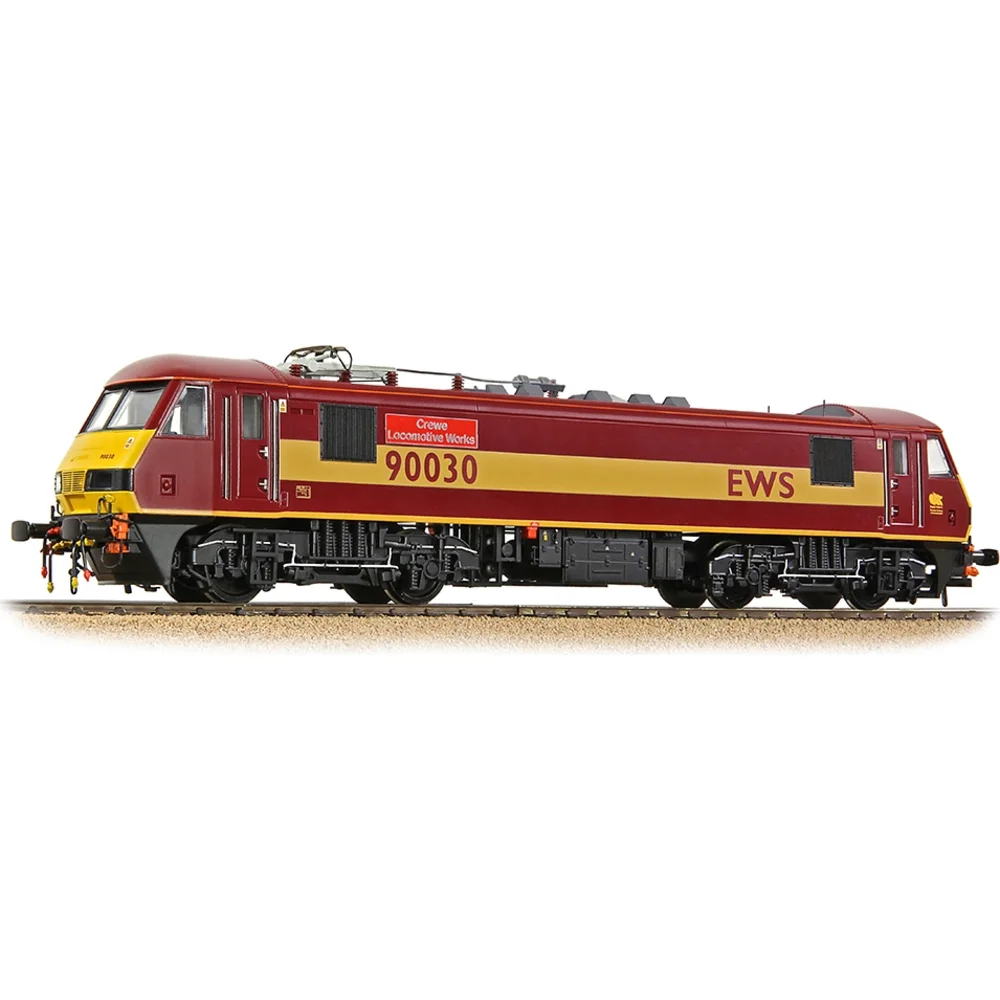
Bachmann 32-619

British Rail Class 90 90030 Crewe Locomotive Works English, Welsh & Scottish Railway Maroon & Gold

Tooling

Announced in 2019, Bachmann’s all-new tooling for the British Rail Class 90 in OO gauge marked a significant upgrade over previous models. The Class 90 is a 25kV AC electric locomotive introduced in 1988 for West Coast Main Line services, later operating across the East Coast and Great Eastern routes. Bachmann’s release aimed to deliver a premium, highly detailed representation of this iconic Bo-Bo locomotive for modern layouts.

Tooling Features

  • Construction: Plastic bodyshell with separately fitted details and a heavy diecast chassis for weight and stability.
  • Detailing: Etched grilles, lamp irons, sprung buffers, Brecknell Willis high-speed pantograph, full-depth cab interior with painted details, and pre-fitted nameplates on many models.
  • Couplings: NEM pockets with tension-lock couplers; cosmetic buckeye and screw-link options included in detailing packs.

Mechanical & Electrical Specification

  • Motor & Drive: Five-pole, twin-shaft motor with dual flywheels driving all axles via both bogies; separate metal bearings for smooth running.
  • Weighting: Integrated diecast chassis for enhanced adhesion and haulage.
  • Lighting: Directional headlights and tail lights, day/night mode, and cab lighting (DCC only). Lighting functions are switchable on both DC and DCC.
  • Pantograph: Metal Brecknell Willis type, servo-operated for remote raising/lowering on DCC.

DCC Capability

  • DCC Ready with 21-pin socket.
  • Sound-fitted versions available using ESU LokSound V5 decoders.
  • Special Bachmann decoder (36-569) recommended for pantograph operation to avoid servo damage.

Reviews & Commentary

The Bachmann Class 90 has been widely praised for its accuracy, fine detailing, and smooth performance. Reviewers highlight the near-silent running, excellent slow-speed control, and impressive haulage capability. The servo-operated pantograph and lighting functions add realism, though users note the importance of using the correct decoder for pantograph operation. Social media and forums generally regard this tooling as a benchmark for modern British electric models, often preferred over older Hornby offerings.

Interesting Features

  • Factory-fitted etched nameplates on many models.
  • Day/Night lighting modes accessible via roof switches on DC layouts.
  • Highly detailed bogies and underframe with separately applied pipework.

This tooling represents Bachmann’s commitment to high-fidelity modelling, combining robust engineering with exceptional detail for collectors and operators alike.

Class & Prototype

  • Running Number: 90030
  • Name: Crewe Locomotive Works

Operator & Livery

The English, Welsh & Scottish Railway (EWS) operated Britain's largest rail freight network from 1996-2007, controlling 90% of the UK freight market. Formed by Wisconsin Central through acquisition of five British Rail freight companies, EWS revolutionised British freight transport with 250 new General Motors Class 66 locomotives and distinctive maroon and gold livery featuring the famous "three beasties" logo. The company was acquired by Deutsche Bahn in 2007, eventually becoming today's DB Cargo UK while maintaining its freight market dominance.

The EWS maroon and gold livery was introduced in April 1996, with the first locomotive to receive the scheme being Class 37 number 37057, which emerged from Toton Depot on 25 April 1996 to coincide with the launch of the English, Welsh & Scottish brand. The colour specification featured maroon bodysides, roofs and ends with black underframes and buffer beams, standard UK yellow warning panels, and a distinctive gold stripe running centrally between the cab ends.

To ensure accurate colour consistency, a sample plate was flown from Wisconsin Central's American operations to Britain, where British paints were mixed to match this standard. Interestingly, when Class 66 and 67 locomotives were later built by General Motors, another sample plate was sent to the manufacturer, resulting in a slightly lighter shade than the original British mix.

The livery evolved through several variations. Early applications from April 1996 featured "EW&S" lettering (including the ampersand) in Arial typeface within the gold band. From January 1997, this was simplified to "EWS" with improved Gill Sans typeface - continuing a tradition established by the LNER in the 1920s and used by British Railways until the 1960s.

The gold band width varied by locomotive class - most received 600mm bands, but Classes 37, 58, and 73 looked better with 550mm bands due to their distinctive body shapes. Company lettering and locomotive numbers appeared in maroon within the gold stripe with 20mm clearance from the band edges, positioned at opposite ends on each side of the locomotive.

For model railway enthusiasts, specialist paint manufacturers like Phoenix Paints produce authentic colour matches, with their E.W.&S. Red (P193) and E.W.&S. Gold (P194) paints matched to original Wisconsin Central colour panels. Alternative options include RailMatch EWS Maroon (1255) which many modellers prefer for value and colour accuracy.

The EWS maroon and gold scheme became one of the most recognisable railway liveries in modern British history, remaining in use until Deutsche Bahn's acquisition in 2007 and the subsequent adoption of DB Schenker corporate red livery from 2009.