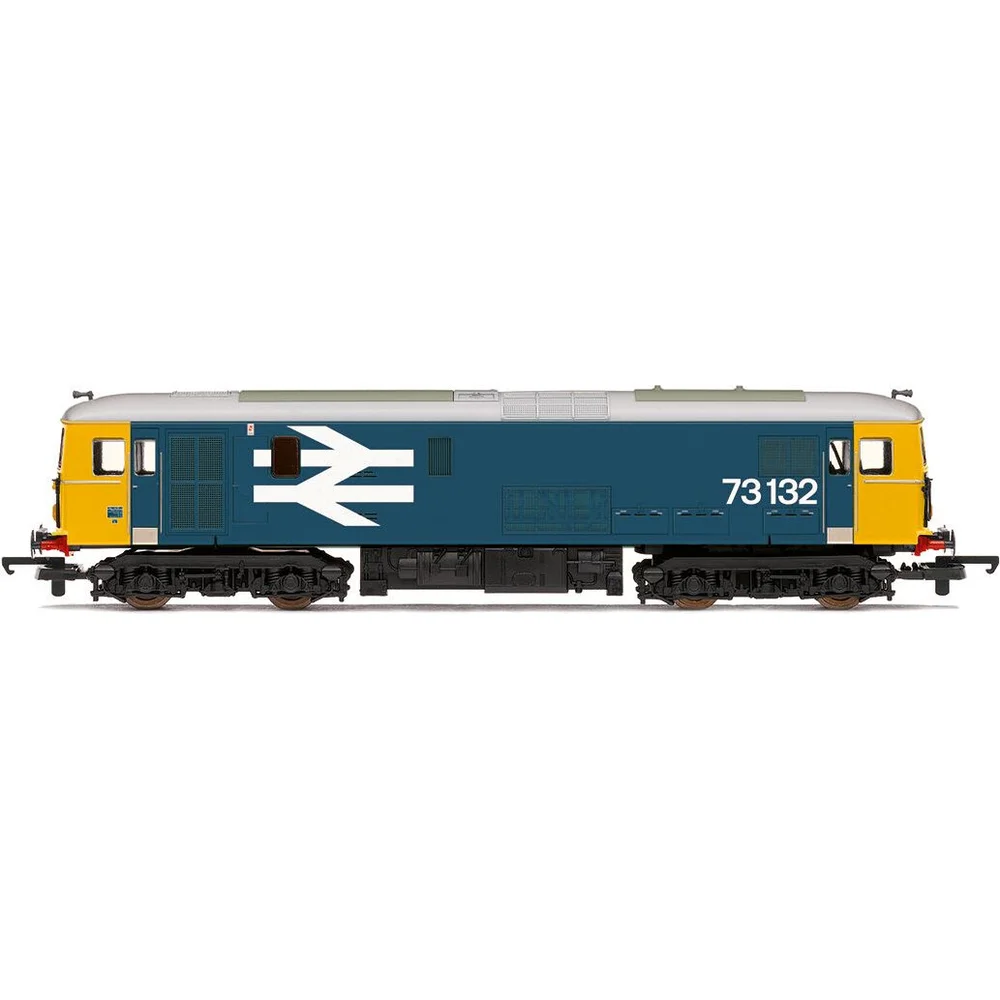
Hornby R30431

British Rail Class 73 73132 British Rail Blue

Tooling

Hornby significantly upgraded its British Rail Class 73 electro-diesel locomotive tooling in 2007, replacing earlier Lima-based models with a modern specification aimed at meeting contemporary expectations for accuracy and performance. This release marked a step forward in Hornby’s diesel range, offering improved detailing, enhanced mechanical design, and full DCC readiness. The Class 73 prototype remained popular for its dual-power capability, operating on Southern Region third-rail electrification and diesel power, making it a versatile choice for layouts spanning multiple eras.

The 2007 upgrade was widely praised for its accurate body profile, crisp moulding, and improved running qualities compared to earlier Lima-based models. Reviewers highlighted the smooth performance of the 5-pole motor and the ease of DCC conversion. Criticism was minimal, though some enthusiasts noted the absence of factory lighting and suggested that finer handrails could enhance realism. The model remains popular for its versatility and upgrade potential, with many examples fitted with sound and weathering by hobbyists.

Hornby’s Class 73 continues to feature prominently in YouTube reviews, Facebook groups, and model railway forums. Topics include sound installations, weathering projects, and comparisons with other manufacturers. The Pullman and Network SouthEast versions are particularly sought after by collectors, while RailRoad Plus sound-fitted editions have attracted attention for their value and modern control options.

Detailing: Factory-fitted separate details including horns, jumper cables, cab interiors, footplate detail, window wipers, and flush glazing. Underframe detail includes battery boxes, air tanks, fuel tanks, and third-rail pick-up shoes. Chemically blackened wheels enhance realism.

The tooling represents multiple sub-classes (73/0, 73/1, and 73/2) through variations in detail and livery.

Class & Prototype

  • Running Number: 73132

The British Rail Class 73 electro-diesel represents one of Britain's most versatile and longest-serving locomotive classes, designed in the early 1960s to solve the Southern Region's third-rail gap problem in goods yards. With dual 1,600hp electric and 600hp diesel modes (1,600hp diesel in Class 73/9 rebuilds), these Bo-Bo locomotives served prestigious duties from Gatwick Express to Venice Simplon Orient Express, and now operate Caledonian Sleeper services in Scotland. Of 49 built (6 Class 73/0, 43 Class 73/1), 39 survive with approximately 22 still operational, making them among British Rail's most enduring designs spanning over 60 years of continuous service.

Operator & Livery

  • Operator: British Rail
  • Livery: Blue
  • Era: 8 - British Rail Sectorisation

British Rail (1965-1997) transformed Britain's railways through revolutionary modernisation, introducing the iconic double arrow logo, Rail Blue livery, and business sectorisation. BR pioneered high-speed rail with the InterCity 125 and Advanced Passenger Train, electrified major routes, and created profitable divisions like InterCity and Network SouthEast. From steam succession through diesel and electric development to privatisation preparation, British Rail's diverse locomotive fleet, multiple livery schemes, and operational scenarios provide unparalleled variety for railway modellers across all scales and periods.

BR Blue, also known as Rail Blue or Monastral Blue, was introduced in 1965 as part of British Rail's comprehensive corporate identity overhaul that accompanied the rebranding from British Railways to British Rail. The colour was officially defined by British Standards BR28/6001 (airless spray finish) and BR28/5321 (brush finish), representing a dark, greyish blue tone specifically chosen to hide dirt and weathering effects well.

The livery was prototyped on the experimental XP64 train in 1964 before becoming the standard scheme from 1 January 1965. Rail Blue was applied to all diesel and electric locomotives with yellow warning panels (initially small, then extending to full yellow ends from 1966). The standardised application included the iconic double arrow logo and Rail Alphabet typeface, creating one of the most successful transport corporate identities of the 20th century.

The livery dominated British Rail operations for over two decades until sectorisation in the 1980s began fragmenting the unified appearance. Despite initial colour fading problems in early applications, these were resolved by the late 1970s when the Large Logo variant was introduced featuring extended yellow areas and full-height double arrow symbols. Rail Blue's enduring appeal among railway enthusiasts reflects its role as the definitive British Rail image during the organisation's most unified period.