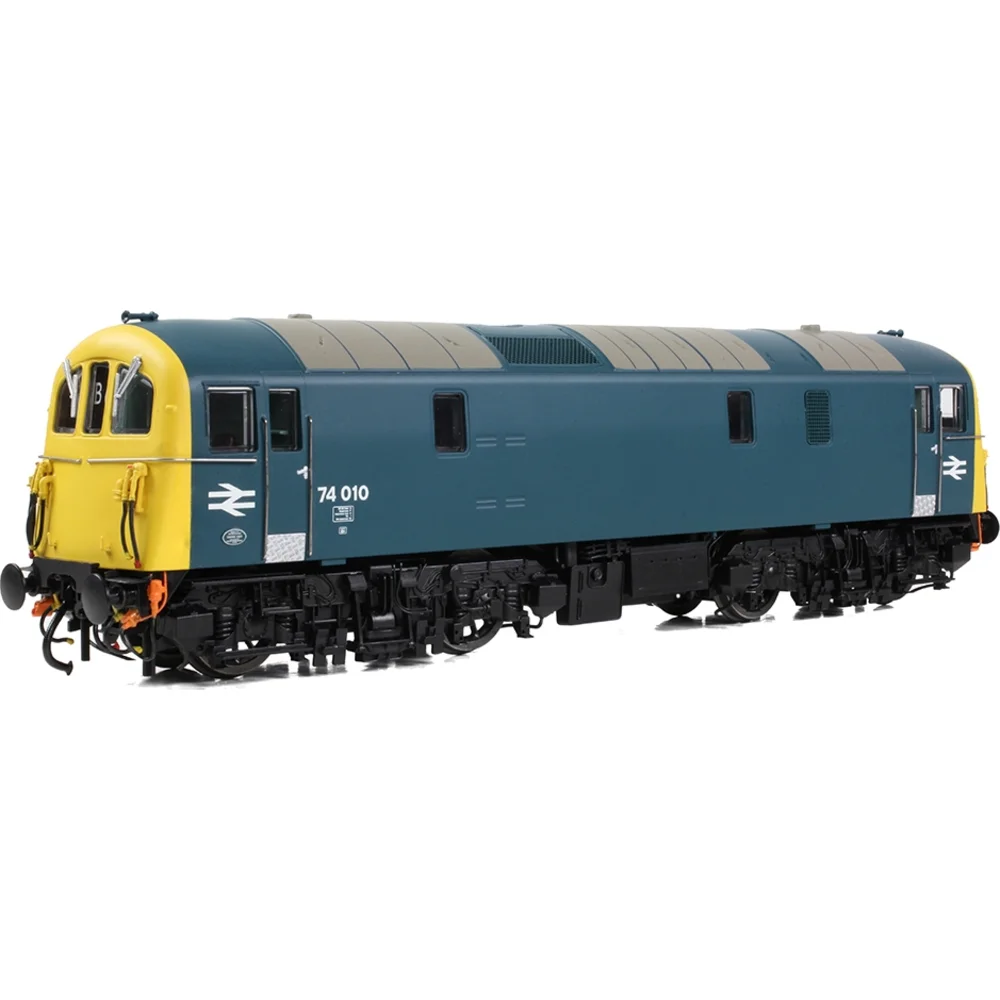
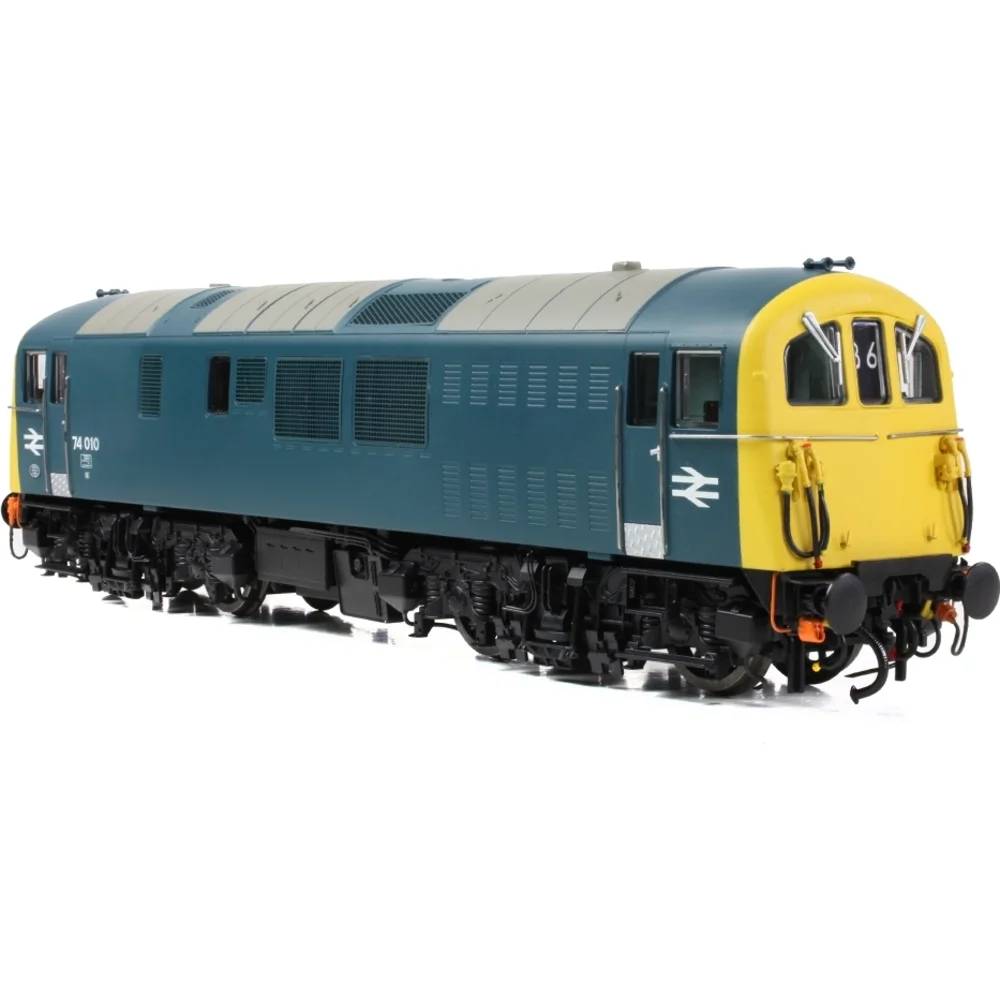
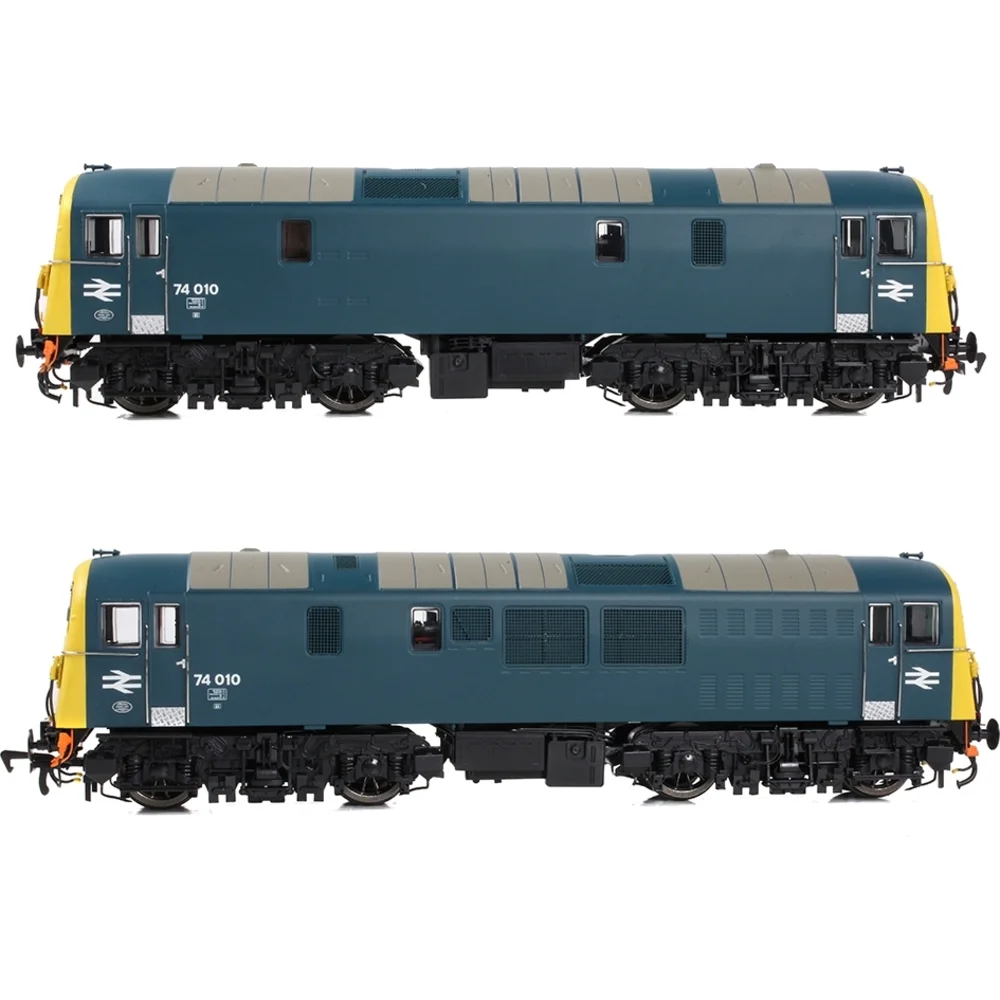
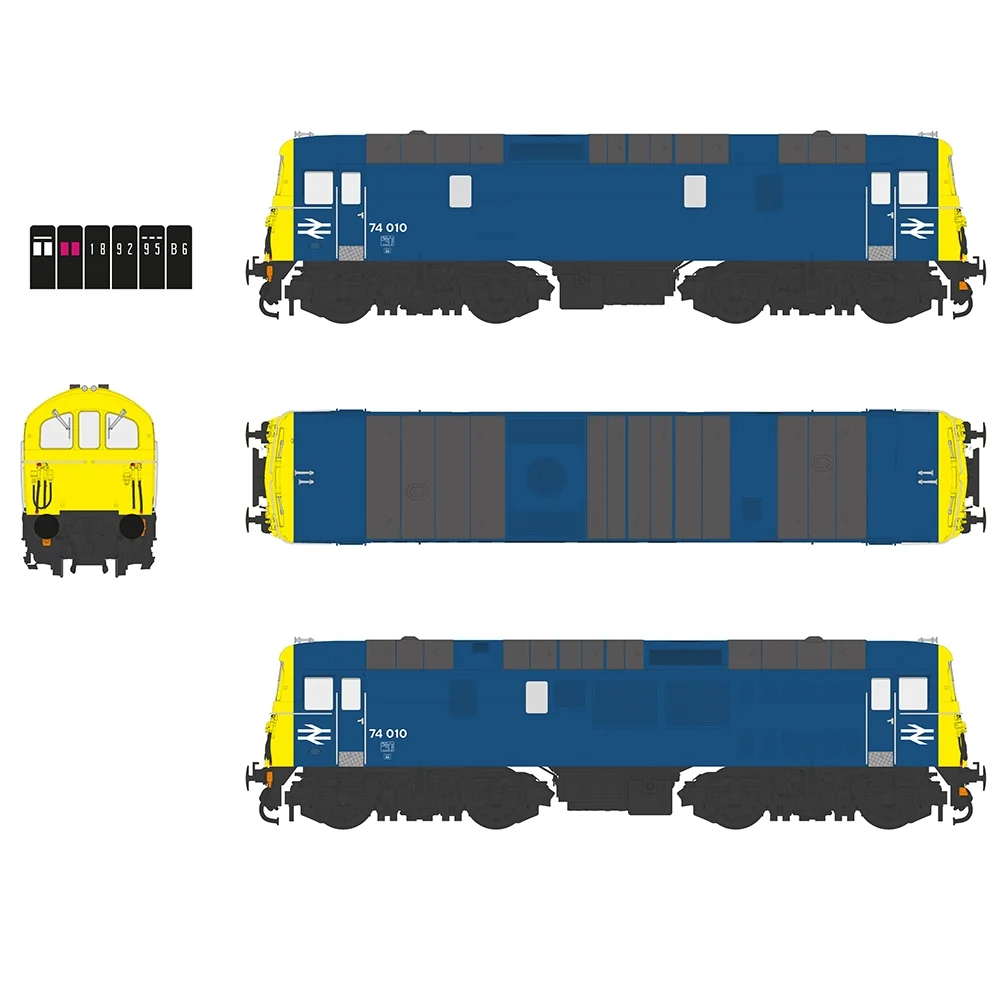
EFE Rail E82009
British Rail Class 74 74010 British Rail Blue
Tooling
The EFE Rail British Rail Class 74 in OO gauge marks a landmark in model railway tooling. Announced by Bachmann Europe under its EFE Rail brand in early 2025, it's the first high-fidelity mainstream ready-to-run model of this unique electro-diesel locomotive. The original Class 74 fleet—rebuilt from Class 71 electrics—served the Southern Region from the late 1960s through the 1970s, working prestigious services including boat trains on partially unelectrified routes.
Initial reviews praised the high fidelity of the tooling, especially in cab fit, glazing, and detailing. Minor tweaks during production refined bufferbeam, handrails, and glazing alignment. Performance received high marks for reliable, smooth running on tight curves and mixed consists, with good traction and stable electrical pickup. The DCC-ready and sound-ready design was welcomed by modellers looking for future upgrade potential. The weathered version drew positive attention from photographers and layout modellers for its realistic finish straight from the box.
Video reviews on platforms like YouTube underscored the model’s authentic sound and running characteristics, referencing archive recordings of the prototype. On forums such as RMweb and RailAdvent, the tooling has been praised as long-awaited and excellently executed—particularly noting the attention to prototype variations across different numbers, such as later cab ventilators. Online retailers including Rails of Sheffield and TMC Direct reported robust demand and rapid sales following first deliveries in late 2025.
Subtle prototype-specific differences are modelled across the range—such as cab ventilators in A-pillars—assuring collectors of accurate representation. An accessory pack includes optional parts like loco-to-bogie retaining brackets and alternative pipework, enabling further customisation. Layout modellers have found the Class 74 tooling ideal for bridging eras on Southern Region layouts, adding variety and operational interest in mixed traction consists.
Overall, the EFE Rail Class 74 in OO gauge sets a new benchmark for tooling quality in British outline electro-diesel models, blending authentic detail, performance versatility, and future-ready DCC & sound capabilities.
Shell & Detailing: Injection-moulded body with etched metal grilles, separate metal handrails, lamp irons, window wipers, cab-end jumper cables, and bufferbeam pipework. Spring buffers and NEM coupling pockets included.
EFE Rail's Description & Specifications
The Class 74 Electro-Diesel Locomotive is the next new tooling model to be developed for the EFE Range and a subject that has never before been produced as a mainstream ready to run model in OO Scale.
This class of ten locomotives was creating by rebuilding redundant Class 71 Electrics and whilst they operated for little more than a decade at most, their work was varied and spanned the early years of the popular BR Blue era making this new model a must for any Southern Region modeller depicting the period from the end of steam to the late-1970s.
The new EFE Rail model boasts a high level of detail and technical features. Powered by a high-quality coreless motor, drive is provided to both bogies and every axle, and electrical collection comes from every wheel. DCC provision comes by way of a 21 Pin decoder socket whilst there is space for a speaker to be fitted. Cab lighting is available to both analogue and DCC users, along with illuminated blinds at each end, for which a selection of interchangeable route blinds is provided. The lighting features can be switched on/off via DCC, whilst analogue users can use the chassis-mounted switches to turn the cab lights on/off, and a second switch allows the illuminated blinds to be turned off at the trailing end. The models sport NEM coupling pockets and sprung buffers along with etched metal grilles, separate metal handrails and a full complement of cab end cables and bufferbeam pipework.
- EFE Rail OO Scale
- Era 7
- Pristine BR Blue livery
- Running No. 74010
- Equipped with a 21 Pin DCC Decoder Socket – recommended Decoder item No. 36-557A
- Length 205mm (over couplings)
EFE RAIL CLASS 74 ‘ELECTRO-DIESEL’ SPECIFICATION
MECHANISM:
- Coreless, twin shaft motor providing drive to both bogies
- All axle drive
- Electrical pickup from all wheels
- Separate metal bearings fitted to each axle
- Diecast metal chassis block
- Gearing arranged for prototypical running speeds and haulage capabilities
- 5mm (OO gauge) wheels to NEM310 & NEM311 standards with authentic profile and spoke detailing
- Close coupling mechanism fitted at either end, each of which is fitted with coupling pockets to NEM362 standards
- Designed to operate on curves of second radius (438mm) or greater
DETAILING:
- High fidelity injection-moulded bodyshell
- Bogies constructed from multiple components featuring full relief detail
- Separately applied detail parts, including lamp irons, metal handrails, etched grilles, cab-end jumper cables, windscreen wipers and whistles
- Sprung buffers
- Cab interior detailing including seats, control desk, controls and dials with authentic decoration
- Slide in destination blinds with a selection of routes, white and red blinds provided for user-fitment
- Each model supplied with a full set of decorated, model-specific bufferbeam pipework and accessory parts including bufferbeam skirt infill pieces to be used when the tension lock couplings are removed
LIGHTING:
- Illuminated headcode blinds, with the rear blinds turned on/off via a chassis-mounted switch on Analogue control. On DCC, headcode blinds can be switched on/off independently at either end via dedicated functions
- Cab lighting, switchable on/off via a chassis-mounted switch on Analogue control, or via dedicated functions on DCC
- Authentic light colours and temperatures selected for each model based on era and application
DCC:
- 21 Pin DCC decoder interface
SOUND:
- Space provided on the chassis for a speaker which can be connected to the main circuit board via the solder pads provided
LIVERY APPLICATION:
- Authentic liveries applied to all models
- Multiple paint applications employed on each model using BR specification colours
- Logos, numerals and text added as appropriate using multi-stage tampo printing using authentic typefaces, logos and colours
Class & Prototype
- Class: British Rail Class 74
- Traction: Electro-diesel
- Built: 1967-1968
- Total Built: 10
- Running Number: 74010
The British Rail Class 74 was a class of ten electro-diesel locomotives rebuilt from Class 71 electric locomotives at BR Crewe Works between 1967 and 1968. Designed to eliminate locomotive changes on Southern Region boat trains between electrified and non-electrified routes, they featured impressive 2,552 hp electric power but limited 650 bhp diesel capability. Despite advanced solid-state electronics, chronic unreliability plagued the class throughout its brief operational career. All ten locomotives were allocated to Eastleigh depot and worked boat trains to Southampton Docks, Weymouth services, and night parcels trains. The entire fleet was withdrawn between 1976 and 1977 after just ten years' service, with all locomotives scrapped by 1981. No examples survived into preservation. EFE Rail released the first mainstream ready-to-run OO gauge model in December 2025.
Operator & Livery
- Operator: British Rail
- Livery: Blue
- Era: 7 - British Rail Blue TOPS
British Rail (1965-1997) transformed Britain's railways through revolutionary modernisation, introducing the iconic double arrow logo, Rail Blue livery, and business sectorisation. BR pioneered high-speed rail with the InterCity 125 and Advanced Passenger Train, electrified major routes, and created profitable divisions like InterCity and Network SouthEast. From steam succession through diesel and electric development to privatisation preparation, British Rail's diverse locomotive fleet, multiple livery schemes, and operational scenarios provide unparalleled variety for railway modellers across all scales and periods.
BR Blue, also known as Rail Blue or Monastral Blue, was introduced in 1965 as part of British Rail's comprehensive corporate identity overhaul that accompanied the rebranding from British Railways to British Rail. The colour was officially defined by British Standards BR28/6001 (airless spray finish) and BR28/5321 (brush finish), representing a dark, greyish blue tone specifically chosen to hide dirt and weathering effects well.
The livery was prototyped on the experimental XP64 train in 1964 before becoming the standard scheme from 1 January 1965. Rail Blue was applied to all diesel and electric locomotives with yellow warning panels (initially small, then extending to full yellow ends from 1966). The standardised application included the iconic double arrow logo and Rail Alphabet typeface, creating one of the most successful transport corporate identities of the 20th century.
The livery dominated British Rail operations for over two decades until sectorisation in the 1980s began fragmenting the unified appearance. Despite initial colour fading problems in early applications, these were resolved by the late 1970s when the Large Logo variant was introduced featuring extended yellow areas and full-height double arrow symbols. Rail Blue's enduring appeal among railway enthusiasts reflects its role as the definitive British Rail image during the organisation's most unified period.