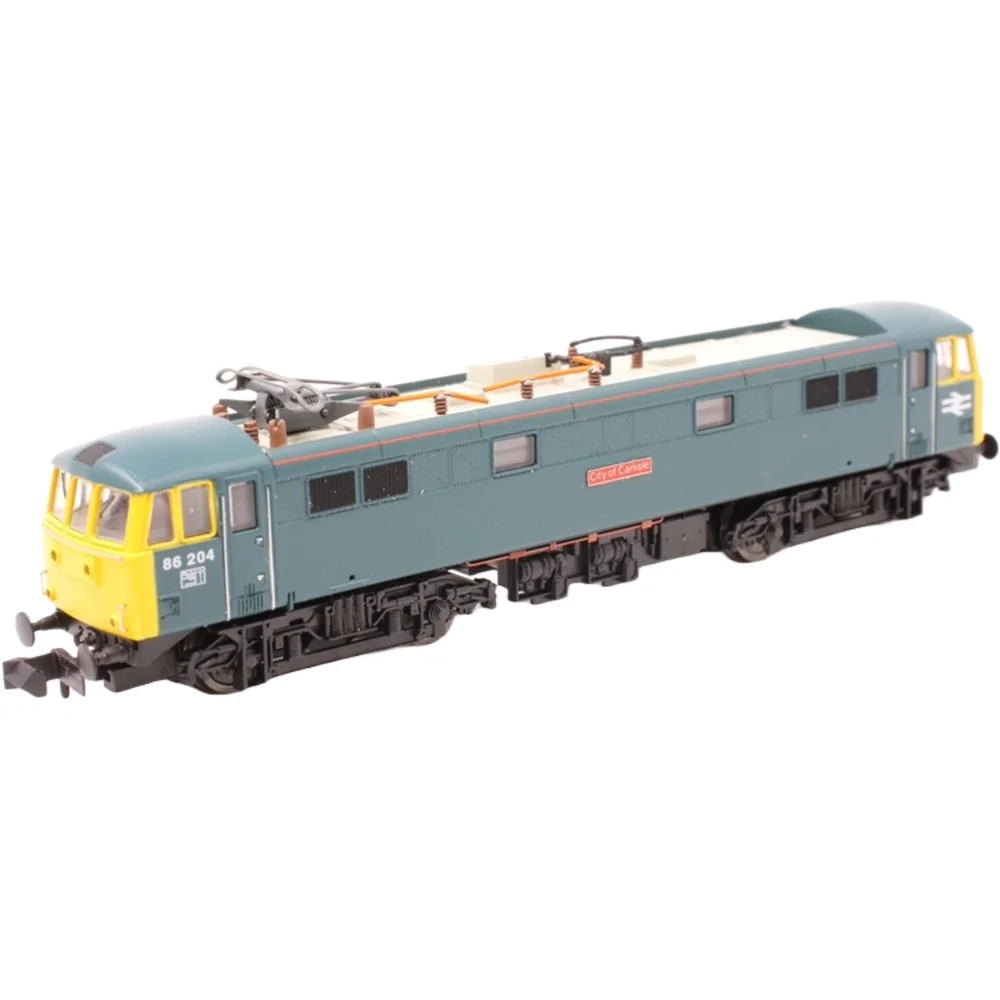
Dapol CMM002

British Rail Class 86 86204 British Rail Blue

Tooling

Dapol introduced its first N gauge model of the British Rail Class 86 electric locomotive in 2010. The Class 86, built between 1965 and 1966, was a key part of British Rail’s AC electric fleet for the West Coast Main Line. Dapol’s tooling aimed to capture the distinctive features of these Bo-Bo locomotives while providing reliable performance and digital readiness for modern layouts.

Tooling Features

  • Body Construction: Finely moulded plastic bodyshell with metal components; chassis combines plastic and metal for strength and weight.
  • Detailing: Factory-fitted separate details including door handles, handrails, jumper cables, etched nameplates (user-fit), roof electrical gear, bufferbeam detail packs, and fully painted cab interiors with glazing and seating.
  • Pantographs: Brecknell Willis high-speed and Stone Faiveley AMBR types, poseable but unpowered.
  • Couplings: NEM pockets with Rapido-style couplers; cosmetic screw-link options included in accessory packs.

Mechanical & Electrical

  • Motor: 5-pole “Super Creep” motor with twin flywheels for smooth, slow-speed control.
  • Drive: All-wheel drive and all-wheel electrical pickup for reliable performance.
  • Lighting: Directional head and tail lights (white/red).
  • Weighting: Internal chassis weighting for improved adhesion.
  • Pantograph: Working cosmetic feature (poseable, not powered).

DCC Capability

  • DCC Ready with a 6-pin socket.
  • No factory provision for sound speaker.

Reviews & Commentary

Enthusiast feedback at the time praised the fine detailing, smooth running qualities, and accurate liveries. The poseable pantograph and etched nameplates were considered strong points. Criticism focused on the delicate nature of some roof fittings and the lack of sound capability. Overall, the model was regarded as a significant step forward for modern N gauge electric locomotives.

Media & Social Media

Retailer showcases and early YouTube reviews highlighted the model’s slow-speed performance and crisp decoration. Forum discussions (RMweb, N Gauge Forum) noted good reliability when properly maintained, though some users reported occasional lighting quirks.

Interesting Notes: The tooling represented multiple sub-classes (86/2, 86/4, and 86/6), allowing Dapol to cover passenger, mixed-traffic, and freight variants. Special commissions included limited-edition BR Blue models for C&M Models.

Class & Prototype

  • Running Number: 86204

The British Rail Class 86 was English Electric's pioneering 25 kV AC electric locomotive for West Coast Main Line electrification, with 100 built 1965-1966. Originally designated AL6, these Bo-Bo locomotives delivered 3,600-4,000 hp and served 56 years hauling express passenger services and freight traffic. Revolutionary flexicoil suspension modifications from 1971 transformed the class from problematic 80 mph freight locomotives into reliable 100 mph express passenger machines. Class 86s worked for BR, InterCity, Virgin Trains, Anglia Railways, and Freightliner until February 2021, with three preserved examples still hauling charter trains. Approximately 32 locomotives were exported to Hungary and Bulgaria where many remain operational.

Operator & Livery

British Rail (1965-1997) transformed Britain's railways through revolutionary modernisation, introducing the iconic double arrow logo, Rail Blue livery, and business sectorisation. BR pioneered high-speed rail with the InterCity 125 and Advanced Passenger Train, electrified major routes, and created profitable divisions like InterCity and Network SouthEast. From steam succession through diesel and electric development to privatisation preparation, British Rail's diverse locomotive fleet, multiple livery schemes, and operational scenarios provide unparalleled variety for railway modellers across all scales and periods.

BR Blue, also known as Rail Blue or Monastral Blue, was introduced in 1965 as part of British Rail's comprehensive corporate identity overhaul that accompanied the rebranding from British Railways to British Rail. The colour was officially defined by British Standards BR28/6001 (airless spray finish) and BR28/5321 (brush finish), representing a dark, greyish blue tone specifically chosen to hide dirt and weathering effects well.

The livery was prototyped on the experimental XP64 train in 1964 before becoming the standard scheme from 1 January 1965. Rail Blue was applied to all diesel and electric locomotives with yellow warning panels (initially small, then extending to full yellow ends from 1966). The standardised application included the iconic double arrow logo and Rail Alphabet typeface, creating one of the most successful transport corporate identities of the 20th century.

The livery dominated British Rail operations for over two decades until sectorisation in the 1980s began fragmenting the unified appearance. Despite initial colour fading problems in early applications, these were resolved by the late 1970s when the Large Logo variant was introduced featuring extended yellow areas and full-height double arrow symbols. Rail Blue's enduring appeal among railway enthusiasts reflects its role as the definitive British Rail image during the organisation's most unified period.