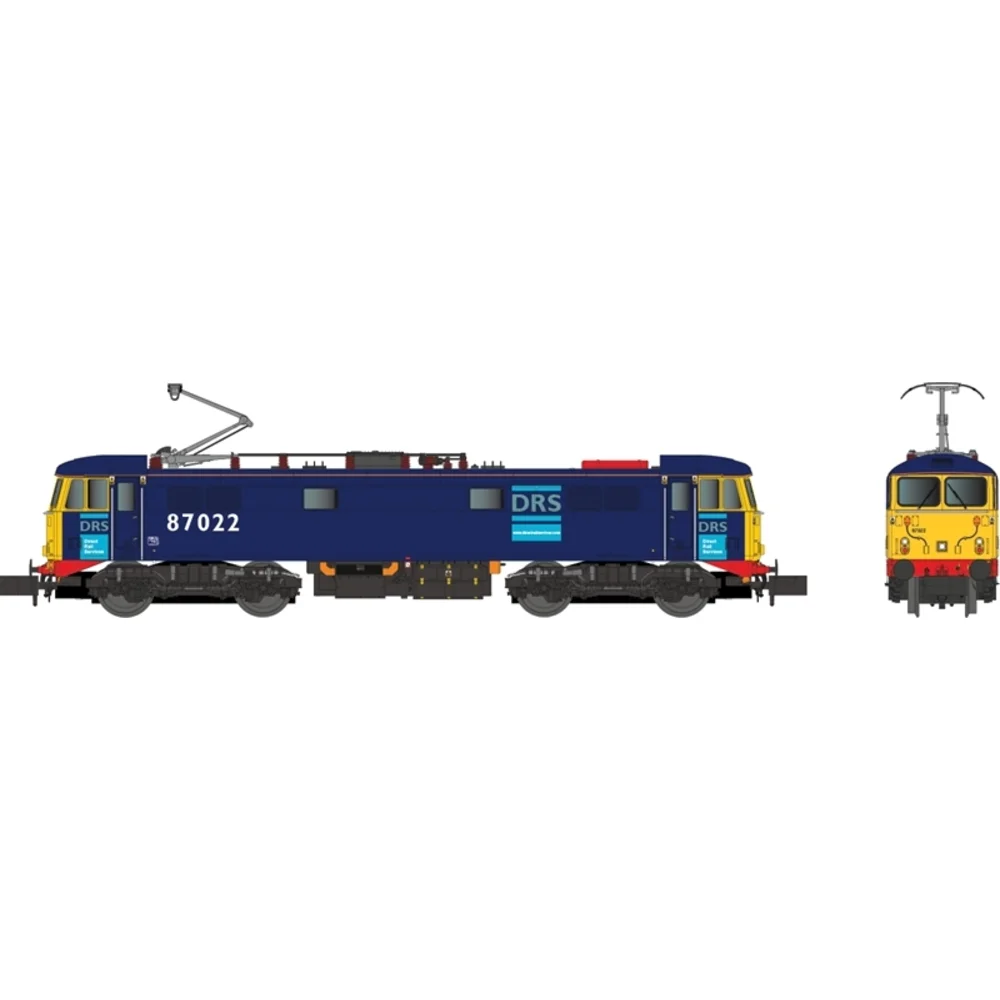
Dapol 2D-087-004

British Rail Class 87 87022 Direct Rail Services Blue

Tooling

The British Rail Class 87 was introduced in 1973 to operate on the newly electrified northern section of the West Coast Main Line to Glasgow. Based on the successful Class 86 design, these AC electric locomotives delivered 5,000 HP and became synonymous with high-speed services such as the “Electric Scots.” They served British Rail and later Virgin Trains until 2005, after which many were exported or preserved. Dapol announced its all-new N gauge tooling for the Class 87 in 2023, with models expected in stores from Q3 2024. This tooling allows accurate representation of the locomotive throughout its service life, including unique variants such as 87101.

Early reaction from enthusiasts has been positive, praising the investment in accurate tooling and the inclusion of multiple cab and roof variants. RMweb and N Gauge Forum discussions highlight excitement for WCML modellers, though some note the reuse of Class 86 mechanicals rather than a “next-generation” chassis. Social media commentary suggests strong interest in Virgin and Caledonian Sleeper liveries, with collectors welcoming the first N gauge representation of 87101.

Detailing: Factory-fitted separate details including etched grilles, handrails, jumper cables, roof-mounted electrical gear, and bufferbeam detail packs. The tooling allows accurate depiction from original 1973 condition through to modern liveries. First time 87101, with its unique thyristor roof equipment, has been offered in N gauge. Dapol collaborated with the 87035 Group at Crewe Heritage Centre for research access.

Class & Prototype

  • Running Number: 87022

The British Rail Class 87 represented BR's most successful express electric locomotive, with 36 built at Crewe Works 1973-1975 for West Coast Main Line services. Delivering 5,000hp continuously through revolutionary body-mounted traction motors with Flexicoil suspension, these Bo-Bo electrics hauled premier Anglo-Scottish expresses at 110mph for three decades. Named to celebrate Anglo-Scottish connections, the class served from Electric Scot inauguration in 1974 until Virgin's final service in December 2006. Twenty-one locomotives exported to Bulgaria continue freight operations, whilst 87002 Royal Sovereign remains UK's only operational example. Available as Hornby OO gauge and Dapol N gauge models in multiple liveries spanning BR Blue through InterCity Swallow to Virgin red.

Operator & Livery

Direct Rail Services (DRS) is Britain's premier nuclear transport and commercial rail freight operator, established in 1995 by British Nuclear Fuels Limited to handle the safe movement of nuclear materials. Now owned by the Nuclear Decommissioning Authority through Nuclear Transport Solutions, DRS has evolved into one of the UK's leading freight companies whilst maintaining its core nuclear transport mission.

Operating from major depots at Carlisle Kingmoor, Crewe Gresty Bridge, and Motherwell, DRS runs a modern fleet including cutting-edge Class 68 diesels and revolutionary Class 88 bi-mode locomotives alongside heritage Class 37s and specialist Class 20/3s. The company's distinctive blue and grey livery has become synonymous with operational excellence and technical innovation.

DRS's commercial success centres on its partnership with Tesco, operating ten dedicated rail routes carrying over 12,000 containers monthly, whilst infrastructure support services include rail head treatment, snow clearance, and rescue locomotive provision. The company's commitment to environmental leadership delivers 76% fewer CO2 emissions compared to road transport, with Class 88 locomotives achieving additional efficiency gains through dual-mode electric/diesel operation.

Key Facts:

  • Founded: 1995 (30 years of operation)
  • Owner: Nuclear Decommissioning Authority via Nuclear Transport Solutions
  • Headquarters: Carlisle Kingmoor Depot
  • Fleet: Class 20/3, 37, 66/4, 68, 88 locomotives
  • Specialty: Nuclear transport, intermodal freight, infrastructure support
  • Major Contract: Tesco (12,000+ containers/month across 10 routes)
  • Environmental Impact: 76% CO2 reduction vs road transport