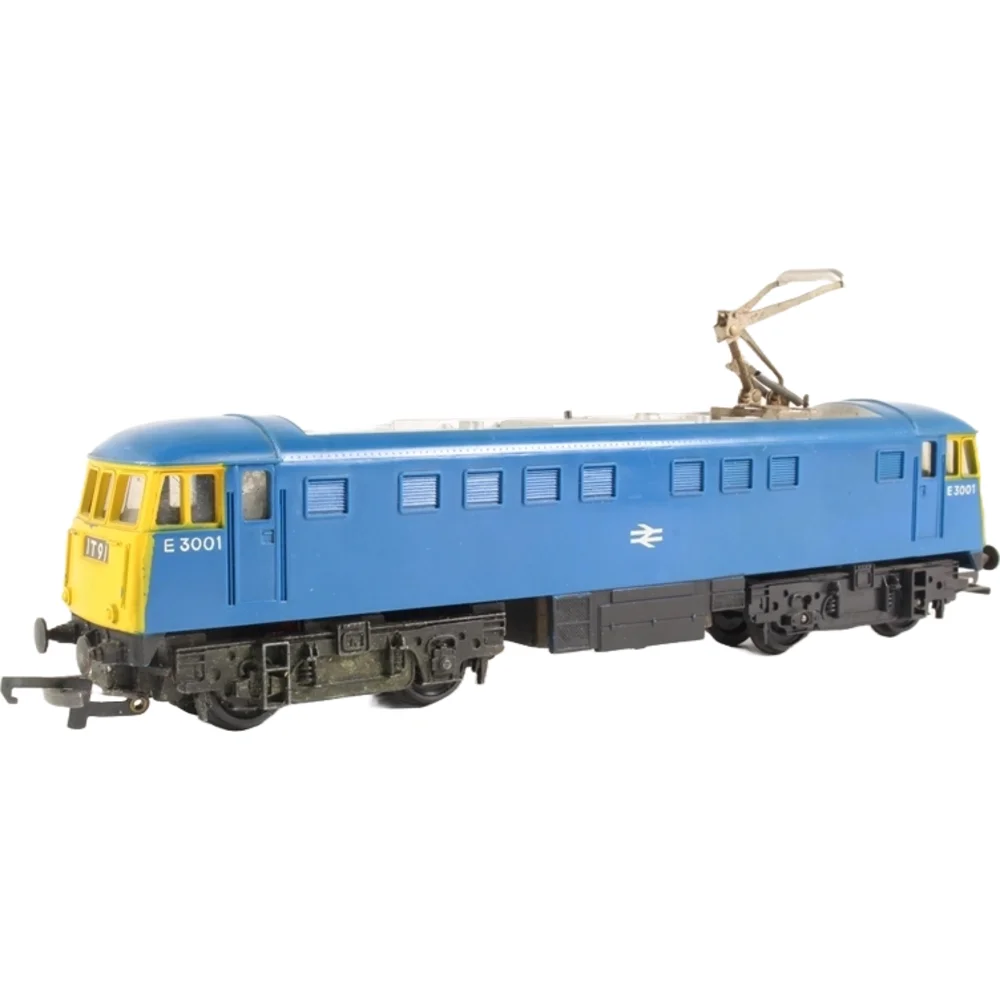
Tri-ang R753
British Railways AL1 E3001 British Rail Electric Blue
Tooling
The Tri-ang British Rail Class 81 model was introduced in 1966 following the Lines Brothers’ acquisition of Hornby Dublo. This release represented Tri-ang’s entry into AC electric locomotive models, reflecting the modernization of British Railways and the electrification of the West Coast Main Line. The prototype Class 81 (originally AL1) was the first AC electric type delivered to British Railways between 1959 and 1964.
At launch, the model was considered advanced for its time, offering a detailed bodyshell and working pantograph. However, by modern standards, it is regarded as basic, with limited underframe accuracy and a single powered bogie. Enthusiasts often note its robustness and nostalgic appeal, though performance and fidelity lag behind contemporary models. Collectors value early examples, particularly boxed versions, for their historical significance.
Discussion on forums such as RMweb highlights the model’s potential for upgrades, including re-motoring and detailing. Videos and posts often showcase restoration projects and conversions for modern layouts. Despite its age, the Class 81 remains a popular subject among vintage model railway communities.
The tooling reused Tri-ang’s standard motor bogie design, originally developed for other models, adapted to fit the Class 81 body.
Detailing: Factory-fitted details including Stone Faiveley AMBR pantograph, cab and footplate detail, interior glazing, and underframe battery box. Wheels were chemically blackened for improved aesthetics. The original tooling is DCC incompatible. There is no socket or space for a decoder or speaker. Conversion requires hard-wiring and insulation of the motor from the chassis.
Class & Prototype
- Class: British Railways AL1
- Traction: Electric
- Built: 1959-1964
- Total Built: 25
- Running Number: E3001
The British Railways Class 81 were Britain's first production mainline AC electric locomotives, with 25 examples built 1959-1964 by Birmingham Railway Carriage & Wagon Company with AEI electrical equipment. Pioneering 25kV AC electrification on the West Coast Main Line, these Bo-Bo locomotives delivered 3,680 hp through mercury-arc rectifiers and frame-mounted motors. Operating primarily from Manchester, Liverpool, and later Glasgow depots, they hauled Anglo-Scottish expresses and freight until withdrawal in 1991. Only 81002 survives in preservation at Barrow Hill.
Operator & Livery
- Operator: British Rail
- Livery: Electric Blue
- Era: 6 - British Rail Blue Pre-TOPS
British Rail (1965-1997) transformed Britain's railways through revolutionary modernisation, introducing the iconic double arrow logo, Rail Blue livery, and business sectorisation. BR pioneered high-speed rail with the InterCity 125 and Advanced Passenger Train, electrified major routes, and created profitable divisions like InterCity and Network SouthEast. From steam succession through diesel and electric development to privatisation preparation, British Rail's diverse locomotive fleet, multiple livery schemes, and operational scenarios provide unparalleled variety for railway modellers across all scales and periods.