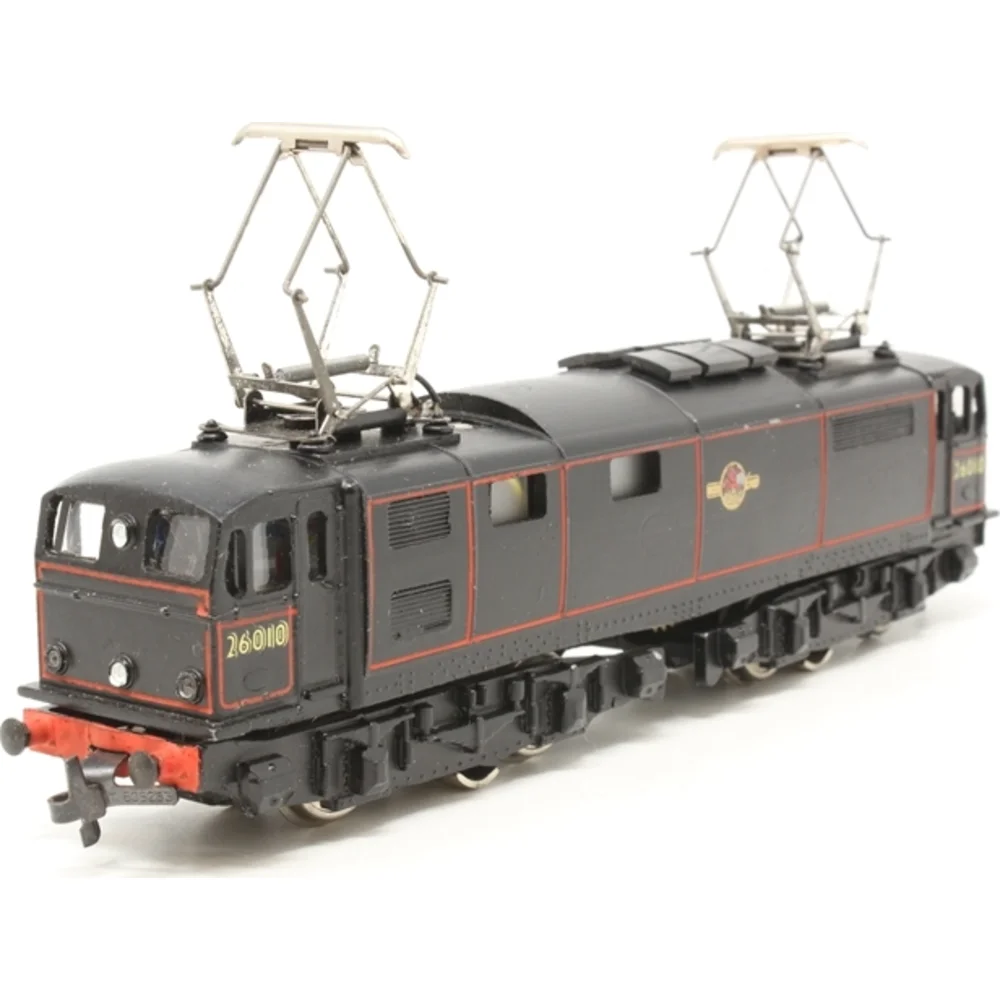
Trix F105

London & North Eastern Railway EM1 26010 British Railways Black with Late Crest

Tooling

The Trix British Rail Class 76, also known as EM1 (Electric Mixed-Traffic 1), was introduced in 1959 as an OO gauge (1:76 scale) model. This release represented one of the earliest ready-to-run British-outline electric locomotives in OO gauge, inspired by the real Class 76 locomotives that operated on the Woodhead Route between Manchester and Sheffield. The prototype locomotives were designed for 1500V DC overhead electrification and were visually distinctive with their twin pantographs and Bo-Bo wheel arrangement.

Collectors and enthusiasts often describe the Trix EM1 as a robust and powerful model for its time, capable of smooth running and overhead operation via its pantograph. However, its electrical system and coupling arrangements were considered unconventional, reflecting Trix’s "Twin Train" heritage. Modern commentary highlights its historical significance and collectability rather than fine-scale accuracy. Issues noted by users include reverse polarity quirks on 2-rail setups and limited detailing compared to contemporary standards.

The Trix EM1 remains a popular subject in vintage model railway forums and social media groups, where it is praised for its engineering ingenuity and nostalgic appeal. Videos and posts often showcase its operation under catenary, a feature rarely seen in British-outline models of the era.

The original 1959 Trix Class 76 tooling is DCC incompatible. There is no provision for a decoder or speaker, reflecting its pre-DCC era design.

Detailing: Includes cross-arm pantograph (functional for catenary operation), cab and footplate detail, interior glazing, and nickel-plated wheels.

Class & Prototype

  • Running Number: 26010

The British Rail Class 76 (LNER Class EM1) comprised 58 electric locomotives built 1941-1953 for the Manchester-Sheffield-Wath route, Britain's first mainline electrification operating at 1500V DC. Featuring distinctive Bo+Bo wheel arrangement with innovative bogie-mounted buffers designed by Gresley, these locomotives hauled intensive Yorkshire coal traffic through challenging Pennine terrain until the controversial Woodhead Route closure in July 1981. The entire 52-locomotive surviving fleet faced simultaneous withdrawal despite serviceability, with only 26020 preserved at the National Railway Museum. Heljan produced limited OO gauge models (2011, now scarce) in BR black, green, and blue liveries featuring DCC-ready operation and comprehensive detailing.

Operator & Livery

  • Operator: British Railways
  • Livery: Black with Late Crest
  • Era: 5 - British Railways Late Crest

British Railways transformed Britain's fragmented rail network into a unified national system following nationalisation on 1st January 1948. Created from the "Big Four" companies under the Transport Act 1947, BR operated most of Great Britain's railways until rebranding as British Rail in 1965, managing over 20,000 route miles and inheriting nearly 20,000 locomotives of diverse designs.

The organisation pioneered standardisation through its revolutionary BR Standard locomotive programme (1951-1960), producing 999 advanced steam engines under Robert Riddles' direction. These included the versatile Britannia Pacifics, mighty 9F freight engines, and mixed-traffic classes that incorporated the best features from all predecessor companies. The 1955 Modernisation Plan accelerated diesel and electric traction development, creating fascinating mixed-traction operations.

Notable achievements included establishing unified locomotive classification systems, introducing distinctive corporate liveries, and managing the complex transition from steam to modern traction. BR's six regional structure preserved operational diversity whilst enabling standardisation of practices, signalling, and rolling stock that had eluded private enterprise for over a century.

The BR era represents steam traction's final flowering alongside emerging diesel technology, creating unparalleled locomotive variety. Today, this heritage remains highly popular with railway enthusiasts through extensive preserved fleets, heritage railway operations, and comprehensive model ranges from manufacturers like Hornby, Bachmann, and Dapol, making BR subjects essential for authentic post-war British railway modelling across all scales.

British Railways' plain black livery remained the standard finish for freight and shunting locomotives from 1956 onwards, representing the most economical and practical scheme for inherently dirty industrial operations. Plain black locomotives retained red buffer beams and received white lettering in Gill Sans style, maintaining the utilitarian approach established in the early BR period. The livery was applied to a vast range of locomotive types, from powerful freight engines like the 9F class down to humble shunting locomotives and industrial engines working in goods yards, collieries, and freight terminals.

From 1956, these locomotives received the new "Lion and Crown" emblem (nicknamed the "Ferret and Dartboard"), a proper heraldic device featuring a rampant lion emerging from a crown and holding a spoked wheel, enclosed in a roundel with "British Railways" displayed on bars either side. Unlike earlier practice, the new emblem was positioned centrally on tender sides or tank sides without reference to axle boxes, following heraldic conventions with the lion facing left. This livery period coincided with increasing neglect as steam operations wound down, with locomotives often covered in layers of grime that obscured the paintwork and made the already austere black finish appear even more weathered. The plain black finish continued until individual locomotives were withdrawn from service, with many examples lasting into the final years of steam operation in 1968. For modellers, this livery represents the twilight of steam freight operations, capturing the workaday reality of British Railways' industrial locomotive fleet during the final phase of steam traction.