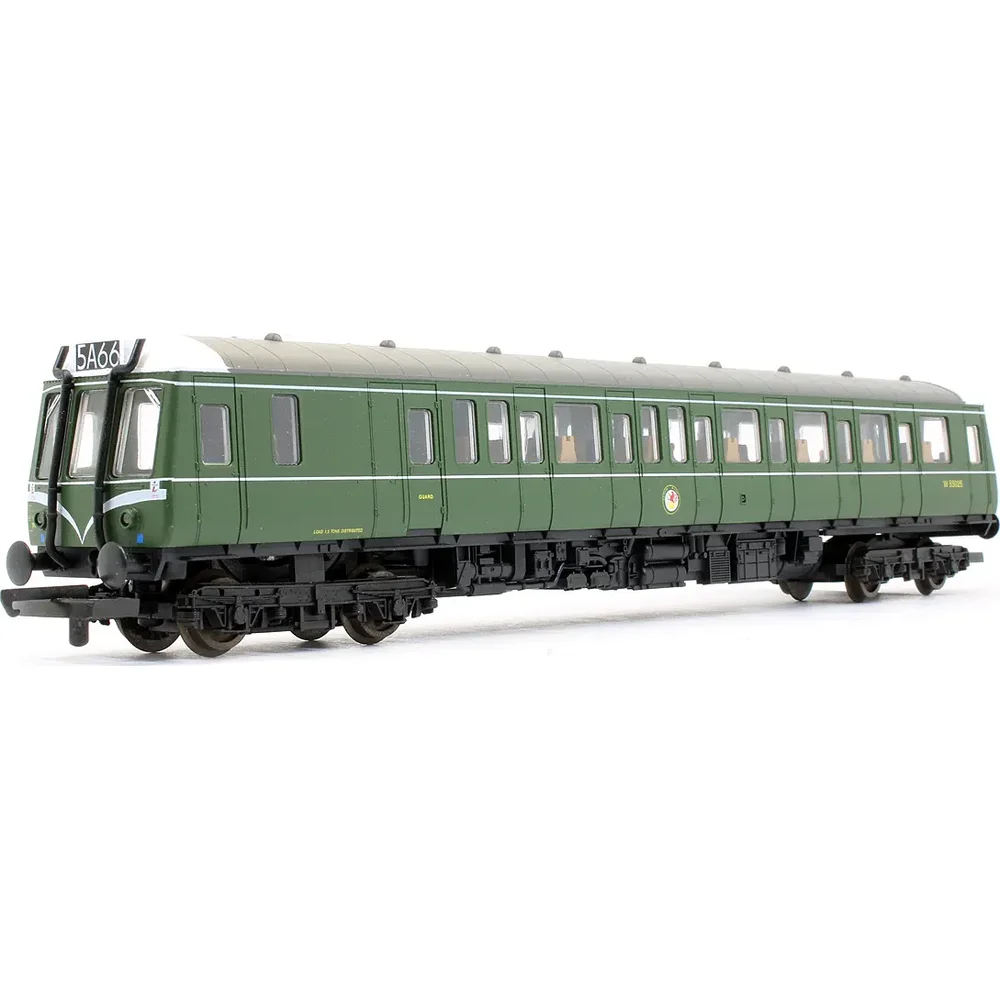
Lima L204630

British Rail Class 121 W55025 British Railways Green

Tooling

The Lima OO gauge tooling for the British Rail Class 121 "Bubble Car" dates back to circa 1998, capturing the vintage charm of these single-car DMUs. The tooling replicates the iconic design introduced between 1959–1961 by the Pressed Steel Company. The Class 121 units were primarily used across branch lines, initially in Western Region depots in Cornwall and the Thames Valley before expanding elsewhere.

Model community feedback highlights the tooling's excellent detailing and vintage accuracy, often praising its cab window clarity and body proportions. Performance reviewers typically note the noisy ringfield/pancake motor as an area for upgrade, albeit acknowledging its charming "retro" character. Aftermarket tutorials demonstrate easy conversion to quieter CD motors and fitting of decoder sockets. Video reviews credit its affordability and detailing, though improved smoothness and lighting are common upgrade paths.

Despite its age, this Lima tooling remains popular for modelling early 1960s branch-line operation, often paired with Hornby coaching stock. Models often fetch modest prices today, with "Clearing the Way" and Speed Whiskers variants trending among collectors.

Detailing: Separate moulded parts for cab handrails, exhausts, buffer-beams, and accurately applied glazing. Includes realistic roof-mounted headcode box, wipers, interior cab and footplate, seating with visible partitions, battery boxes, engine pipework, fuel tank, and bufferbeam pipework.

Class & Prototype

  • Running Number: W55025

The British Rail Class 121 "Bubble Car" single-car DMU operated for 57 years from 1960-2017, making it Britain's longest-serving diesel multiple unit. Built by Pressed Steel Company, just 16 DMBS power cars served Western Region branches including the Greenford shuttle, Henley, Marlow, and Severn Beach line. Distinctive "antler" exhausts curving around illuminated headcode boxes set them apart from similar Class 122 designs. Originally AEC-powered, the fleet was re-engined with Leyland 680 units during 1971-1980. Following privatisation, units worked for Silverlink on the Marston Vale Line before Chiltern Railways' remarkable 2003-2017 renaissance extended their career. Twelve vehicles survive in preservation. Available as models from Bachmann (OO), Dapol (OO/N/O), and Heljan (O gauge) in numerous authentic liveries.

Operator & Livery

British Railways transformed Britain's fragmented rail network into a unified national system following nationalisation on 1st January 1948. Created from the "Big Four" companies under the Transport Act 1947, BR operated most of Great Britain's railways until rebranding as British Rail in 1965, managing over 20,000 route miles and inheriting nearly 20,000 locomotives of diverse designs.

The organisation pioneered standardisation through its revolutionary BR Standard locomotive programme (1951-1960), producing 999 advanced steam engines under Robert Riddles' direction. These included the versatile Britannia Pacifics, mighty 9F freight engines, and mixed-traffic classes that incorporated the best features from all predecessor companies. The 1955 Modernisation Plan accelerated diesel and electric traction development, creating fascinating mixed-traction operations.

Notable achievements included establishing unified locomotive classification systems, introducing distinctive corporate liveries, and managing the complex transition from steam to modern traction. BR's six regional structure preserved operational diversity whilst enabling standardisation of practices, signalling, and rolling stock that had eluded private enterprise for over a century.

The BR era represents steam traction's final flowering alongside emerging diesel technology, creating unparalleled locomotive variety. Today, this heritage remains highly popular with railway enthusiasts through extensive preserved fleets, heritage railway operations, and comprehensive model ranges from manufacturers like Hornby, Bachmann, and Dapol, making BR subjects essential for authentic post-war British railway modelling across all scales.