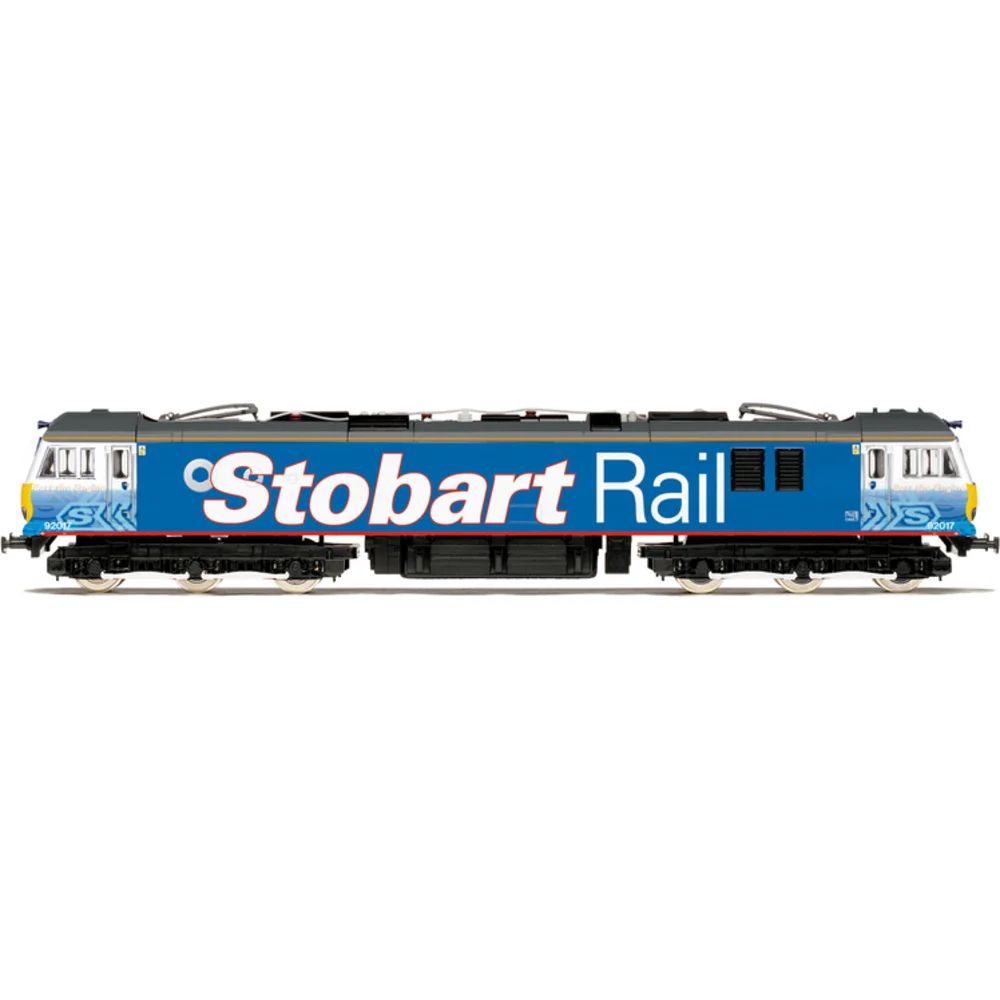
Hornby R3057
British Rail Class 92 92017 Bart the Engine Direct Rail Services Stobart Rail Blue
Tooling
In 2011, Hornby introduced an upgraded version of its British Rail Class 92 model in OO gauge, replacing the original 1995 tooling. This revision aimed to modernize the model for contemporary standards, particularly addressing digital control compatibility and improving overall detailing. The upgrade coincided with growing interest in modern freight and sleeper operations, including the Caledonian Sleeper service, and reflected Hornby’s strategy to refresh long-standing models in its range.
Reviews noted that the 2011 upgrade improved cosmetic detailing and introduced DCC compatibility, but the mechanical design retained limitations from the earlier tooling. The single bogie drive and relatively light weight continued to restrict haulage capacity, leading many enthusiasts to add extra weight for better performance. Directional headlights were welcomed, though the absence of tail lights and sound provision was seen as a drawback. Forum discussions and social media commentary often praised the model’s appearance and livery accuracy but highlighted that its running qualities lagged behind newer premium models.
Despite improvements, the tooling remained fundamentally based on the original chassis concept, limiting performance enhancements. The model continued to be popular for layouts depicting electrified freight and sleeper services until superseded by newer tooling from other manufacturers.
Detailing: Plastic bodyshell with separately fitted details, including Brecknell Willis pantographs (poseable), roof electrical equipment, cab interiors, and flush glazing. Detailed chassis with third-rail pickup shoe representation, footsteps, and chemically blackened wheels.
Class & Prototype
- Class: British Rail Class 92
- Traction: Electric
- Built: 1993-1996
- Total Built: 46
- Running Number: 92017
- Name: Bart the Engine
The British Rail Class 92 is Britain's most powerful electric locomotive, capable of 5,040 kW output on 25kV AC overhead supply. Built by Brush Traction 1993-1996, these 46 dual-voltage Co-Co electrics were designed for Channel Tunnel freight operations, featuring unique capability to operate on both 25kV AC overhead and 750V DC third rail systems. Originally intended for the cancelled Nightstar sleeper services, seven locomotives were later refurbished for Caledonian Sleeper overnight trains between London and Scotland from 2015 onwards. The class wears diverse liveries including Railfreight grey, EWS maroon, DB Schenker red, GBRf blue/orange, Stobart Rail blue, and striking Caledonian Sleeper midnight teal. All 46 locomotives survive—16 active in UK service, 13 operating in Bulgaria/Croatia/Romania, 17 stored awaiting future deployment.
Operator & Livery
- Operator: Direct Rail Services
- Livery: Stobart Rail Blue
- Era: 9 - Privatisation
Direct Rail Services (DRS) is Britain's premier nuclear transport and commercial rail freight operator, established in 1995 by British Nuclear Fuels Limited to handle the safe movement of nuclear materials. Now owned by the Nuclear Decommissioning Authority through Nuclear Transport Solutions, DRS has evolved into one of the UK's leading freight companies whilst maintaining its core nuclear transport mission.
Operating from major depots at Carlisle Kingmoor, Crewe Gresty Bridge, and Motherwell, DRS runs a modern fleet including cutting-edge Class 68 diesels and revolutionary Class 88 bi-mode locomotives alongside heritage Class 37s and specialist Class 20/3s. The company's distinctive blue and grey livery has become synonymous with operational excellence and technical innovation.
DRS's commercial success centres on its partnership with Tesco, operating ten dedicated rail routes carrying over 12,000 containers monthly, whilst infrastructure support services include rail head treatment, snow clearance, and rescue locomotive provision. The company's commitment to environmental leadership delivers 76% fewer CO2 emissions compared to road transport, with Class 88 locomotives achieving additional efficiency gains through dual-mode electric/diesel operation.
Key Facts:
- Founded: 1995 (30 years of operation)
- Owner: Nuclear Decommissioning Authority via Nuclear Transport Solutions
- Headquarters: Carlisle Kingmoor Depot
- Fleet: Class 20/3, 37, 66/4, 68, 88 locomotives
- Specialty: Nuclear transport, intermodal freight, infrastructure support
- Major Contract: Tesco (12,000+ containers/month across 10 routes)
- Environmental Impact: 76% CO2 reduction vs road transport
The DRS Stobart Rail Blue livery represented a distinctive promotional scheme applied to Direct Rail Services Class 66/4 locomotives operating the Tesco Express intermodal service on behalf of Eddie Stobart Group between 2006 and 2010. The most famous example was locomotive 66411 "Eddie the Engine," which wore a striking blue-based livery featuring prominent white "Stobart Rail" branding with the characteristic red chevron design elements, combined with Eddie Stobart's corporate colours and graphics including cartoon-style character imagery. This locomotive, along with 66414 "James the Engine" in a similar but slightly varied promotional scheme, hauled container trains on the high-profile Daventry to Mossend and Grangemouth to Inverness services, marking Stobart's £5.5 million investment in switching 70% of Tesco's cross-border traffic from road to rail.
The Stobart Rail livery represented a significant departure from DRS's standard corporate blue and grey scheme, instead prominently featuring the Eddie Stobart brand identity to highlight the logistics partnership. When the Daventry-Scotland Stobart contract transferred to DB Schenker in January 2010, the locomotives were debranded and 66411 eventually passed to Freightliner before being sent to work in Poland. The promotional livery has become highly collectible among railway modellers, with manufacturers including Bachmann producing detailed OO and N gauge models capturing this distinctive scheme. The livery represents an important period in British rail freight history when major retailers and logistics companies increasingly recognised rail's environmental and efficiency benefits, with the colourful promotional schemes helping to raise public awareness of rail freight's role in modern supply chains.