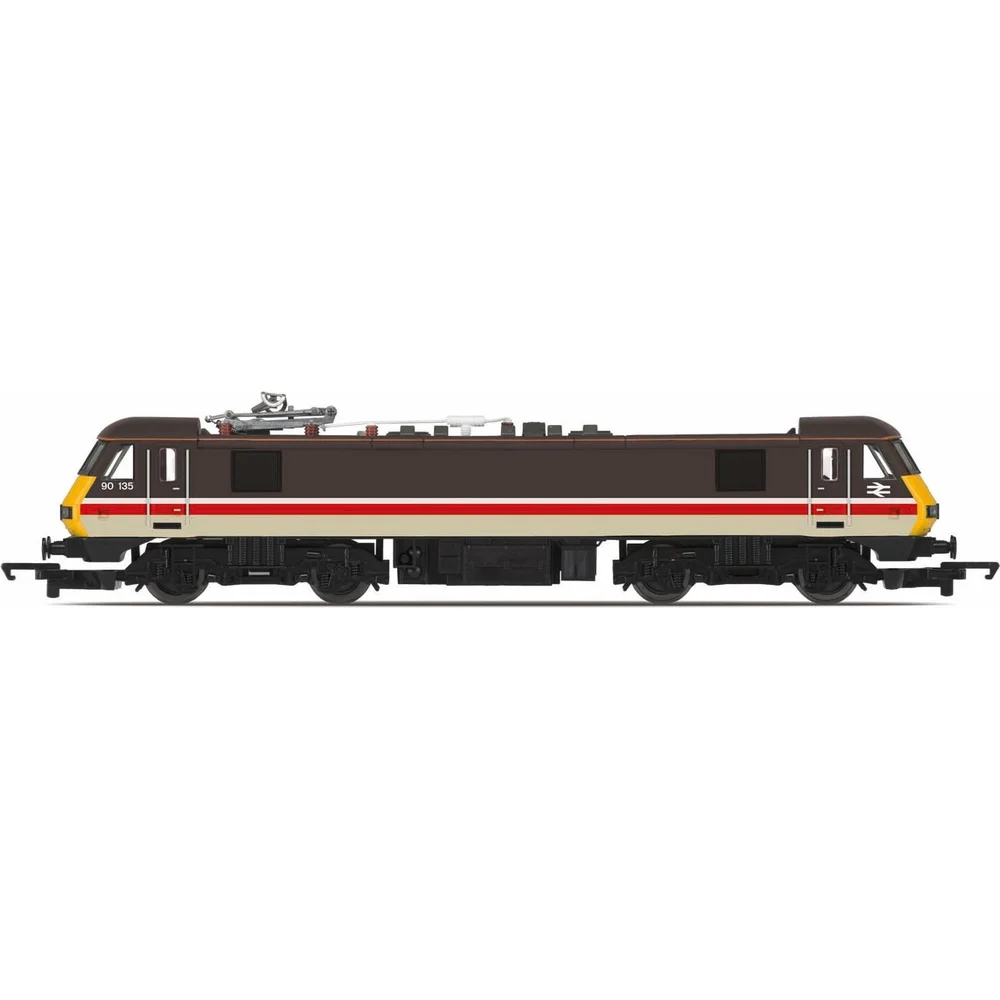
Hornby R3585

British Rail Class 90/1 90135 British Rail InterCity Mainline

Tooling

Hornby launched a major retooling of its Class 90 in 2008, replacing the earlier versions with a significantly improved model aimed at meeting modern expectations for detail and digital capability. This upgrade coincided with growing demand for accurate representations of contemporary electric traction and was positioned as a premium offering in Hornby’s range.

Tooling Features

  • Construction: Plastic bodyshell with metal reinforcement; improved chassis for rigidity and weight distribution.
  • Detailing: Factory-fitted separate details including Brecknell Willis high-speed pantograph (poseable), roof electrical gear, bufferbeam detail, front valance, cab interior, flush glazing, and underframe equipment such as battery boxes and electrical housings.
  • Finish: Chemically blackened wheels for enhanced realism.

Mechanical & Electrical

  • Motor: 5-pole motor mounted in one bogie.
  • Drive: 4-wheel drive via powered bogie; pickups on the power bogie only.
  • Power Collection: 2-rail DC; pantograph is cosmetic and unpowered.
  • Weighting: Integrated within chassis for traction.
  • Lighting: No factory lighting provision.

DCC Capability

The 2008 tooling introduced DCC readiness with an 8-pin socket, simplifying digital conversion. No provision for sound installation was included.

Reviews & Commentary

Contemporary reviews praised the improved body detailing, flush glazing, and accurate roof equipment. The addition of NEM coupler pockets and DCC readiness was welcomed, though some criticism remained regarding the single-bogie drive and lack of lighting or sound provision. Enthusiasts often describe it as “a solid mid-range model” that looks excellent but offers only modest mechanical sophistication compared to later high-spec competitors. Social media and forums highlight its reliability and ease of digital conversion, making it a popular choice for modern layouts.

Interesting Notes

  • The pantograph remained poseable but was no longer functional for power collection.
  • This tooling marked Hornby’s transition toward modern standards, introducing NEM pockets and DCC sockets across its electric range.
  • Service Sheet 359 covered maintenance and parts for this version, including the motor bogie assembly.

Class & Prototype

  • Running Number: 90135

The British Rail Class 90 electric locomotive, built 1987-1990 at BREL Crewe, delivered 5,000 hp from 25kV AC overhead supply through sophisticated thyristor control. Fifty locomotives served BR InterCity, Virgin Trains, Greater Anglia, and freight operators across 37 years. Pioneer of Time-Division Multiplexing push-pull operations, the class worked West Coast and East Coast main lines at 110 mph with Mark 3 coaching stock. Over 35 liveries span InterCity Swallow through privatisation operators to contemporary Freightliner freight. Bachmann's 2019 OO gauge tooling features world-first servo-operated pantograph; Graham Farish offers excellent N gauge versions. Approximately 30 remain operational.

Operator & Livery

British Rail InterCity was the premium express passenger brand that operated from 1966 to 1997, transforming long-distance rail travel across Britain. Initially launched as a marketing brand for high-speed services, InterCity became an autonomous business sector in 1982 under the sectorisation programme, operating profitable express services from London to Scotland, Wales, the West Country, and extensive cross-country routes.

The brand pioneered revolutionary rolling stock including the iconic InterCity 125 HST (High Speed Train) from 1976, which achieved 125mph operations on existing infrastructure, and the electric InterCity 225 sets from 1989, capable of 140mph but limited to 125mph in service. InterCity also developed the ground-breaking Advanced Passenger Train (APT) with tilting technology that influenced modern high-speed trains worldwide.

Distinguished by its evolving livery schemes - from Rail Blue and Grey through the sophisticated Executive livery with dark grey upper bodies and red stripes - InterCity became synonymous with quality, speed, and reliability. All day services featured buffet cars and the majority operated at 100mph or above, making British Rail one of the world's most intensive high-speed operators.

The brand was divided among multiple operators during railway privatisation in the 1990s, but its technical innovations, operational excellence, and commercial principles continue influencing modern rail services. InterCity remains hugely popular with railway modellers, with extensive ranges of locomotives and coaching stock available in all major scales from manufacturers like Hornby, Bachmann, and Heljan.

BR Mainline livery was introduced in 1989 as part of a comprehensive rebranding programme that modified the InterCity image whilst creating a neutral livery for locomotives working across multiple sectors. This livery was applied to locomotives that might operate for both InterCity and freight sectors, deliberately avoiding the InterCity brand being associated with freight operations.

The Mainline livery scheme consisted of dark grey upper body panels with beige (sometimes described as fawn or biscuit) lower sections, separated by the distinctive red and white horizontal stripe below the windows that had characterised InterCity Executive livery. Crucially, Mainline livery featured the traditional BR double arrow logos rather than InterCity branding, making it suitable for locomotives that might work freight or parcels traffic.

On locomotives, the scheme typically included a white lower body section rather than the beige used on coaching stock. Power cars and locomotives featured half-yellow front ends with black-outlined cab windows, maintaining safety visibility standards whilst providing a smart, professional appearance.

The livery was applied extensively to Class 86, 87, and 90 electric locomotives, numerous Class 47 diesels, some Class 37s, and other traction types that operated across sector boundaries. Many locomotives carried this livery only briefly before receiving full InterCity Swallow branding or being transferred to freight sectors with appropriate liveries.

For modellers, Mainline livery offers an authentic intermediate stage between InterCity Executive and Swallow schemes, representing the late 1980s transition period when British Rail was refining its sectoral branding. The livery's neutral character makes it suitable for mixed traffic operations on model railways, whilst its smart appearance maintains the quality associated with InterCity operations.