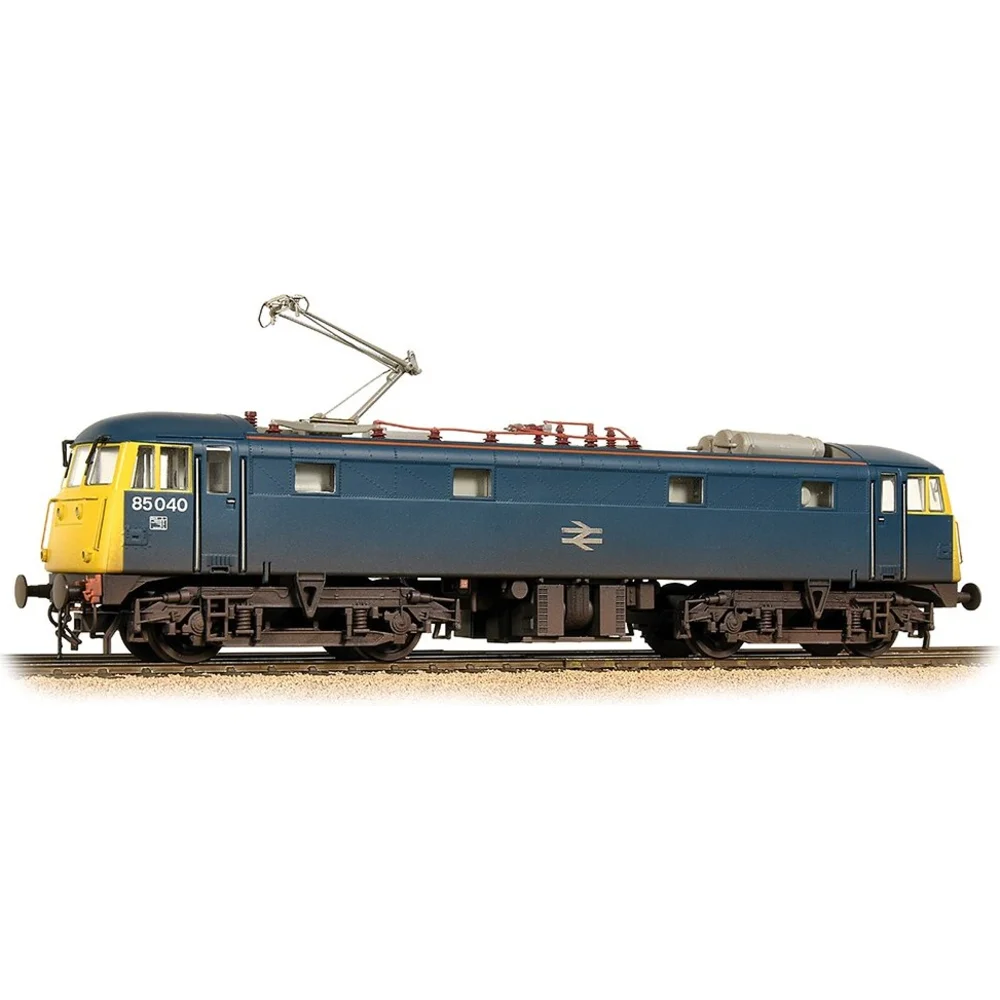
Bachmann 31-678A

British Rail Class 85 85040 British Rail Blue

Tooling

Announced in 2012, Bachmann’s British Rail Class 85 marked the company’s first UK-outline AC electric locomotive in OO gauge. The prototype Class 85, originally designated AL5, was built between 1961 and 1964 for the electrification of the West Coast Main Line. Bachmann’s decision to produce this model filled a long-standing gap in the market for accurate AC electrics, following mixed reception of earlier models from other manufacturers.

The model was widely praised for its accurate body shape, fine detailing, and exceptional roof equipment, particularly the pantograph which was considered superior to previous offerings. Running performance was reported as smooth and reliable. Minor criticisms focused on pantograph adjustment and calls for finer-scale grilles in future reissues. Enthusiasts on RMweb and YouTube highlighted its appeal as an essential addition for West Coast Main Line layouts, with many fitting sound decoders for enhanced realism.

Detailing: Factory-fitted separate details including handrails, buffer-beam detail, roof-mounted electrical equipment, Stone Faiveley AMBR pantograph, window wipers, and fully detailed cab interior. Sprung metal buffers. Etched cab emblems. Accessory packs provided additional detailing parts for buffer-beams and pipework and cosmetic screw-link couplings.

Class & Prototype

  • Running Number: 85040
  • Ordered By: British Railways
  • Built By: British Railways
  • Built At: Doncaster
  • Built: 12/1964
  • Withdrawn: 10/1991
  • Length of Service: 26.8 years
  • Running Numbers: BR E3095, BR 85040
  • Names: -

The British Rail Class 85 electric locomotive was built at Doncaster Works between 1961-1964 as part of the West Coast Main Line's innovative five-prototype AC electrification programme. Originally designated AL5, these 40 Bo-Bo locomotives produced 3,200 hp and earned the nickname "Britain's most boring class" through exceptional reliability—semiconductor rectifiers avoided the dramatic failures plaguing contemporary types. Serving express passenger, parcels, and freight duties across the WCML for thirty years, the class was progressively displaced by Classes 87 and 90 before final withdrawal in December 1991. Only 85006 survives in preservation at Barrow Hill Roundhouse. Bachmann's discontinued 2012 OO gauge range remains the sole model representation, with typical pricing £155-165 for remaining new stock.

Operator & Livery

  • Operator: British Rail
  • Livery: Blue
  • Era: 7 - British Rail Blue TOPS

British Rail (1965-1997) transformed Britain's railways through revolutionary modernisation, introducing the iconic double arrow logo, Rail Blue livery, and business sectorisation. BR pioneered high-speed rail with the InterCity 125 and Advanced Passenger Train, electrified major routes, and created profitable divisions like InterCity and Network SouthEast. From steam succession through diesel and electric development to privatisation preparation, British Rail's diverse locomotive fleet, multiple livery schemes, and operational scenarios provide unparalleled variety for railway modellers across all scales and periods.

BR Blue, also known as Rail Blue or Monastral Blue, was introduced in 1965 as part of British Rail's comprehensive corporate identity overhaul that accompanied the rebranding from British Railways to British Rail. The colour was officially defined by British Standards BR28/6001 (airless spray finish) and BR28/5321 (brush finish), representing a dark, greyish blue tone specifically chosen to hide dirt and weathering effects well.

The livery was prototyped on the experimental XP64 train in 1964 before becoming the standard scheme from 1 January 1965. Rail Blue was applied to all diesel and electric locomotives with yellow warning panels (initially small, then extending to full yellow ends from 1966). The standardised application included the iconic double arrow logo and Rail Alphabet typeface, creating one of the most successful transport corporate identities of the 20th century.

The livery dominated British Rail operations for over two decades until sectorisation in the 1980s began fragmenting the unified appearance. Despite initial colour fading problems in early applications, these were resolved by the late 1970s when the Large Logo variant was introduced featuring extended yellow areas and full-height double arrow symbols. Rail Blue's enduring appeal among railway enthusiasts reflects its role as the definitive British Rail image during the organisation's most unified period.