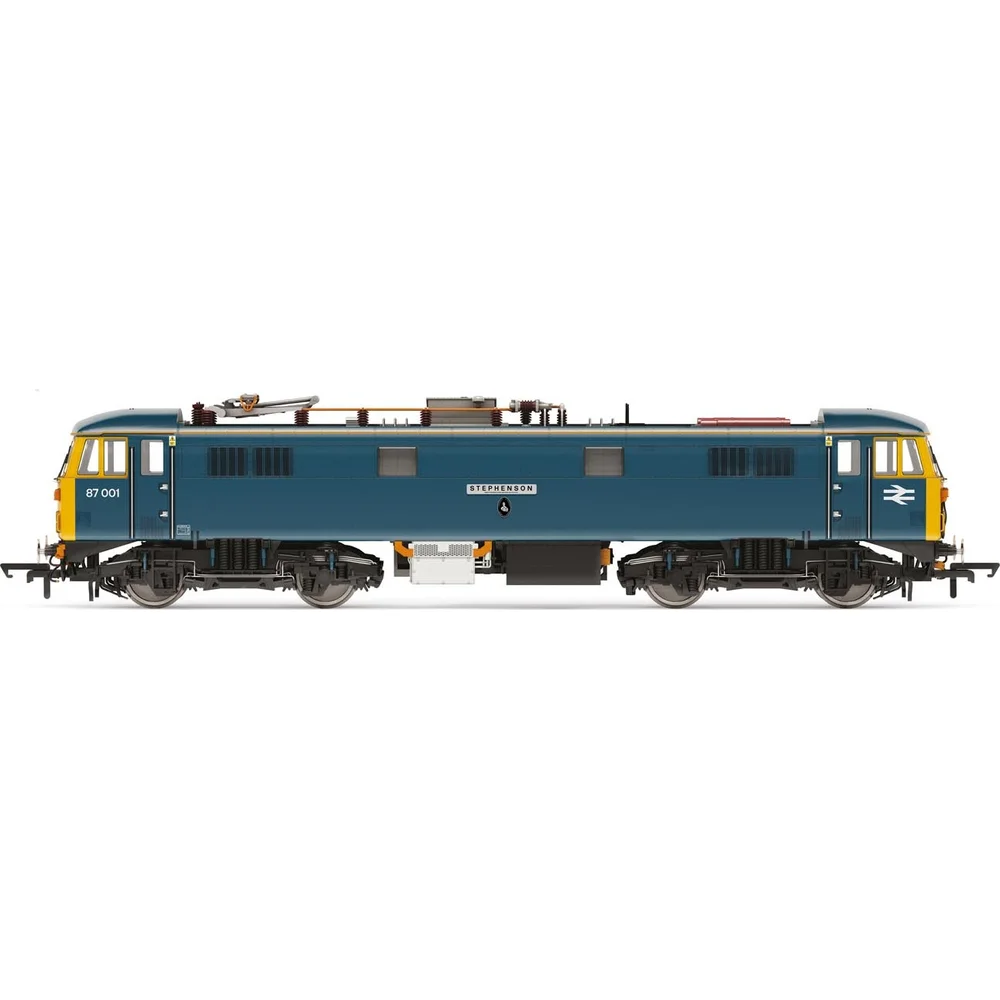
Hornby R3739

British Rail Class 87 87001 Royal Scot/Stephenson British Rail Blue

Tooling

Hornby launched an all-new OO gauge model of the British Rail Class 87 in 2018, replacing the earlier Lima-derived tooling. This retooling was a complete redesign, aimed at delivering modern standards of accuracy, performance, and digital capability. The Class 87 was a flagship AC electric locomotive on the West Coast Main Line, and Hornby’s new model catered to growing interest in overhead electric traction among UK modellers.

Tooling Features

  • Construction: High-detail plastic bodyshell with diecast chassis for strength and weight.
  • Detailing: Factory-fitted separate parts including handrails, lamp irons, jumper cables, roof electrical gear, radio antenna, sprung buffers, and detailed bufferbeam pipework (with additional detailing pack). Cab interiors feature seats, footplates, and instrument detail. Glazing is flush and chemically blackened wheels enhance realism.
  • Pantograph: Brecknell Willis high-speed type, poseable but unpowered.

Mechanical & Electrical

  • Motor: Centrally mounted 5-pole motor with twin flywheels for smooth operation.
  • Drive: All-wheel drive and all-wheel pickup for reliable performance.
  • Weighting: Diecast chassis provides good adhesion.
  • Lighting: Directional headlights and tail lights, plus cab lighting.

DCC Capability

The 2018 model is DCC Ready with an 8-pin socket and provision for a 15x11mm speaker for sound installation. Later variants (from 2022 onwards) moved to a 21-pin socket. Sound upgrades are popular, with space for sugarcube speakers in the chassis.

Reviews & Commentary

Hornby’s 2018 Class 87 received strong praise for its accuracy and running qualities. Reviewers highlighted the diecast chassis, smooth twin-flywheel drive, and comprehensive detailing as major improvements over previous versions. Directional lighting and cab lights added realism, while the model’s weight ensured reliable haulage. Criticism was minimal, though some noted that the pantograph remained cosmetic and the 8-pin socket was less future-proof than 21-pin alternatives.

Media & Community Feedback

Hornby Magazine and online reviewers showcased the model’s performance and detail, with videos demonstrating smooth running and lighting features. RMweb discussions praised the ease of DCC and sound fitting, while enthusiasts shared custom detailing and weathering projects. The model is regarded as a benchmark for British AC electric locomotives in OO gauge.

Interesting Notes

  • This tooling was entirely new and did not reuse any Lima components.
  • Hornby later enhanced the specification with 21-pin DCC sockets and additional liveries in subsequent releases.

Class & Prototype

  • Running Number: 87001
  • Name: Royal Scot/Stephenson

The British Rail Class 87 represented BR's most successful express electric locomotive, with 36 built at Crewe Works 1973-1975 for West Coast Main Line services. Delivering 5,000hp continuously through revolutionary body-mounted traction motors with Flexicoil suspension, these Bo-Bo electrics hauled premier Anglo-Scottish expresses at 110mph for three decades. Named to celebrate Anglo-Scottish connections, the class served from Electric Scot inauguration in 1974 until Virgin's final service in December 2006. Twenty-one locomotives exported to Bulgaria continue freight operations, whilst 87002 Royal Sovereign remains UK's only operational example. Available as Hornby OO gauge and Dapol N gauge models in multiple liveries spanning BR Blue through InterCity Swallow to Virgin red.

Operator & Livery

British Rail (1965-1997) transformed Britain's railways through revolutionary modernisation, introducing the iconic double arrow logo, Rail Blue livery, and business sectorisation. BR pioneered high-speed rail with the InterCity 125 and Advanced Passenger Train, electrified major routes, and created profitable divisions like InterCity and Network SouthEast. From steam succession through diesel and electric development to privatisation preparation, British Rail's diverse locomotive fleet, multiple livery schemes, and operational scenarios provide unparalleled variety for railway modellers across all scales and periods.

BR Blue, also known as Rail Blue or Monastral Blue, was introduced in 1965 as part of British Rail's comprehensive corporate identity overhaul that accompanied the rebranding from British Railways to British Rail. The colour was officially defined by British Standards BR28/6001 (airless spray finish) and BR28/5321 (brush finish), representing a dark, greyish blue tone specifically chosen to hide dirt and weathering effects well.

The livery was prototyped on the experimental XP64 train in 1964 before becoming the standard scheme from 1 January 1965. Rail Blue was applied to all diesel and electric locomotives with yellow warning panels (initially small, then extending to full yellow ends from 1966). The standardised application included the iconic double arrow logo and Rail Alphabet typeface, creating one of the most successful transport corporate identities of the 20th century.

The livery dominated British Rail operations for over two decades until sectorisation in the 1980s began fragmenting the unified appearance. Despite initial colour fading problems in early applications, these were resolved by the late 1970s when the Large Logo variant was introduced featuring extended yellow areas and full-height double arrow symbols. Rail Blue's enduring appeal among railway enthusiasts reflects its role as the definitive British Rail image during the organisation's most unified period.