Accurascale ACC2190-92001
British Rail Class 92 92001 Victor Hugo English, Welsh & Scottish Railway Maroon & Gold
Source: Accurascale
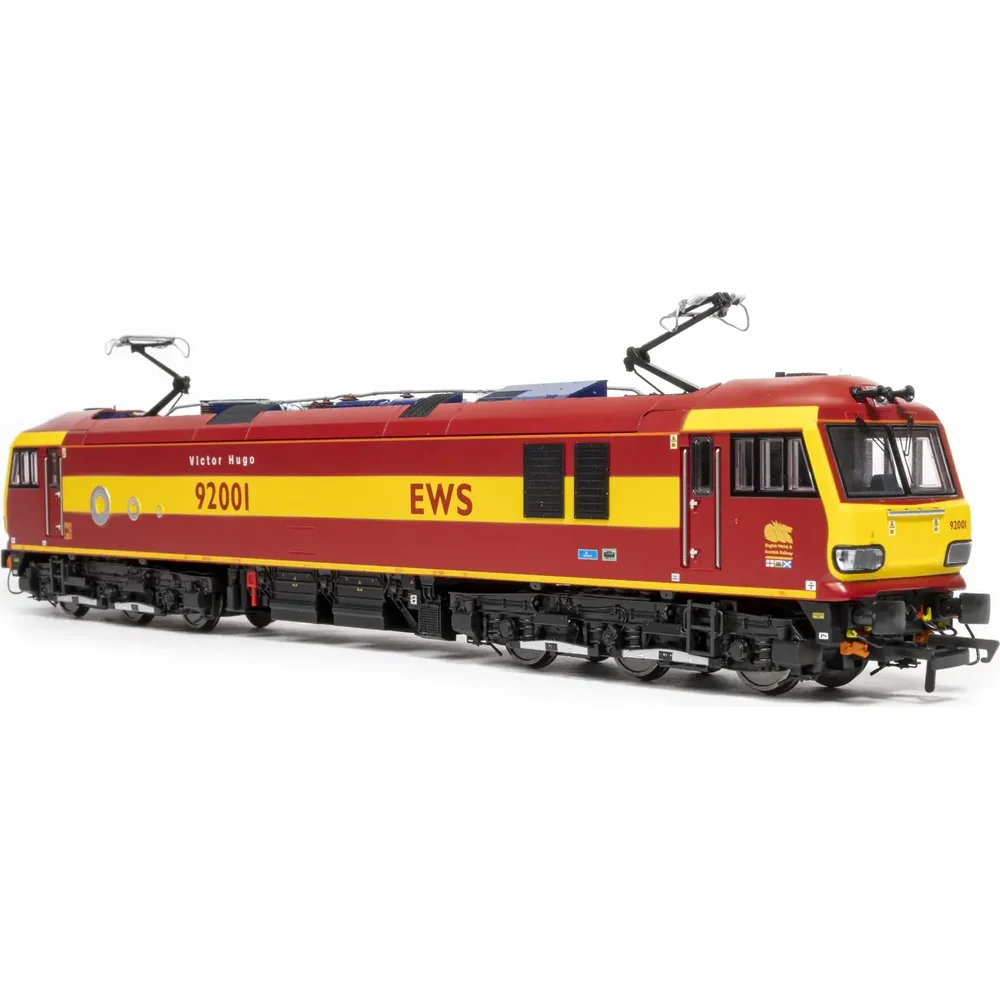
Right front three quarter view
Source: Accurascale
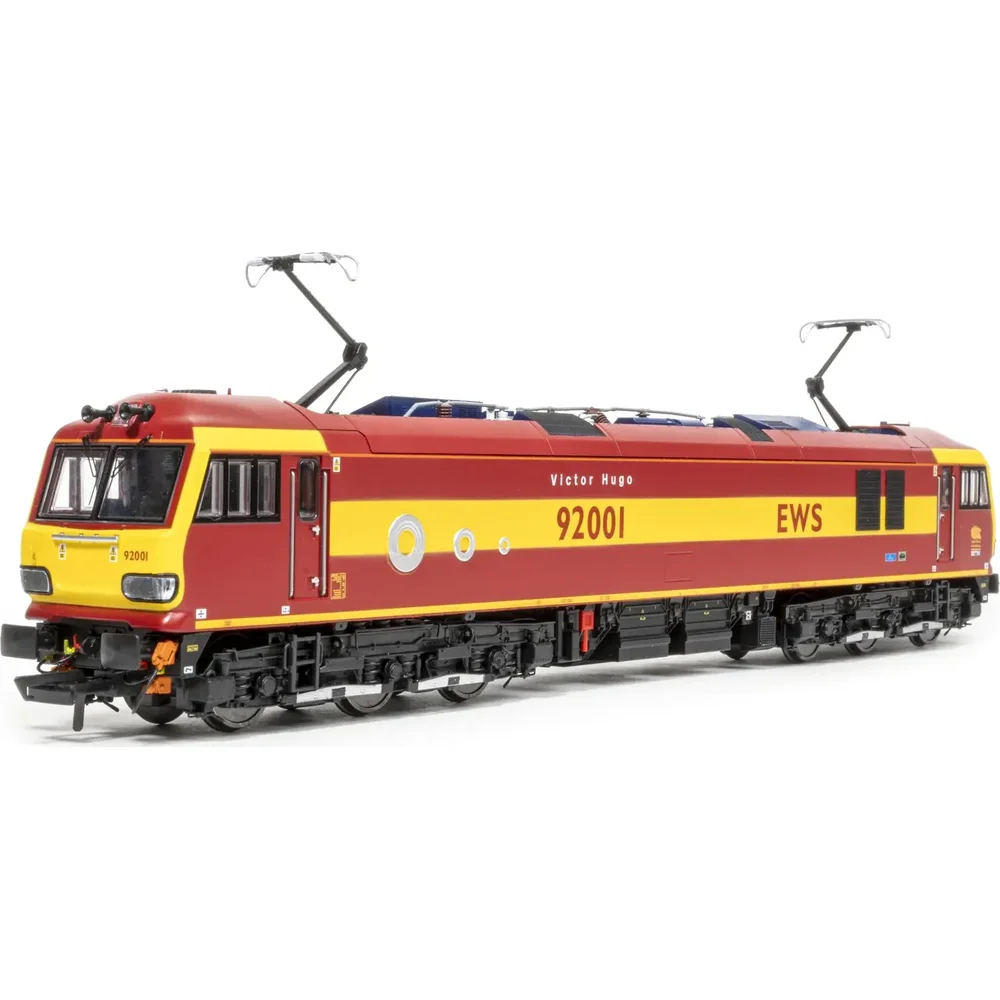
Left front three quarter view
Source: Accurascale
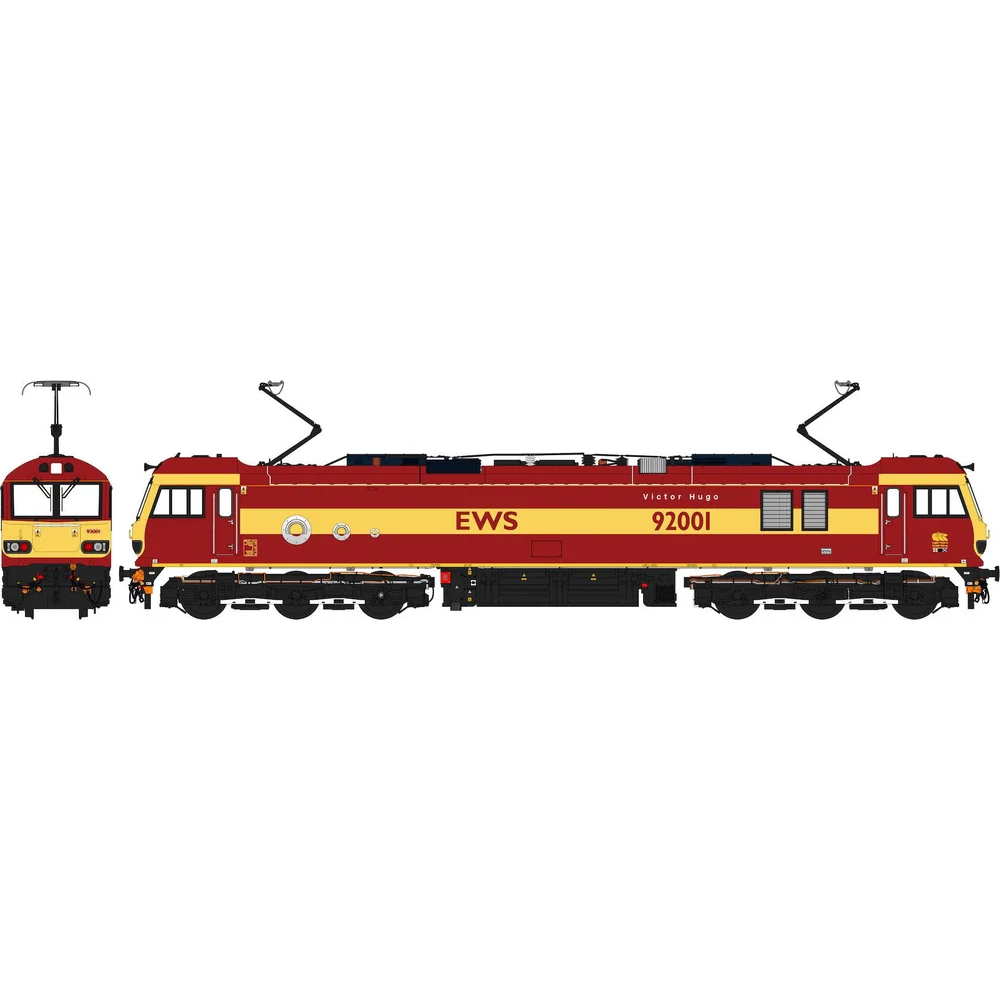
Illustration front and side elevations
Tooling
Accurascale introduced its highly detailed British Rail Class 92 electric locomotive in OO gauge (1:76 scale) in 2022, marking a significant step forward in ready-to-run electric models. The Class 92, a dual-voltage Co-Co locomotive built for Channel Tunnel operations and heavy freight, has served across Europe and the UK since the mid-1990s. Accurascale’s tooling reflects the prototype’s complexity and operational diversity, offering exceptional fidelity for modern image modellers.
The Class 92 has been widely praised by reviewers and enthusiasts for its exceptional detailing, smooth performance, and advanced features. Highlights include the robust die-cast chassis, servo-operated pantographs, and comprehensive lighting suite. Reviewers note the model’s fidelity to the prototype, particularly in roof and bogie detailing, and commend its value for money given the specification. Social media and video reviews emphasize the impressive sound quality and running characteristics, with many considering it a benchmark for modern electric outline models.
First announced in 2019 and delivered from late 2022, the Accurascale Class 92 remains one of the most technically advanced OO gauge locomotives available, combining prototype accuracy with cutting-edge electronics and sound.
Detailing: Etched grilles, Brecknell Willis high-speed pantographs, roof electrical equipment, sprung buffers, fine pipework, and etched nameplates supplied. Fully detailed bufferbeam with cosmetic coupling hooks. Optional etched “Polo Mint” discs supplied for bodyside detailing. Provision for re-gauging wheels to EM (18mm) and P4 (18.83mm) standards. Accessory packs include etched nameplates and window blinds.
Class & Prototype
- Class: British Rail Class 92
- Traction: Electric
- Built: 1993-1996
- Total Built: 46
- Running Number: 92001
- Name: Victor Hugo
The British Rail Class 92 is Britain's most powerful electric locomotive, capable of 5,040 kW output on 25kV AC overhead supply. Built by Brush Traction 1993-1996, these 46 dual-voltage Co-Co electrics were designed for Channel Tunnel freight operations, featuring unique capability to operate on both 25kV AC overhead and 750V DC third rail systems. Originally intended for the cancelled Nightstar sleeper services, seven locomotives were later refurbished for Caledonian Sleeper overnight trains between London and Scotland from 2015 onwards. The class wears diverse liveries including Railfreight grey, EWS maroon, DB Schenker red, GBRf blue/orange, Stobart Rail blue, and striking Caledonian Sleeper midnight teal. All 46 locomotives survive—16 active in UK service, 13 operating in Bulgaria/Croatia/Romania, 17 stored awaiting future deployment.
Operator & Livery
- Operator: English, Welsh & Scottish Railway
- Livery: Maroon & Gold
- Era: 9 - Privatisation
The English, Welsh & Scottish Railway (EWS) operated Britain's largest rail freight network from 1996-2007, controlling 90% of the UK freight market. Formed by Wisconsin Central through acquisition of five British Rail freight companies, EWS revolutionised British freight transport with 250 new General Motors Class 66 locomotives and distinctive maroon and gold livery featuring the famous "three beasties" logo. The company was acquired by Deutsche Bahn in 2007, eventually becoming today's DB Cargo UK while maintaining its freight market dominance.
The EWS maroon and gold livery was introduced in April 1996, with the first locomotive to receive the scheme being Class 37 number 37057, which emerged from Toton Depot on 25 April 1996 to coincide with the launch of the English, Welsh & Scottish brand. The colour specification featured maroon bodysides, roofs and ends with black underframes and buffer beams, standard UK yellow warning panels, and a distinctive gold stripe running centrally between the cab ends.
To ensure accurate colour consistency, a sample plate was flown from Wisconsin Central's American operations to Britain, where British paints were mixed to match this standard. Interestingly, when Class 66 and 67 locomotives were later built by General Motors, another sample plate was sent to the manufacturer, resulting in a slightly lighter shade than the original British mix.
The livery evolved through several variations. Early applications from April 1996 featured "EW&S" lettering (including the ampersand) in Arial typeface within the gold band. From January 1997, this was simplified to "EWS" with improved Gill Sans typeface - continuing a tradition established by the LNER in the 1920s and used by British Railways until the 1960s.
The gold band width varied by locomotive class - most received 600mm bands, but Classes 37, 58, and 73 looked better with 550mm bands due to their distinctive body shapes. Company lettering and locomotive numbers appeared in maroon within the gold stripe with 20mm clearance from the band edges, positioned at opposite ends on each side of the locomotive.
For model railway enthusiasts, specialist paint manufacturers like Phoenix Paints produce authentic colour matches, with their E.W.&S. Red (P193) and E.W.&S. Gold (P194) paints matched to original Wisconsin Central colour panels. Alternative options include RailMatch EWS Maroon (1255) which many modellers prefer for value and colour accuracy.
The EWS maroon and gold scheme became one of the most recognisable railway liveries in modern British history, remaining in use until Deutsche Bahn's acquisition in 2007 and the subsequent adoption of DB Schenker corporate red livery from 2009.