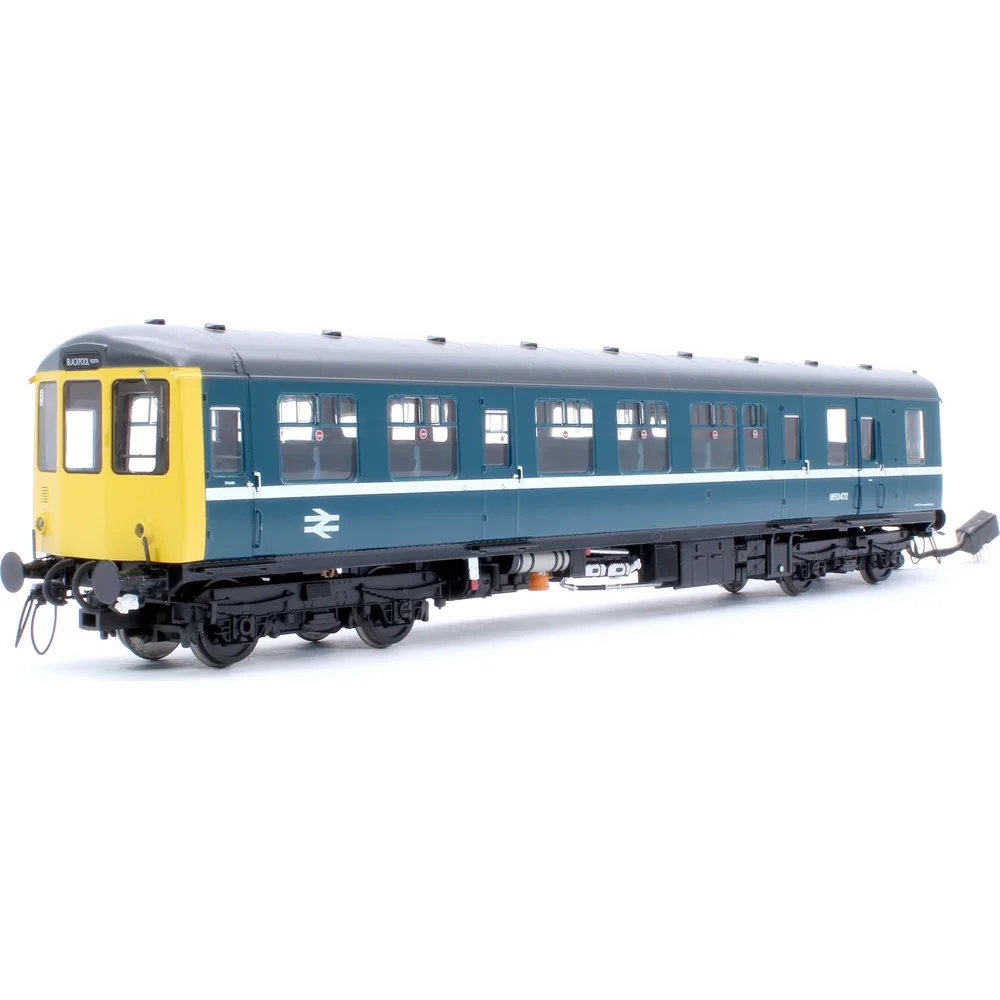
Heljan 1454

British Rail Class 104 DMBS M50472 British Rail Blue

Tooling

Heljan's long-awaited tooling of the British Rail Class 104 in OO gauge, first unveiled in design work around 2020, entered production by late 2024/early 2025 and reached retailers through mid-2025. This marks the first-ever ready-to-run OO representation of the Birmingham Railway Carriage & Wagon-built 1957–59 DMUs, allowing modellers to recreate their distinctive first-generation diesel look.

Early reviews from YouTube channels such as "Proper Chuffed" and "DJP/Dean Park Model Railway" praised the tooling's fine detail and smooth running, highlighting the vibrant "Mexican Bean" livery and impressive lighting features. Model Rail and Hornby Magazine articles in late 2025 described the project as "worth the five-year wait," commending the accuracy of cab ends and interior layouts. Sound specialists like Legomanbiffo have produced tailored Leyland DMU sound profiles for enthusiasts fitting DCC sound. On RMweb and social media, collectors noted Heljan's Class 104 as one of the most complex and detailed DMU models to date, with strong demand leading to rapid sell-outs.

The release generated significant coverage across hobby media. Video reviews and unboxings showcased interior lighting, headcode illumination, and magnetic couplers in action, while retailers such as Gaugemaster and Rails of Sheffield published detailed photo galleries. Social platforms amplified excitement, with modellers sharing layout integration tips and praising the model's fidelity to prototype variations.

Each model includes a 21-pin DCC decoder socket in the DMBS driving car and factory-fitted speakers under the floor. While a single decoder per set controls all cars through hidden wiring in the gangways, Heljan also offers optional factory-fitted DCC sound, with custom Leyland DMU sound files available through third-party modding projects.

Heljan's Class 104 OO tooling delivers an unprecedented combination of prototype fidelity, mechanical sophistication, and operational flexibility. The choice of liveries spans the class's entire service life, and features like 21-pin DCC readiness, interior/exterior lighting control, and robust detailing mark this as a standout release. It offers a compelling option for enthusiasts modelling first-generation DMU operations, particularly those replicating mid-20th-century scenes across the London Midland, North Eastern Regions, and Scottish services.

Detailing: Highly accurate to prototype variations—different cab end styles, guard's doors, gangways, engine and exhaust detail. Interiors offer realistic seating layouts, plus separate lamp irons and water pipes. Body glazing is flush-fitting and super-thin. Highly accurate to prototype variations—different cab end styles, guard's doors, gangways, engine and exhaust detail. Interiors offer realistic seating layouts, plus separate lamp irons and water pipes. Body glazing is flush-fitting and super-thin.

Class & Prototype

  • Running Number: M50472

The British Rail Class 104 was a first-generation diesel multiple unit built by Birmingham Railway Carriage and Wagon Company between 1957-1959, with 302 vehicles serving British Railways for 36 years. Distinctive for their curved BRCW cab fronts and unique varnished wooden interiors, these DMUs operated intensive suburban services from Manchester to Buxton, Yorkshire networks, North Eastern routes, and Scottish West Highland tourist services. Powered by twin Leyland 680 engines producing 150hp each, the class carried BR Green, Rail Blue, Blue/Grey, and Network SouthEast liveries before final withdrawal in October 1993. Twelve vehicles survive in preservation, whilst Heljan's comprehensive OO gauge range released 2024-2025 provides the first ready-to-run models in six decades.

Operator & Livery

  • Operator: British Rail
  • Livery: Blue
  • Era: 6 - British Rail Blue Pre-TOPS

British Rail (1965-1997) transformed Britain's railways through revolutionary modernisation, introducing the iconic double arrow logo, Rail Blue livery, and business sectorisation. BR pioneered high-speed rail with the InterCity 125 and Advanced Passenger Train, electrified major routes, and created profitable divisions like InterCity and Network SouthEast. From steam succession through diesel and electric development to privatisation preparation, British Rail's diverse locomotive fleet, multiple livery schemes, and operational scenarios provide unparalleled variety for railway modellers across all scales and periods.

BR Blue, also known as Rail Blue or Monastral Blue, was introduced in 1965 as part of British Rail's comprehensive corporate identity overhaul that accompanied the rebranding from British Railways to British Rail. The colour was officially defined by British Standards BR28/6001 (airless spray finish) and BR28/5321 (brush finish), representing a dark, greyish blue tone specifically chosen to hide dirt and weathering effects well.

The livery was prototyped on the experimental XP64 train in 1964 before becoming the standard scheme from 1 January 1965. Rail Blue was applied to all diesel and electric locomotives with yellow warning panels (initially small, then extending to full yellow ends from 1966). The standardised application included the iconic double arrow logo and Rail Alphabet typeface, creating one of the most successful transport corporate identities of the 20th century.

The livery dominated British Rail operations for over two decades until sectorisation in the 1980s began fragmenting the unified appearance. Despite initial colour fading problems in early applications, these were resolved by the late 1970s when the Large Logo variant was introduced featuring extended yellow areas and full-height double arrow symbols. Rail Blue's enduring appeal among railway enthusiasts reflects its role as the definitive British Rail image during the organisation's most unified period.