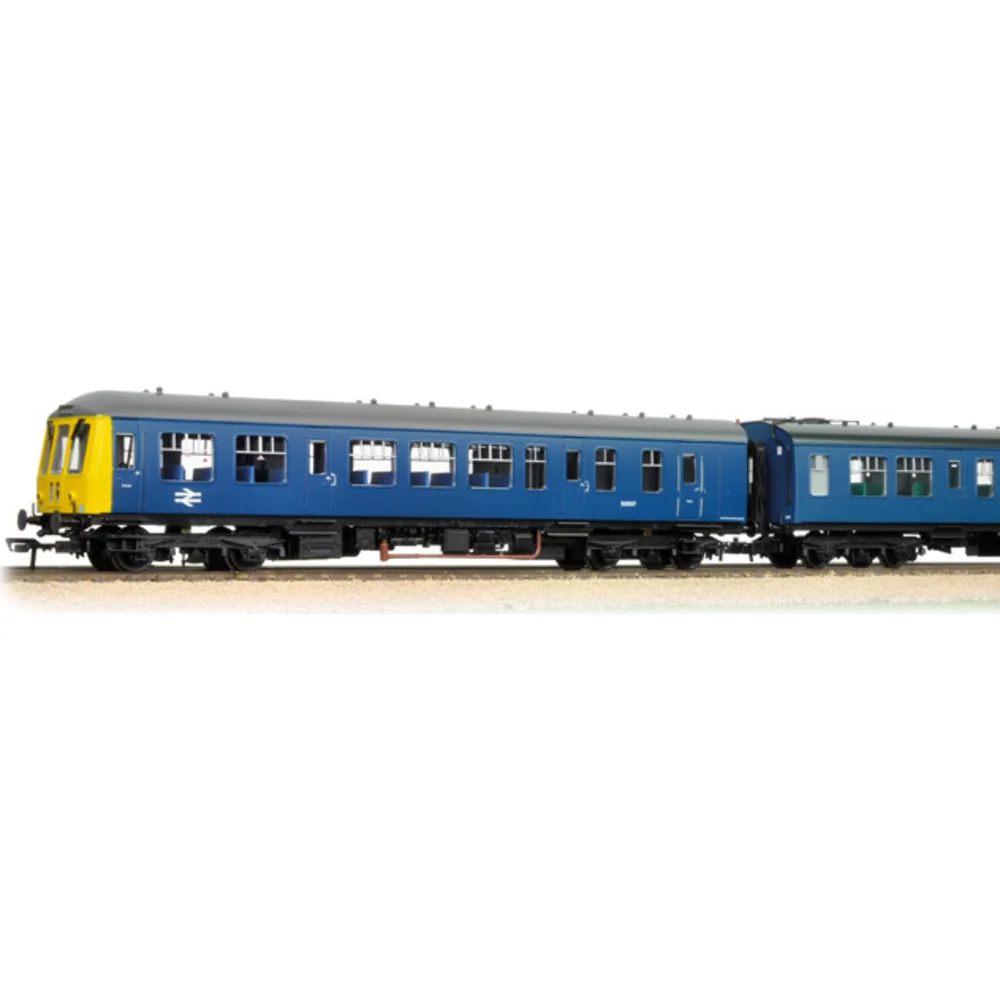
Bachmann 32-912

British Rail Class 108 DMBS E50604 British Rail Blue

Tooling

First released in 2006, Bachmann Branchline introduced a brand-new OO-scale mould for the British Rail Class 108 DMU, capturing its late-1950s design while leveraging modern detailing standards. This tooling marked Bachmann's entry into authentically representing Derby-built DMUs from the intimate, rural-era of British Rail and replaced earlier repurposed tooling from Mainline and Replica Railways.

The Bachmann Class 108 has consistently earned praise from model railway reviewers and enthusiasts alike. Its smooth, slow-speed running and crisp detailing are frequently highlighted as standout features, while the factory-fitted lighting adds a layer of realism that appeals to collectors and operators. Some early releases have been noted for ageing LEDs, which modellers often replace for improved brightness. Publications and online reviewers commend the model's ease of DCC conversion, with Train-O-Matic and similar 8-pin decoders being popular choices. Community feedback also points to its reliable performance on layouts, though its body length can challenge tighter track plans. Overall, the model is regarded as a benchmark for quality in DMU representations.

The Class 108 tooling enjoys strong visibility across social media and video platforms. Numerous unboxing and review videos on YouTube showcase its detailing and operational capabilities, with later blue/grey liveries proving particularly popular among collectors. DCC sound installation tutorials from specialists such as Wickness Models and Howes have further boosted its appeal, demonstrating the model's adaptability for sound enthusiasts. Forum discussions and blog posts frequently celebrate its nostalgic charm and suitability for preserved railway layouts, reinforcing its status as a favourite among OO gauge modellers. This sustained engagement underscores the tooling's enduring relevance and versatility within the hobby.

Bachmann's Class 108 Branchline tooling represents a meticulous, modern interpretation of Britain's mid-century DMU fleets. With authentic detailing, advanced lighting, DCC readiness, and robust mechanical engineering, it remains a favourite among OO enthusiasts. The tooling supports a broad range of liveries and community-driven DCC/sound modifications, making it a versatile and long-lasting member of Bachmann's Branchline catalogue.

Modellers frequently install LokSound or Zimo decoders via the 8-pin socket and add a small speaker beneath the motor vehicle—often in the toilet compartment. Decoder installs yield great exhaust effects, proportional driving sounds, and proper directional/interior lighting control. Some users adjust CVs to fine-tune LED brightness to suit layout lighting conditions.

Detailing: Mixed plastic and metal chassis; detailed bodyshell with separately injected parts (coach-end railings, lamp irons, exhausts, vestibules) and realistic glazing, interior seats, footplate, wipers, and painted window surrounds. Accurately modelled air tanks, battery boxes, engine pipework, fuel tanks, and footsteps. Cosmetic hook included in detailing pack; sprung buffers fitted.

Class & Prototype

  • Running Number: E50604

The British Rail Class 108 was Derby Works' most successful first-generation DMU design, with 333 aluminium-bodied vehicles built between 1958-1961. Powered by twin Leyland 680 engines producing 600bhp in power-twin formations, these versatile units operated across all four BR regions from North Eastern coastal services to the Cumbrian Coast Line, wearing liveries from BR green through corporate blue to Network SouthEast. The class served 35 years until October 1993, with 48 vehicles surviving in preservation—more than any other first-generation DMU type. Bachmann produces comprehensive OO gauge models (13+ variants, £209-£260) whilst Graham Farish offers extensive N gauge coverage including unique factory sound-fitted options.

Operator & Livery

British Rail (1965-1997) transformed Britain's railways through revolutionary modernisation, introducing the iconic double arrow logo, Rail Blue livery, and business sectorisation. BR pioneered high-speed rail with the InterCity 125 and Advanced Passenger Train, electrified major routes, and created profitable divisions like InterCity and Network SouthEast. From steam succession through diesel and electric development to privatisation preparation, British Rail's diverse locomotive fleet, multiple livery schemes, and operational scenarios provide unparalleled variety for railway modellers across all scales and periods.

BR Blue, also known as Rail Blue or Monastral Blue, was introduced in 1965 as part of British Rail's comprehensive corporate identity overhaul that accompanied the rebranding from British Railways to British Rail. The colour was officially defined by British Standards BR28/6001 (airless spray finish) and BR28/5321 (brush finish), representing a dark, greyish blue tone specifically chosen to hide dirt and weathering effects well.

The livery was prototyped on the experimental XP64 train in 1964 before becoming the standard scheme from 1 January 1965. Rail Blue was applied to all diesel and electric locomotives with yellow warning panels (initially small, then extending to full yellow ends from 1966). The standardised application included the iconic double arrow logo and Rail Alphabet typeface, creating one of the most successful transport corporate identities of the 20th century.

The livery dominated British Rail operations for over two decades until sectorisation in the 1980s began fragmenting the unified appearance. Despite initial colour fading problems in early applications, these were resolved by the late 1970s when the Large Logo variant was introduced featuring extended yellow areas and full-height double arrow symbols. Rail Blue's enduring appeal among railway enthusiasts reflects its role as the definitive British Rail image during the organisation's most unified period.