Quick Takeaways
- Production Numbers: 120 locomotives built between 1886-1895, establishing standard NER shunting operations
- Technical Innovation: First successful side-tank conversion from Fletcher's saddle tanks with simplified valve gear
- Operational Excellence: Served for 74 years, with last example withdrawn in 1961 after exceptional service life
- Legacy Impact: Direct foundation for the famous J72 (Class E1) locomotives built until 1951
- Modelling Appeal: New Bachmann ready-to-run OO scale model launching 2026, ending decades without RTR representation
- Historical Significance: Participated in 1925 Stockton & Darlington Railway centenary celebrations
- Preservation Status: None preserved, making accurate models crucial for historical representation
Historical Background and Context
When Thomas William Worsdell arrived at the North Eastern Railway in 1885, he inherited a locomotive department facing significant challenges. The boiler shops at Gateshead were undergoing reorganization, creating a substantial backlog of repairs and replacements. More critically, the large numbers of locomotives built during the early 1870s were simultaneously reaching the end of their boiler lives, creating an operational crisis that demanded immediate attention.
The existing fleet of short-coupled saddle tanks, particularly the troublesome Class 44 locomotives inherited from Fletcher's era, had proven inadequate for the railway's expanding shunting requirements. These locomotives found little favour with Worsdell, who recognized the need for a completely new approach to small tank engine design. In 1886, he introduced what would become the NER Class E, a replacement standard shunting engine that would revolutionize operations across the entire North Eastern Railway system.
Unlike Worsdell's other contemporary designs, the new Class E deliberately avoided the complexity of Joy valve motion and compound expansion that characterized many of his passenger locomotives. This decision reflected practical operational requirements rather than theoretical advancement - shunting engines needed reliability and simplicity above all else. The Class E represented essentially a side tank development of the existing saddle tank concept, but with crucial improvements in weight distribution, water capacity, and maintenance accessibility.
The timing of the Class E's introduction coincided with the North Eastern Railway's rapid expansion during the late Victorian era. The railway was experiencing unprecedented growth in both passenger and freight traffic, particularly around the industrial centres of Tyneside, Teesside, and the Yorkshire coalfields. This expansion demanded reliable, standardized motive power that could handle the intricate shunting movements required in busy goods yards, cramped dock areas, and the increasingly complex marshalling operations that characterized late 19th-century railway operations.
Design and Technical Specifications
The NER Class E represented T.W. Worsdell's philosophy of robust simplicity applied to industrial locomotive design. The 0-6-0 wheel arrangement provided the maximum adhesive weight possible within the constraints of a small tank engine, while the inside cylinder configuration kept the centre of gravity low and reduced maintenance complexity compared to outside cylinder alternatives prevalent on other railways.
The adoption of Stephenson valve gear proved particularly astute, offering excellent reliability and relatively straightforward maintenance procedures that workshop staff could master quickly. This contrasted sharply with the more complex valve systems that Worsdell employed on his express passenger designs, reflecting his understanding that different operating environments demanded different engineering priorities.
Technical Innovation: Frame Design Variations
The first eighteen Class E locomotives featured square-cut frames ending below the buffer beams, with angle brackets supporting vertical oak planks that acted as buffers when moving the NER's characteristic cauldron wagons. This unique detail highlights the railway's attention to specific operational requirements in their locomotive specifications.
An fascinating aspect of the Class E design was the incorporation of second-hand materials during construction of the first batch. Nine of the initial ten locomotives received 4ft diameter wheels instead of the standard 4ft 7¼in wheels, apparently utilizing components from earlier locomotive rebuilds. Most remarkably, eight of these eventually received the correct wheel diameter before withdrawal, demonstrating the NER's commitment to standardization even when expedient shortcuts had been initially necessary.
The boiler design shared characteristics with contemporary NER practice, featuring a relatively short barrel suited to the restricted loading gauge requirements of dock tramways and industrial sidings. The side tanks held 1,200 gallons of water, providing adequate range for typical shunting duties while maintaining the low center of gravity essential for stability on sharply curved track. The rear bunker capacity of 1.5 tons reflected the relatively low coal consumption of shunting operations compared to main line duties.
Service History and Operations
The NER Class E locomotives quickly established themselves as the backbone of North Eastern Railway shunting operations, with their operational scope extending far beyond simple yard movements. Many of the 120 locomotives found their primary employment at the coastal ports served by the NER, where their compact dimensions and relatively light axle loading made them ideally suited to the sharp curves and weight restrictions that characterized most dock installations of the era.
The class proved particularly valuable for local trip work between freight depots and wharves, handling the complex movements of coal wagons from pit to port that formed such a crucial part of the North Eastern Railway's revenue base. Their operational territory extended throughout the NER system, from the Scottish border down to the Yorkshire coalfields, adapting to local conditions with remarkable versatility.
A particularly prestigious assignment involved two locomotives, Nos. 237 and 1167, which were specially maintained for passenger pilot duties at York station. These locomotives served in this capacity for over sixty years, demonstrating both their mechanical reliability and the NER's confidence in the design. Their duties included assisting heavy trains up the steep approaches to York station and providing standby power for failed locomotives on the East Coast Main Line.
Operational Insight: Specialist Duties
Two Class E locomotives (Nos. 263 and 1142) were specifically allocated to towing dead engines at Darlington Works, while the wagon shops at Shildon utilized Class E locomotives for moving crippled wagons. This demonstrates the class's versatility beyond conventional shunting duties.
During World War I, three locomotives (Nos. 1789, 1834, and 1864) were fitted with Hunslet spark arresters for working in shell filling factories, highlighting the class's adaptation to wartime requirements. This modification demonstrates the railway's willingness to modify standard designs for specialized industrial applications where safety considerations demanded additional equipment.
The transition to LNER ownership in 1923 brought the Class E locomotives under the new classification system as Class J71, but their operational patterns remained largely unchanged. By Grouping, the 120 locomotives were allocated to 22 different sheds, illustrating their widespread distribution across the former NER territory. Interestingly, despite their extensive deployment, Heaton remained the only shed north of the Tyne to receive J71 allocation during the NER period, though Tweedmouth would eventually receive one locomotive after nationalization.
The LNER era saw the gradual replacement of Class E locomotives by their successors, the Class J72 (originally NER Class E1). This transition accelerated during the 1930s when economic depression significantly reduced goods traffic levels, making some of the older locomotives surplus to requirements. However, many Class E locomotives continued in service well into the British Railways era, with their simple design and robust construction ensuring continued reliability despite their advancing age.
Withdrawal, Legacy, and Historical Impact
The withdrawal history of the NER Class E reflects both the locomotives' exceptional longevity and the gradual modernization of British railway operations during the mid-20th century. Withdrawals began modestly during the 1930s economic depression, when reduced freight traffic made some of the older shunting locomotives surplus to operational requirements. However, the onset of World War II created a temporary reprieve, as wartime traffic demands meant that every available locomotive was pressed into service.
The most remarkable testament to the class's design excellence came with the final withdrawal of BR No. 68233 (formerly LNER No. 326) in 1961. This locomotive had achieved the extraordinary milestone of 74 years in continuous service, spanning the reigns of Queen Victoria, King Edward VII, King George V, King Edward VIII, King George VI, and Queen Elizabeth II. Such longevity was virtually unprecedented in British locomotive practice and testified to both the robust initial design and the high standards of maintenance practiced by successive railway administrations.
The acceleration of withdrawals during the 1950s coincided with the introduction of 350hp diesel shunters, which offered significant operational advantages in terms of instant availability, reduced maintenance requirements, and elimination of the fire risk that concerned many industrial users. Despite these practical considerations, the transition represented the end of an era that had begun with T.W. Worsdell's innovative design philosophy in the 1880s.
Industrial Legacy: Private Railway Sales
During the 1930s withdrawals, two Class E locomotives found second careers with private companies. No. 34 was sold to Cowpen Coal Co in 1936, becoming their No. 12, while No. 1144 joined Ryhope Coal Co as their No. 3 in 1938. Both served until the 1950s-60s, extending the class's working life even further.
Perhaps the most significant legacy of the NER Class E lies in its direct influence on the design of the Class E1 (later LNER J72), which became one of the most successful and long-lived locomotive classes in British railway history. Wilson Worsdell's modifications to his brother's original design created a locomotive that was built continuously from 1898 to 1951 - a production span of 53 years that represents a unique achievement in locomotive engineering.
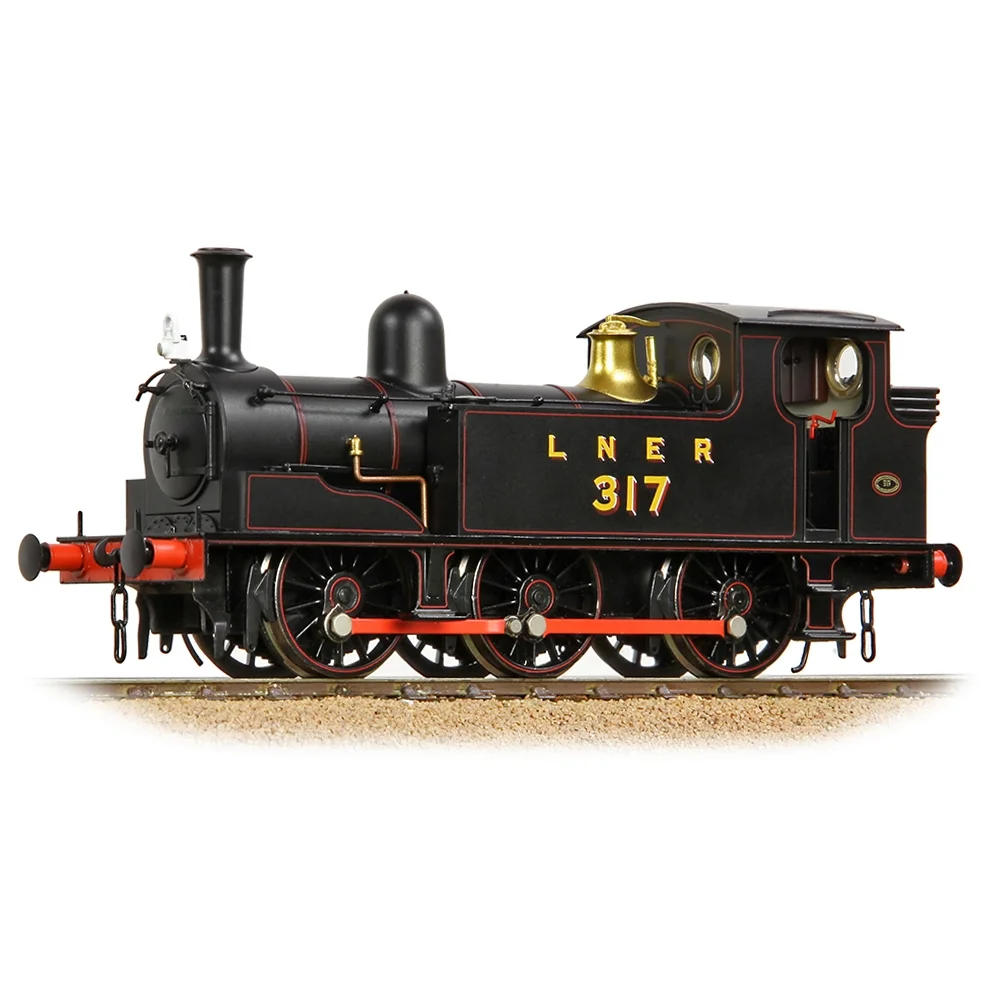
The class's involvement in the 1925 Stockton & Darlington Railway centenary celebrations provides a tangible link to railway heritage that extends to the present day. LNER No. 317 was among the locomotives displayed during these historic celebrations, connecting the industrial heritage of the 1880s with the railway preservation movement that would emerge decades later.
Tragically, none of the original 120 Class E locomotives survived into preservation, representing a significant gap in the historical record of British industrial locomotive development. This absence makes accurate scale models particularly important for maintaining the visual and technical memory of these influential designs, highlighting the crucial role that model manufacturers play in preserving railway heritage.
Modelling Significance and Scale Replications
The NER Class E has long represented one of the most significant gaps in British railway modelling, with no ready-to-run representation available until Bachmann's ground-breaking announcement of their new OO scale model set for release in early 2026. This absence has been particularly frustrating for modelers of North Eastern Railway operations, given the class's fundamental importance to the prototype railway's freight and shunting operations throughout its existence.
The modelling challenge presented by the Class E lies partly in the subtle but crucial differences that distinguish it from the much more frequently modelled J72 (Class E1). While both classes share similar overall proportions and basic design philosophy, the Class E's larger driving wheels (4ft 7¼in versus 4ft 1¼in), different wheelbase spacing (6ft 6in + 7ft 2in versus 6ft 8in + 7ft 0in), and smaller coal bunker create a distinctly different visual impression that cannot be adequately represented by simple modifications to existing J72 models.
Upcoming Ready-to-Run Model: Bachmann Branchline NER Class E
Expected Release: Early 2026
Scale: OO (4mm:1ft)
Catalogue Numbers: See below
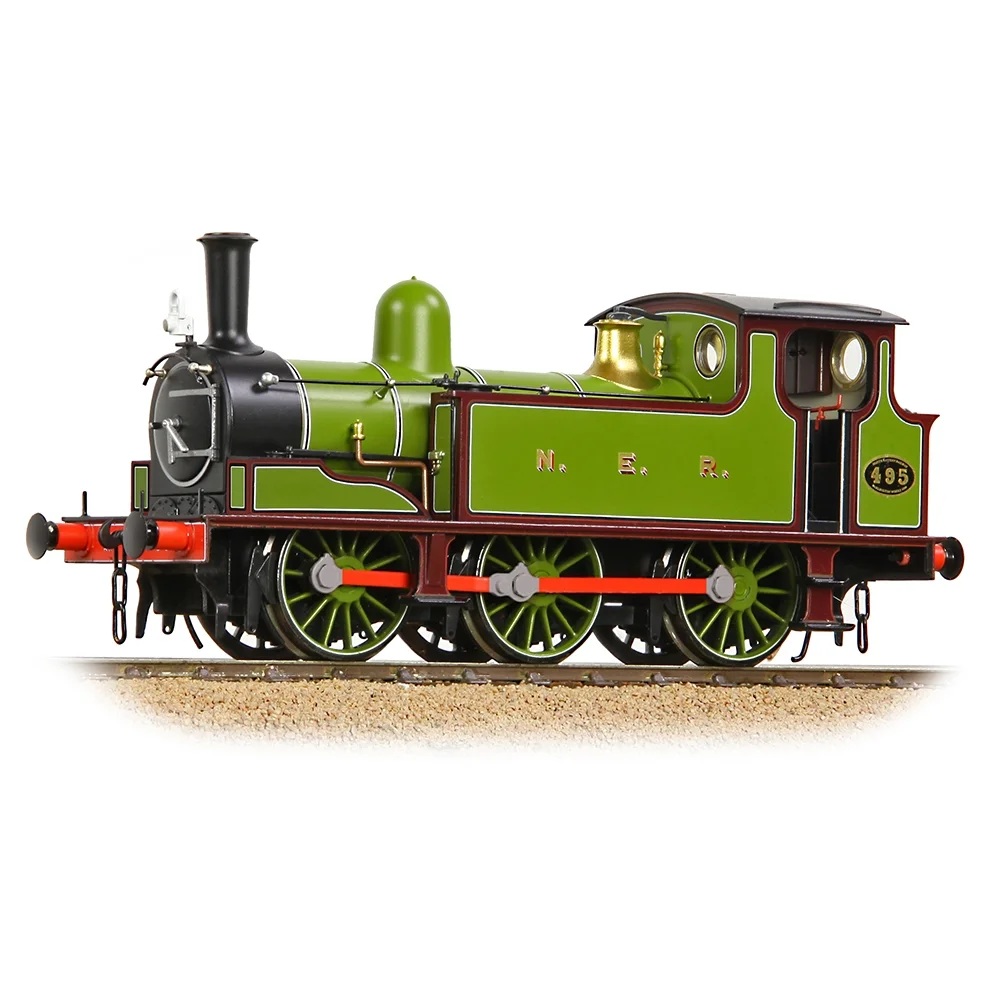
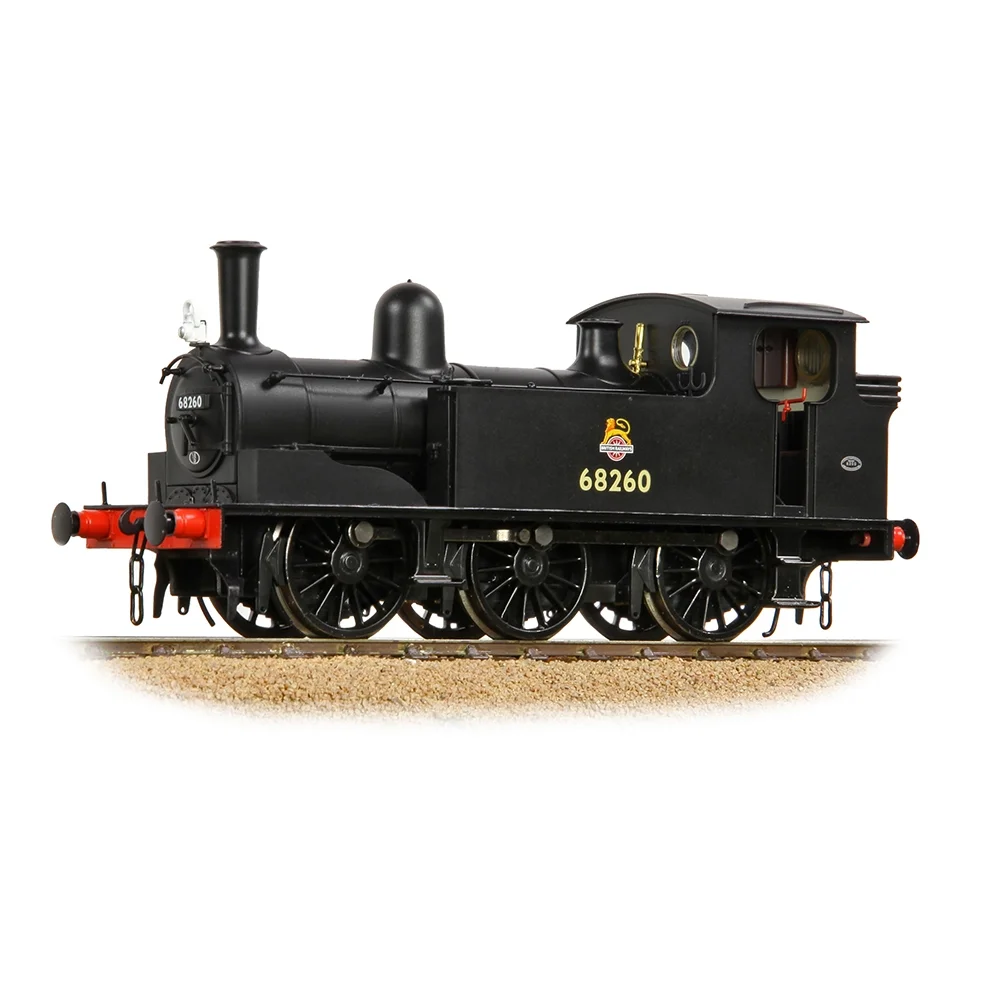
Versions: Three planned - LNER No. 317 (1925 centenary locomotive), No. 495 in original T.W. Worsdell livery, and No. 68260 in BR service
Features: New tooling, DCC Ready with Next18 socket, coreless motor, sprung metal buffers, separate metal bearings, built-in speaker and firebox lighting
Price Range: From £159.95
DCC Compatibility: Next18 socket fitted as standard
For advanced modelers, Connoisseur Models has offered an etched brass kit for O gauge (7mm scale) construction, designed by Jim McGeown. This kit represents the pinnacle of Class E modelling accuracy, with every detail correctly scaled and positioned according to original NER drawings. The kit requires significant modelling experience but rewards the builder with an exceptionally accurate representation that captures the subtle design nuances often lost in ready-to-run production.
In 3mm scale, Finney and Smith produce a kit that allows modelers working in the increasingly popular 3mm:1ft scale to incorporate Class E locomotives into their layouts. This scale offers particular advantages for modelling industrial railways and docks, where the compact nature of the prototype translates well to domestic layout constraints.
For modelers working in 4mm scale (OO gauge), the most practical approach until the Bachmann release has been to use Mainly Trains conversion kit MT249, which provides etched chassis components and detail parts to convert the readily available Bachmann J72 model. This conversion requires moderate modelling skills but produces a convincing representation of the Class E that captures the most significant visual differences from its more famous successor.
Models
Unique Modelling Tips and Layout Integration
Successfully incorporating NER Class E locomotives into model railway layouts requires understanding both their operational patterns and the specific infrastructure requirements of North Eastern Railway practice. These locomotives were primarily designed for shunting operations, which means your layout planning should emphasize goods yards, engine sheds, and the complex trackwork arrangements that characterized busy freight terminals of the late Victorian and Edwardian periods.
When planning track layouts for Class E operations, consider that these locomotives regularly worked in cramped dock environments and industrial sidings with sharp curves and restricted clearances. Model curves of 18-inch radius (OO scale) or tighter can be prototypically justified, allowing you to create convincing industrial scenes even within limited space constraints. The locomotives' short wheelbase and light axle loading made them ideal for track configurations that would have challenged larger locomotives.
Modelling Tip: Authentic NER Operational Patterns
Model Class E locomotives in pairs when representing larger yards like York or Newcastle. The prototype railway often allocated multiple locomotives to busy locations, with one handling arrival/departure movements while another managed internal shunting. This creates more dynamic operational possibilities and reflects authentic NER practice.
Authentic weathering of Class E models should reflect their primarily freight-oriented duties. These locomotives accumulated considerable grime from coal dust, ash, and industrial atmospheric pollution, particularly those allocated to dock areas or heavy industrial regions like Teesside. Focus weathering effects around the smokebox, running plate edges, and lower portions of the side tanks, while keeping the cab area relatively clean to reflect regular crew cleaning efforts.
For the most convincing operation, consider the specific duties that made Class E locomotives so valuable to the NER. These included assembling coal trains from colliery branches, shunting dock areas with their weight restrictions, and pilot duties at major stations. Model these activities using appropriate rolling stock - the NER's distinctive wagon designs, including their characteristic cauldron wagons, provide authentic operational scenarios that showcase the locomotives' versatility.
Sound-equipped models benefit from programming that reflects the locomotive's typical duty cycle. Unlike main line locomotives with sustained running periods, shunting engines operated in short bursts with frequent stops and starts. DCC sound decoders should be configured with realistic idle times and responsive acceleration characteristics that mirror the careful control required for precise wagon positioning and coupling operations.
When choosing appropriate train formations, remember that Class E locomotives typically handled relatively short trains - perhaps 15-20 wagons maximum for trip workings, though individual shunting moves might involve just one or two wagons at a time. This operational pattern allows modelers to create convincing train movements even on layouts where storage sidings are limited, making the Class E particularly suitable for compact layout designs focused on operational interest rather than main line spectacle.
Finally
The North Eastern Railway Class E represents a fascinating study in practical locomotive engineering, demonstrating how thoughtful design responding to specific operational requirements could create machines of exceptional longevity and versatility. T.W. Worsdell's decision to prioritize simplicity and reliability over technical innovation produced a locomotive class that served faithfully for three-quarters of a century, adapting successfully to changing operational demands while maintaining the robust characteristics that made it initially successful.
For railway enthusiasts and modelers, the Class E offers insights into the evolution of industrial locomotive design during the crucial period when Britain's railway network was reaching maturity. The class's influence extended far beyond its own service life through its direct descendant, the J72, creating a design lineage that spanned from the Victorian era through to the early years of railway modernization.
The upcoming Bachmann model represents more than just another locomotive release - it finally provides accurate representation of a class that played a fundamental role in British railway operations but has been largely invisible in the modelling world. For enthusiasts planning North Eastern Railway layouts or seeking to understand the practical reality of late Victorian freight operations, the Class E offers authentic operational possibilities that reflect the day-to-day work that kept Britain's industrial economy moving.
Whether your interest lies in historical accuracy, operational modelling, or simply appreciating elegant engineering solutions to practical problems, the NER Class E deserves recognition as one of the foundational designs of British railway locomotive development. Its story reminds us that innovation often lies not in complexity, but in the thoughtful refinement of proven principles to meet changing demands - a lesson that remains relevant in locomotive design to this day.
Frequently Asked Questions
How many NER Class E locomotives were built and what happened to them all?
A total of 120 NER Class E locomotives were built between 1886 and 1895. The last example, BR No. 68233, was withdrawn in 1961 after 74 years of service. Unfortunately, none survived into preservation, making them completely extinct today.
What's the difference between the NER Class E and the more famous J72?
The Class E had larger driving wheels (4ft 7¼in vs 4ft 1¼in), different wheelbase spacing, and smaller cylinders (16in vs 17in). The J72 was Wilson Worsdell's development of his brother T.W. Worsdell's original Class E design with improved specifications.
Are there any preserved Class E locomotives I can visit?
Sadly, no NER Class E locomotives survived into preservation. However, you can see the closely related J72 No. 69023 "Joem" at various heritage railways, which represents the direct evolution of the Class E design principles.
When will the new Bachmann NER Class E model be available?
Bachmann announced their new OO scale NER Class E model for release in early 2026. This will be the first ready-to-run model of the class ever produced, featuring new tooling and full DCC compatibility with Next18 socket.
What modelling options exist for NER Class E locomotives currently?
Currently available options include Connoisseur Models etched brass kit for O gauge, Finney and Smith 3mm scale kit, and Mainly Trains MT249 conversion kit to modify the Bachmann J72. The upcoming Bachmann ready-to-run model will transform availability from 2026.
The National Railway Museum at York holds extensive NER archives and documentation. Locomotion at Shildon also features North Eastern Railway exhibits, though no actual Class E locomotives survive at either location.
What made the Class E design so successful for shunting work?
The combination of short wheelbase for tight curves, adequate water capacity in side tanks, simple Stephenson valve gear for reliability, and optimal weight distribution made these locomotives perfect for dock work and industrial shunting operations.
How does the Class E compare to contemporary shunting locomotives from other railways?
The Class E was notably more successful than many contemporary designs, with its 74-year maximum service life exceeding most rivals. Its side tank configuration offered advantages over saddle tanks in terms of stability and maintenance access.
What specific details should I look for when weathering a Class E model?
Focus on coal dust around the bunker and smokebox, oil stains on running plates, and general grime from industrial environments. The distinctive square-cut frames on early examples and oak buffer planks for cauldron wagon working are key period details.
Were any Class E locomotives exported or used outside the NER system?
The Class E remained exclusively within NER/LNER territory throughout their service lives. Two examples were sold to private collieries in the 1930s (Cowpen Coal Co and Ryhope Coal Co) but remained within the North East region.
What rolling stock pairs authentically with NER Class E locomotives?
Authentic consists include NER wooden goods wagons, distinctive cauldron wagons, early steel mineral wagons, and occasional passenger coaching stock for pilot duties at major stations like York and Newcastle.