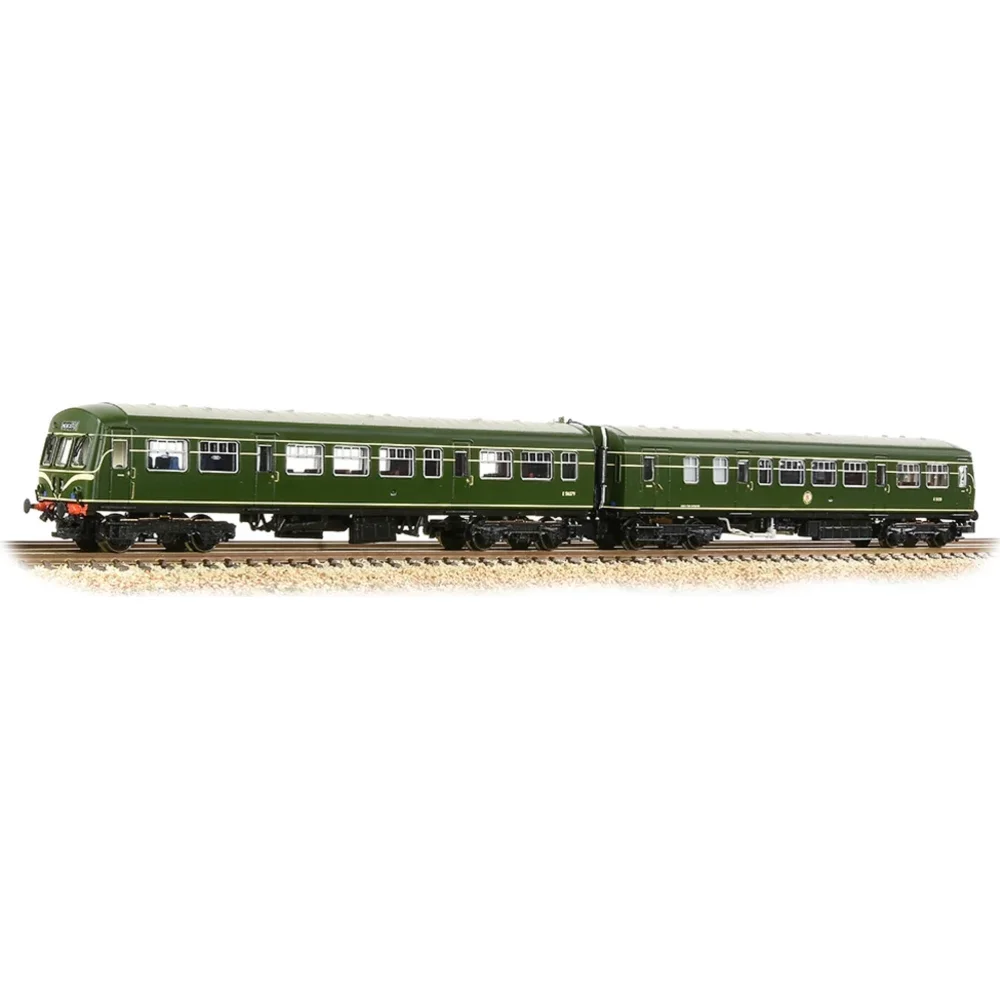
Graham Farish 371-508SF
British Rail Class 101 DMBS E51221 British Railways Green
Tooling
In 2011, Graham Farish (by then under Bachmann's brand umbrella) retooled its N-gauge British Rail Class 101 "Met-Cam" range, bringing the tooling up to modern standards with enhanced mechanics and full DCC readiness—leaving the 1982 tooling behind.
Upon release, the modernised 2011 tooling received enthusiastic praise in N-gauge reviews and online forums. Reviewers highlighted the improved motor chassis, quieter gearing, and added directional lighting as significant upgrades. The dual-DCC decoder option enabled independent control of power units, bolstering operation flexibility, especially for 3-car formations. Collector-led video reviews praised the robust detailing and faithful liveries, often awarding a 9/10 score. Most hobbyists found the built-in speaker space ideal for aftermarket sound chips, with installation requiring minimal effort—further validating the tooling's design for enhanced realism and performance.
Detailing: Precise N-gauge bodies featuring separate cab headcode boxes—some with roof-mounted heads—alongside finely moulded handrails, exhausts, vestibules, and bufferbeam details. Chemically blackened wheels, factory-fitted glazing with optional extras like window wipers, pipework for front and rear, and detachable detailing pack for added realism.
Class & Prototype
- Class: British Rail Class 101 DMBS
- Traction: Diesel Multiple Unit
- Built: -
- Total Built: -
- Running Number: E51221
The British Rail Class 101 was Metro-Cammell's most successful first-generation DMU, with over 700 vehicles built 1956-1959 serving across Britain for 47 years until 2003. Powered by twin 150hp BUT AEC or Leyland diesel engines, these distinctive units operated from Tyneside to Scottish Highlands, dominating Birmingham's Cross-City Line for 35 years. Comprehensive 1970s-1980s refurbishment programmes extended their operational lives dramatically. The type carried every major BR livery including green, blue, blue/grey, white/blue, Strathclyde orange, and Network SouthEast schemes. With 41 vehicles preserved and comprehensive model availability from Bachmann (OO), Graham Farish (N gauge), and Hornby, the Class 101 remains essential for depicting authentic British branch line and suburban operations from the late 1950s through early 2000s.
Operator & Livery
- Operator: British Railways
- Livery: Green
- Era: 5 - British Railways Late Crest
British Railways transformed Britain's fragmented rail network into a unified national system following nationalisation on 1st January 1948. Created from the "Big Four" companies under the Transport Act 1947, BR operated most of Great Britain's railways until rebranding as British Rail in 1965, managing over 20,000 route miles and inheriting nearly 20,000 locomotives of diverse designs.
The organisation pioneered standardisation through its revolutionary BR Standard locomotive programme (1951-1960), producing 999 advanced steam engines under Robert Riddles' direction. These included the versatile Britannia Pacifics, mighty 9F freight engines, and mixed-traffic classes that incorporated the best features from all predecessor companies. The 1955 Modernisation Plan accelerated diesel and electric traction development, creating fascinating mixed-traction operations.
Notable achievements included establishing unified locomotive classification systems, introducing distinctive corporate liveries, and managing the complex transition from steam to modern traction. BR's six regional structure preserved operational diversity whilst enabling standardisation of practices, signalling, and rolling stock that had eluded private enterprise for over a century.
The BR era represents steam traction's final flowering alongside emerging diesel technology, creating unparalleled locomotive variety. Today, this heritage remains highly popular with railway enthusiasts through extensive preserved fleets, heritage railway operations, and comprehensive model ranges from manufacturers like Hornby, Bachmann, and Dapol, making BR subjects essential for authentic post-war British railway modelling across all scales.