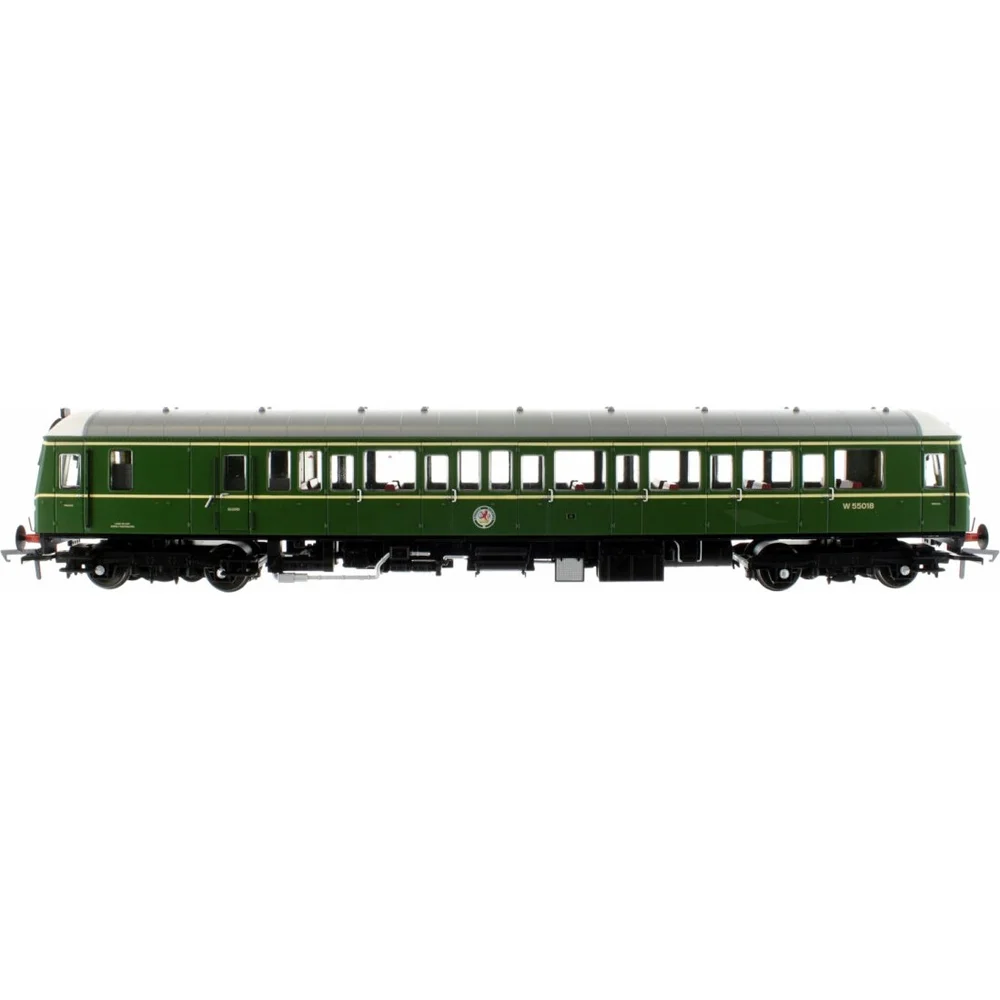
Dapol 4D-015-008
British Rail Class 122 W55018 British Railways Green
Class & Prototype
- Class: British Rail Class 122
- Traction: Diesel Multiple Unit
- Built: 1958-1958
- Total Built: 29
- Running Number: W55018
The British Rail Class 122 "Bubble Car" was a distinctive single-car DMU built by Gloucester Railway Carriage & Wagon Company in 1958. Twenty power cars and nine trailers served Western, London Midland, and Scottish regions for 35 years on branch lines including the famous Stourbridge Town shuttle. Powered by twin AEC 220 engines producing 300 bhp, these iconic vehicles earned their nickname from characteristic rounded cab windows. Eight examples survive in preservation. Dapol produces comprehensive models in N, OO, and O gauge across multiple BR liveries from Green through Blue/Grey to Regional Railways and departmental colours, while Heljan offers new TT:120 and O gauge ranges.
Operator & Livery
- Operator: British Railways
- Livery: Green
- Era: 5 - British Railways Late Crest
British Railways transformed Britain's fragmented rail network into a unified national system following nationalisation on 1st January 1948. Created from the "Big Four" companies under the Transport Act 1947, BR operated most of Great Britain's railways until rebranding as British Rail in 1965, managing over 20,000 route miles and inheriting nearly 20,000 locomotives of diverse designs.
The organisation pioneered standardisation through its revolutionary BR Standard locomotive programme (1951-1960), producing 999 advanced steam engines under Robert Riddles' direction. These included the versatile Britannia Pacifics, mighty 9F freight engines, and mixed-traffic classes that incorporated the best features from all predecessor companies. The 1955 Modernisation Plan accelerated diesel and electric traction development, creating fascinating mixed-traction operations.
Notable achievements included establishing unified locomotive classification systems, introducing distinctive corporate liveries, and managing the complex transition from steam to modern traction. BR's six regional structure preserved operational diversity whilst enabling standardisation of practices, signalling, and rolling stock that had eluded private enterprise for over a century.
The BR era represents steam traction's final flowering alongside emerging diesel technology, creating unparalleled locomotive variety. Today, this heritage remains highly popular with railway enthusiasts through extensive preserved fleets, heritage railway operations, and comprehensive model ranges from manufacturers like Hornby, Bachmann, and Dapol, making BR subjects essential for authentic post-war British railway modelling across all scales.