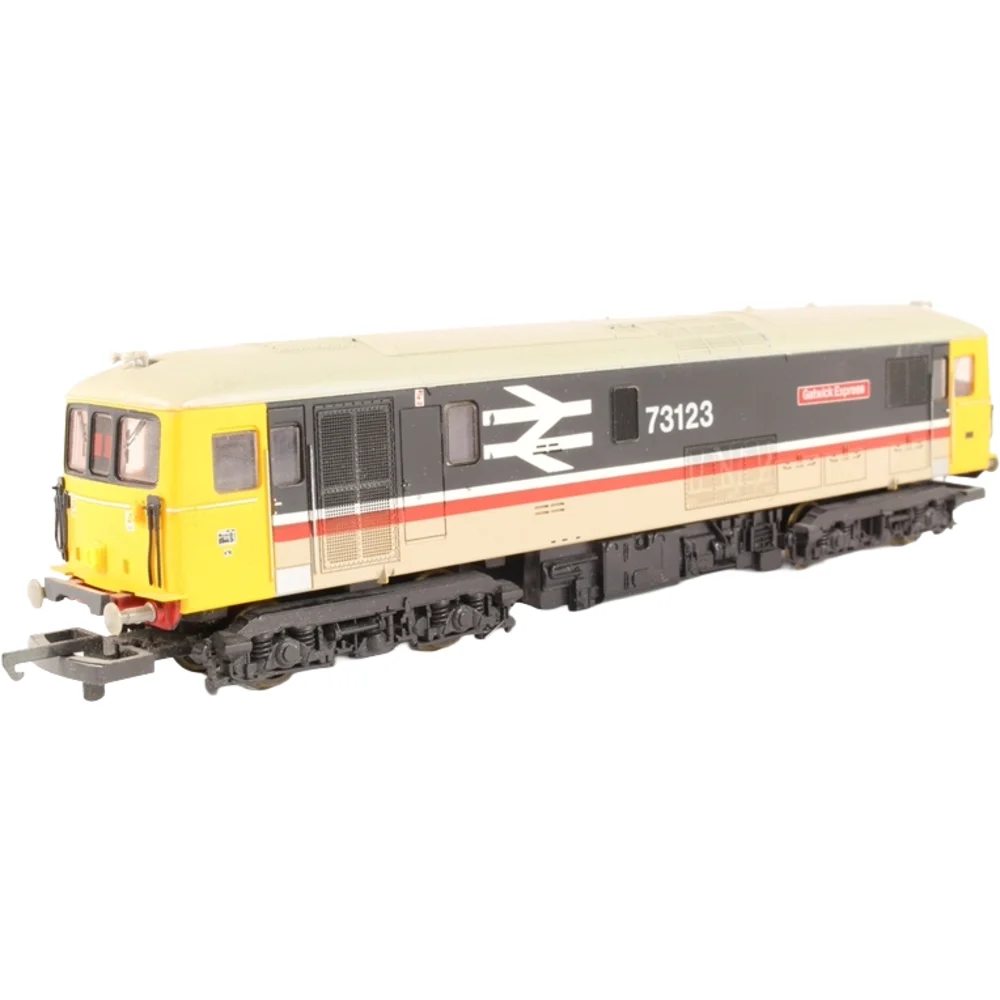
Lima L205193
British Rail Class 73 73123 Gatwick Express British Rail InterCity Executive
Tooling
Lima introduced its British Rail Class 73 electro-diesel locomotive in OO gauge in 1986. At the time, Lima was a major supplier of affordable ready-to-run models for UK enthusiasts, competing with Hornby and Mainline. The Class 73 was a distinctive choice, representing a Southern Region electro-diesel capable of operating on third-rail DC and diesel power, making it a versatile prototype for layouts set from the 1960s onwards.
At launch, the Lima Class 73 was praised for its accurate body shape and crisp moulding, which compared well to competitors of the era. However, the mechanism was considered basic, with limited electrical pickup and a high top speed. Enthusiasts often noted that the model benefited from running-in and regular maintenance. Modern reviews highlight its affordability and suitability for upgrading, with common improvements including rewiring for DCC, fitting better wheels, and replacing the motor for smoother performance. Detailing upgrades such as wire handrails and etched parts are popular among modellers.
The Lima Class 73 remains a frequent subject in online forums, YouTube reviews, and blogs. Videos often showcase servicing tips, repaint projects, and DCC conversions. Collectors value limited editions such as Pullman and Network SouthEast commemorative releases, while budget-conscious modellers appreciate its availability on the second-hand market.
DCC compatible but not DCC-ready. There is no factory-fitted socket; conversion requires hard-wiring a decoder. Space inside the body allows for basic installations, but no provision for speakers or lighting upgrades from the factory.
The tooling represented multiple sub-classes (73/0, 73/1, and 73/2) through variations in detail and livery. Despite its age, the model is still widely used and upgraded, reflecting Lima’s strong pattern-making and printing quality for its time.
Detailing: Factory-fitted separate details including horns, jumper cables, cab interiors, footplate detail, window wipers, and detailed glazing. Underframe features include battery boxes, fuel tanks, and third-rail pick-up shoes.
Class & Prototype
- Class: British Rail Class 73
- Traction: Electro-diesel
- Built: 1962-1967
- Total Built: 49
- Running Number: 73123
- Name: Gatwick Express
The British Rail Class 73 electro-diesel represents one of Britain's most versatile and longest-serving locomotive classes, designed in the early 1960s to solve the Southern Region's third-rail gap problem in goods yards. With dual 1,600hp electric and 600hp diesel modes (1,600hp diesel in Class 73/9 rebuilds), these Bo-Bo locomotives served prestigious duties from Gatwick Express to Venice Simplon Orient Express, and now operate Caledonian Sleeper services in Scotland. Of 49 built (6 Class 73/0, 43 Class 73/1), 39 survive with approximately 22 still operational, making them among British Rail's most enduring designs spanning over 60 years of continuous service.
Operator & Livery
- Operator: British Rail InterCity
- Livery: Executive
- Era: 8 - British Rail Sectorisation
British Rail InterCity was the premium express passenger brand that operated from 1966 to 1997, transforming long-distance rail travel across Britain. Initially launched as a marketing brand for high-speed services, InterCity became an autonomous business sector in 1982 under the sectorisation programme, operating profitable express services from London to Scotland, Wales, the West Country, and extensive cross-country routes.
The brand pioneered revolutionary rolling stock including the iconic InterCity 125 HST (High Speed Train) from 1976, which achieved 125mph operations on existing infrastructure, and the electric InterCity 225 sets from 1989, capable of 140mph but limited to 125mph in service. InterCity also developed the ground-breaking Advanced Passenger Train (APT) with tilting technology that influenced modern high-speed trains worldwide.
Distinguished by its evolving livery schemes - from Rail Blue and Grey through the sophisticated Executive livery with dark grey upper bodies and red stripes - InterCity became synonymous with quality, speed, and reliability. All day services featured buffet cars and the majority operated at 100mph or above, making British Rail one of the world's most intensive high-speed operators.
The brand was divided among multiple operators during railway privatisation in the 1990s, but its technical innovations, operational excellence, and commercial principles continue influencing modern rail services. InterCity remains hugely popular with railway modellers, with extensive ranges of locomotives and coaching stock available in all major scales from manufacturers like Hornby, Bachmann, and Heljan.